 Sign In









How People Use Voice Search
Info
-
Source: NP Digital
-
Date: May 2025
-
Category: Search Trends
-
Study Methodology: Data from surveying 703 people.
Voice search isn’t just a novelty anymore. It’s practical, fast, and becoming part of daily life. This breakdown shows how people actually use voice-enabled devices, so you can align your SEO and UX strategies accordingly.
Essential Statistics
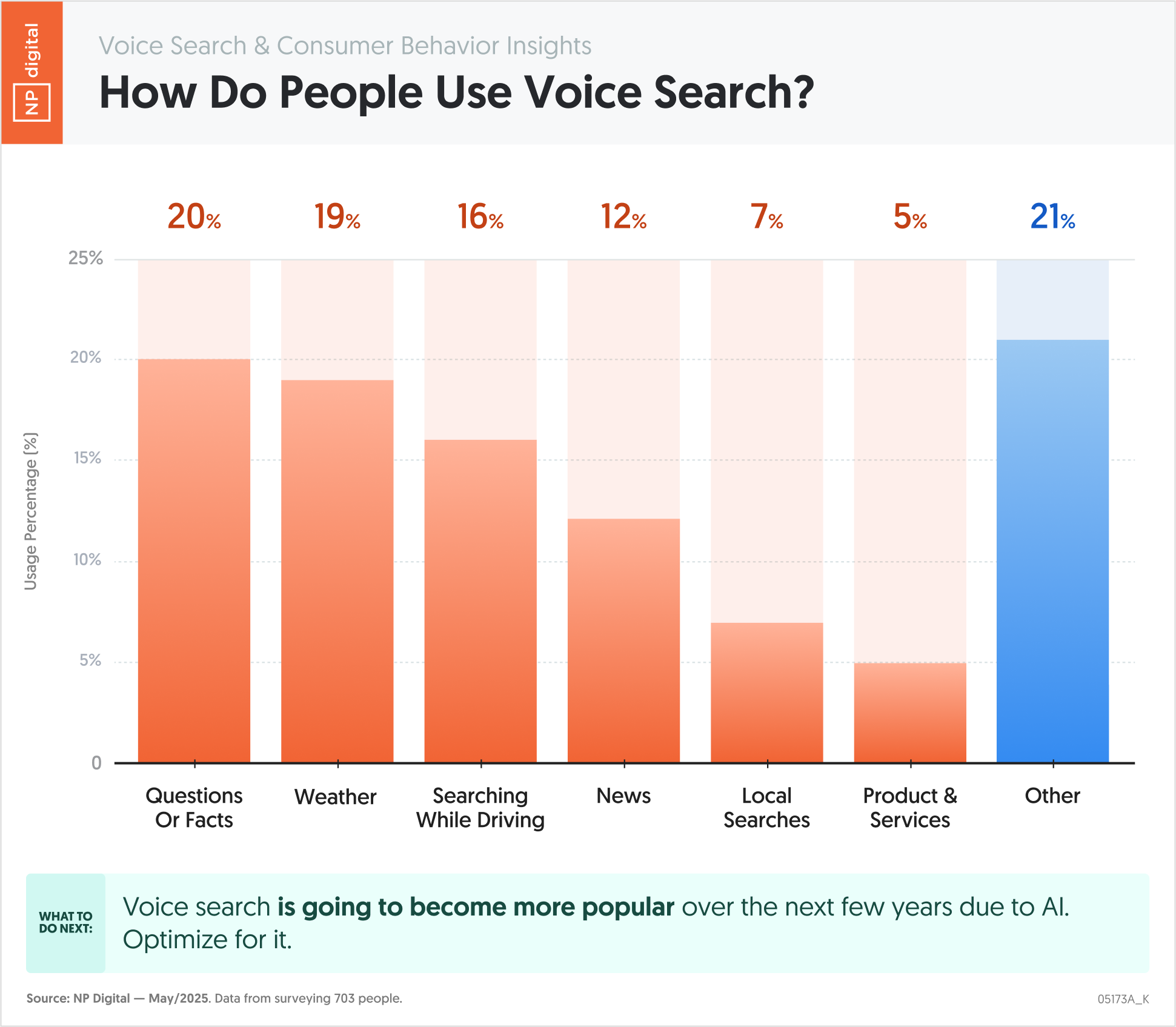
- 20% of users rely on voice search to ask questions or get quick facts.
- 19% use it to check the weather.
- 16% use voice while driving to search hands-free.
- 21% selected Other uses, the largest share in the data.
- Only 7% use voice for local searches and 5% for products and services.
- Voice usage varies significantly by context and convenience.
- Product discovery via voice remains relatively low, but growing.
Key Takeaways
- Voice search is widely used for factual and convenience-driven queries.
- The highest usage areas are utility-based tasks like weather and directions.
- Product and local searches via voice are still emerging behaviors.
- Voice use while driving shows strong contextual relevance.
- Other uses suggest a broader range of untracked voice habits.
- Voice search isn’t replacing traditional SEO, it’s extending it. Marketers should prep for multimodal and voice-friendly content experiences.
Actionable Insights
- Optimize for quick-answer queries. A big portion of voice use is factual questions, so structure pages with clear definitions and concise answers near the top.
- Target utility searches like weather, directions, and simple lookups with schema. Mark up content so assistants can extract answers cleanly.
- If driving contexts matter for your audience, focus on local and ‘near me’ readiness. Keep Google Business Profile details current and build location-specific pages.
- Treat voice as a UX issue, not just SEO. Make pages fast and mobile-friendly since many voice searches end in a quick tap to a result.
- Write in natural language. Voice queries sound conversational, so include phrasing that mirrors how people speak, including question-style headings.
- Measure voice impact indirectly. Track changes in long-tail question queries and featured snippet wins since voice often pulls from those results.
Voice search isn’t just growing, it’s shifting how people interact with search altogether. Optimizing for it now is a future-proof move. – Neil Patel