 Sign In








1000 SEO Vs 1000 PPC Visitors: Cost, Revenue, ROAS
Info
-
Source: NP Digital
-
Date: December 2024
-
Category: SEO & Keyword Strategy
-
Study Methodology: Sample size: 119 businesses generating over $10M in annual revenue; Collection method: Analyzed monthly revenue generated per 1,000 SEO visitors versus 1,000 PPC visitors; Note: revenue does not equal profit.
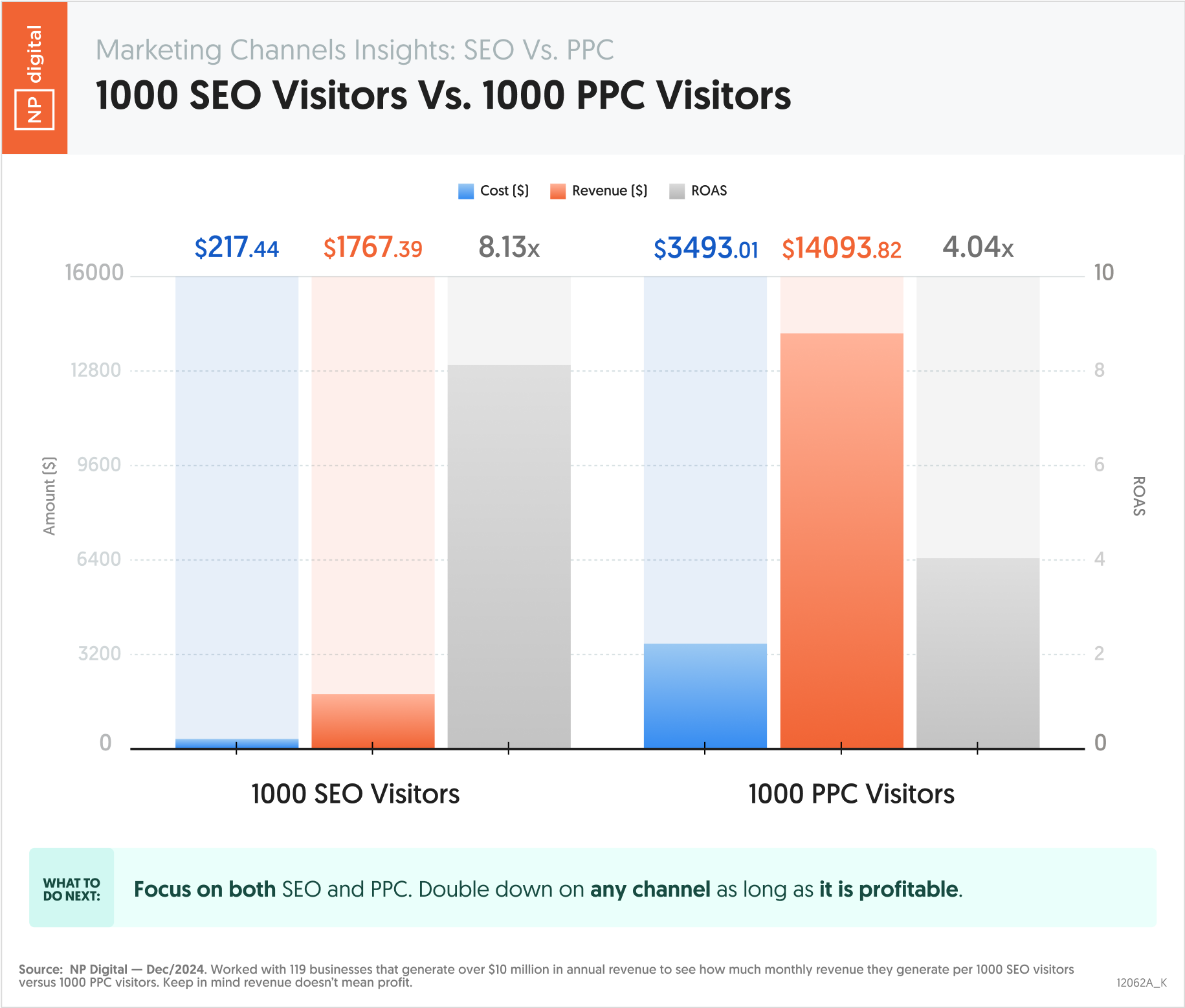
SEO and PPC both work, but they behave very differently when you compare economics. This chart puts cost, revenue, and ROAS side-by-side for 1,000 visitors from each channel. It shows why efficiency and scale are not the same thing. Use it to decide what you should fund for margin now versus what you should build for compounding returns later.
Essential Statistics
- 1,000 SEO visitors cost $217.44 and generate $1,767.39 in revenue.
- SEO delivers 8.13x ROAS at the 1,000-visitor level.
- 1,000 PPC visitors cost $3,493.01 and generate $14,093.82 in revenue.
- PPC delivers 4.04x ROAS at the 1,000-visitor level.
- PPC revenue per 1,000 visitors is higher, but the cost is dramatically higher as well.
- SEO is far more efficient, while PPC is a faster path to higher gross revenue.
Key Takeaways
- PPC can drive bigger top-line revenue, but it does not automatically win on efficiency.
- SEO produces stronger ROAS because costs are lower and gains compound over time.
- Paid and organic should be managed together, not treated as competing teams.
- Channel decisions should be based on margin, payback window, and scalability, not only revenue.
- PPC is ideal for testing and speed, while SEO is ideal for durability and unit economics.
- Revenue metrics must be paired with cost data to avoid scaling unprofitable growth.
Actionable Insights
- Use PPC to identify what converts, because it generates $14,093.82 per 1,000 visitors and gives faster feedback loops. Take the best-performing keywords, offers, and landing pages and turn them into your SEO roadmap.
- Prioritize SEO for efficiency, because $217.44 cost for $1,767.39 revenue produces 8.13x ROAS. Build content and technical improvements around the segments that already show purchase intent in your paid data.
- Set channel-specific ROAS targets, because PPC at 4.04x and SEO at 8.13x should not be judged by the same benchmark. Use higher ROAS expectations for SEO and stricter CAC caps for PPC to protect profitability.
- Allocate budget based on margin, not ego, because PPC can look better on revenue while being less efficient. If PPC is driving sales but compressing margin, shift spend into higher-intent campaigns and invest the savings into SEO compounding work.
- Run CRO on both channels, because the fastest way to lift ROAS is to improve conversion rate and AOV. A small lift on PPC multiplies quickly due to higher spend, while SEO gains compound over months once rankings stick.
- Report cost, revenue, and ROAS together every month, because the chart highlights why revenue alone is misleading. Build a single dashboard view that compares paid and organic on the same unit: per 1,000 visitors.
Do not argue about SEO versus PPC. PPC is for speed and testing, SEO is for efficiency and compounding. Fund both, but scale the one that stays profitable after costs. – Neil Patel