 Sign In









Key Takeaways
- A mini persona is a lightweight audience snapshot built for one piece of content, not an entire marketing program.
- You can build one in minutes using GWI (Global Web Index) data, first-party analytics, or support notes, paired with a focused AI prompt.
- The finished snapshot should shape five real decisions: angle, structure, tone, format, and keyword phrasing.
- Save full personas for audiences you’ll write for repeatedly across many pieces or channels.
You get the brief, and the target audience line reads something like “marketing professionals.” That’s it. So you guess at the tone, pick a reasonable angle, and hope it lands.
Sound familiar? Most writers run into this gap between “know your audience” advice and the reality of a packed content calendar. Building a full persona for every article isn’t realistic, but writing without one usually means content that reads fine and connects with no one.
That’s where a mini persona comes in. It’s a fast, AI-assisted way to write audience-first content without the research overhead a full persona demands.
What Is a Mini Persona?
A mini persona is a lightweight snapshot built for one piece of content, not a full persona covering your entire marketing program.
Think of it as the short version: a name, a mindset, a top pain point, a preferred content format, and the specific language your reader uses to describe their problem. That’s enough detail to make real decisions on the page.
A full persona maps an entire buyer journey and often takes input from sales, product, and marketing teams. It answers a broader question: who are we building for, across every touchpoint we own?
A mini persona answers a narrower one: how do I write this specific piece so it lands with this specific reader? That narrower scope is what makes it fast. Instead of weeks of cross-team research, you’re pulling from a data source you likely already have and running one focused AI prompt.
If you want the full framework for building a complete persona, our guide to using user personas to boost performance walks through that process end to end.
Why Writers Need a Faster Way to Know Their Reader
Content teams face constant pressure to publish on tight timelines across many channels. Full audience research for every single piece just isn’t in the schedule.
That pressure doesn’t excuse generic content, though. Readers can tell when a piece was written for anyone, even when the grammar is clean and the structure holds up. Higher bounce rates and shorter time on page usually follow.
A mini persona fits into that reality as a five-minute habit, built into your process the same way you’d check a style guide or skim a competitor’s top-ranking post before you draft.
Building audience-first content doesn’t require you to slow down. It requires knowing exactly who you’re writing for before you open a blank document, something our audience-first SEO guide covers from the search side of things.
How to Build a Mini Persona With AI and GWI Data
Here’s the process, broken into five steps: choose your data sources, pull the data points that matter, prompt AI to synthesize a snapshot, refine what comes back, then apply it to your actual writing decisions.
Do this once, and the whole thing takes under an hour. Do it a few times, and it drops well under 15 minutes, since you’ll already know which data points matter most for your beat.
Step 1: Choose Your Data Sources
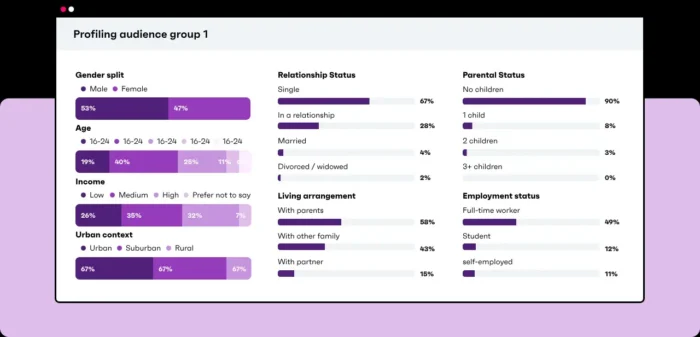
Start with GWI (Global Web Index), a research platform that surfaces attitudinal and behavioral data: values, motivations, media habits, and context that CRM and analytics tools typically miss.
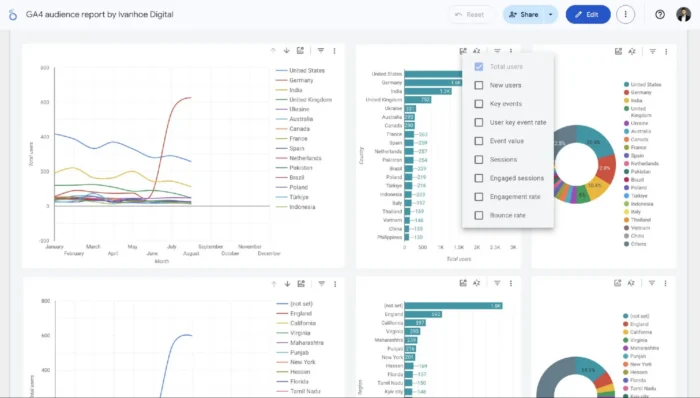
Pair that with first-party data from your own site: Google Analytics 4 (GA4), on-site search terms, and scroll or engagement data. This shows you what your specific audience actually does on your site: their real search terms, clicks, and scroll behavior.
If you have access to sales or support notes, use them. They surface the exact objections and phrasing real prospects use, which is hard to manufacture and valuable for tone.
You don’t need all three every time. One strong source is enough to start a mini persona; layering in more just sharpens the details. For a deeper look at building this kind of data foundation, our guide to using first-party data covers how to collect and use it well.
Step 2: Pull the Data Points That Matter
Once you have a source, resist the urge to pull everything. A mini persona needs four things:
- Mindset and motivation: what is this reader trying to accomplish when they land on this piece?
- Top pain point or objection: what’s the one thing standing between them and taking action?
- Format and channel preference: do they lean toward long-form explainers, quick lists, video, or something else?
- Language cues: specific words or phrases this audience uses to describe their own problem, pulled from support notes, reviews, or survey verbatims when you have them.
Four data points is plenty. Pulling in extra detail starts to resemble a full persona, and you lose the speed advantage that makes this approach worth doing in the first place.
Step 3: Prompt AI to Synthesize the Snapshot
With your four data points in hand, turn them into a usable snapshot with a single AI prompt. The prompt needs three things: the raw data points, the specific piece of content you’re writing, and the exact output format you want.
Something like this works well:
“Using the following data points about business owners, write a short reader snapshot for a blog post titled How Small Businesses Can Use AI for Content Marketing. Include: name, one-sentence mindset, top pain point, preferred content format, and three phrases this audience uses to describe their problem. Data points: [paste your four data points]. Keep the output under 100 words.”
Here’s a sample output for a mini persona built around new franchise owners handling their own marketing:
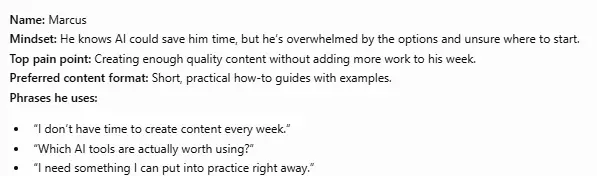
That’s a usable snapshot. It took one prompt, and it gives you enough to make real decisions in the next step. If you want to compare tools beyond a single prompt, our roundup of the best AI writing tools is a good next stop.
Step 4: Refine and Sanity-Check the Output
AI-generated snapshots can drift into generic territory, especially with thin data. Before you use one, run it through three checks.
First, flag anything generic. If a trait could describe almost any reader, it’s not specific enough to guide your writing.
Second, cross-check it against something real: a note from sales, a comment from support, or a quick check with a teammate closer to this audience.
Third, cut anything that reads like an unsupported assumption, and keep only what’s grounded in the data points you pulled in step two. AI will sometimes fill gaps with plausible-sounding details that aren’t actually supported.
This step takes two or three minutes, and it’s the difference between a mini persona that shapes your writing and one that just sounds like it should.
Step 5: Apply the Mini Persona to Your Content Decisions
Now put the snapshot to work. Four decisions benefit most:
Angle: lead with whatever problem or benefit maps to the persona’s top pain point.
Structure: expand the sections that address what this reader actually needs, and cut the ones that don’t.
Tone and format: match sentence length and formality to the persona’s stated preference. A reader who wants quick, tactical lists won’t stick around for a 400-word narrative opening.
Keyword framing: work your focus keyword in using the language this persona actually uses. If Dana says “shoestring budget,” write “shoestring budget,” not “limited marketing spend.”
Mini Persona in Action: A Quick Example
Here’s what the finished product looks like end to end, using the franchise-owner persona from above.
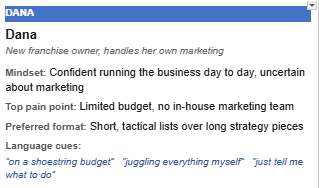
Before, written without the persona:
“A comprehensive marketing strategy requires businesses to allocate resources across multiple channels, including social media, email, and paid advertising, in order to maximize reach and return on investment.”
After, written with the persona:
“You’re already juggling everything, so skip the seven-channel strategy. Pick one channel you can manage on a shoestring budget, and get good at that before adding a second.”
The second version is shorter, uses Dana’s own words, and leads with her actual constraint. That’s the entire value of the exercise: a five-minute snapshot changes a real sentence in the draft.
When to Build a Full Persona Instead
A mini persona is built for one piece. If you notice the same audience showing up across many pieces, campaigns, or channels, it’s worth graduating to a full one.
A few signals worth watching for: you’re launching a recurring content series for this audience, briefing a paid or design team that needs the fuller context a snapshot doesn’t cover, or onboarding a new writer who needs the complete picture.
None of this means the mini persona was wrong to begin with. A snapshot that keeps getting reused is a sign it’s working, not a sign you should have started bigger. When you’re ready to build one, our 6-step framework for finding your target audience walks through the fuller process.
FAQs
What's the difference between a mini persona and a full user persona?
A mini persona is a short snapshot built for one piece of content: mindset, pain point, format preference, and language cues. A full persona maps an entire buyer journey and usually takes input from multiple teams.
What data works best for building a mini persona?
GWI (Global Web Index) for attitudinal data, first-party analytics like GA4 for behavior, and sales or support notes for language, when you have access to them.
How long does it take to build one?
Under an hour the first time. After that, well under 15 minutes once you know which data points matter most for your audience.
Can I reuse a mini persona for multiple articles?
Yes, as long as the audience and content type stay similar. If you’re reusing it often across many pieces, that’s a sign to consider building a full persona instead.
Conclusion
A mini persona doesn’t replace real audience research. What it does is make audience-first content possible on a normal deadline, without waiting for a full persona project to get greenlit.
The next time a brief gives you a vague audience line and nothing else, pull one data source, run one prompt, and spend two minutes checking the output before you draft. That’s a small lift, and it changes the sentences you actually write in the draft.