 Sign In









Key Takeaways
- AI is shifting marketing from campaign-based execution toward continuous growth and optimization.
- Producing more content with AI does not automatically create better marketing results. Teams need content systems that connect strategy, creation, distribution, and measurement.
- Human expertise, original insights, and audience understanding remain important differentiators as AI makes content production more scalable.
- AI-enabled workflows can help content teams produce and improve content more efficiently when they are built around a clear strategy.
- AI search and changing discovery behaviors make structured, adaptable, and trustworthy content more important for long-term visibility.
- The competitive advantage will come from building repeatable content operations that continuously learn from performance and audience behavior.
AI is changing more than how quickly marketers can create content. It is changing how marketing teams operate.
McKinsey’s latest research argues that AI is moving organizations away from campaign-based marketing and toward continuous growth, supported by capabilities such as hyperpersonalization, scaled creativity, and AI-native discoverability. That shift has important implications for content teams, particularly as AI changes how audiences discover and evaluate information.
The opportunity isn’t simply to produce more content with AI. Brands need systems that connect audience insights, human expertise, content creation, distribution, and performance measurement. The teams that build these processes can continuously improve their content while adapting to changing audience behavior and search environments.
AI Is Changing How Marketing Operates
McKinsey’s research points to a broader change in marketing: AI is moving teams away from isolated campaigns and toward a continuously improving growth engine.
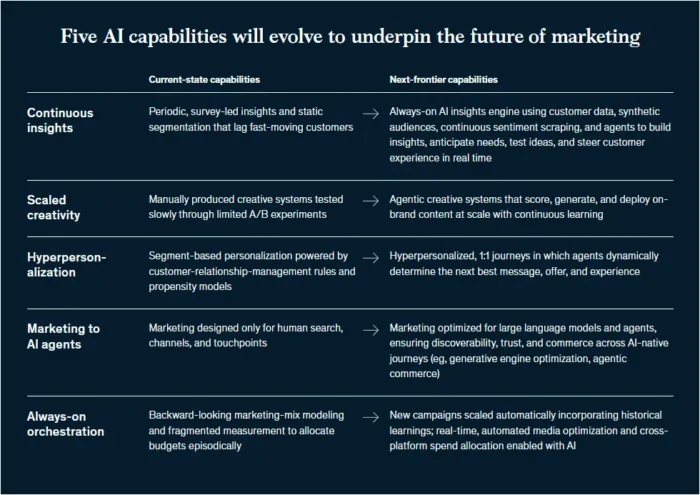
The report identifies five capabilities that will shape AI-first marketing: continuous insights, scaled creativity, hyperpersonalization, marketing to AI agents, and always-on orchestration. The common thread is that these capabilities work together rather than operating as separate AI experiments.
Campaigns Are Becoming Continuous Systems
Traditional campaigns are usually planned around a defined launch, run for a set period, and evaluated afterward.
AI makes it possible to shorten that cycle. Teams can monitor audience signals, identify changes in behavior, adapt content, and use performance data to inform what happens next.
McKinsey argues that the campaign-era marketing model is becoming less effective as customer behavior changes. Its research found that while many organizations are experimenting with AI, fewer than 10% have scaled it or captured value across marketing workflows.
The challenge isn’t simply adopting AI. It is redesigning the process around it.
AI Is Increasing the Need for Better Content Operations
AI can dramatically increase how much content a team can produce. Without the right processes, that can create another problem: more assets to manage without a clear connection between strategy, quality, distribution, and performance.
This is why content operations are becoming increasingly important.
Teams need repeatable processes for deciding what to create, establishing quality standards, adapting content for different channels, and measuring what happens afterward. AI can accelerate many of these steps, but the system connecting them still needs to be deliberately designed.
Why More Content Isn’t the Answer
One of the easiest ways to use AI is to treat it as a production tool. Give it a topic, generate an asset, publish it, and move on. Many businesses are following this strategy, but it can serve as a trap if not executed well.
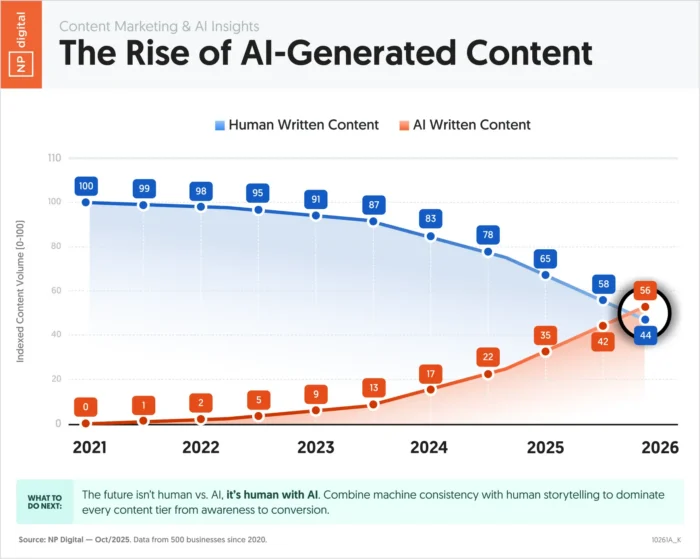
That approach can create short-term efficiency, but it doesn’t necessarily create better marketing.
McKinsey’s research makes a similar distinction. Its scaled creativity capability is about producing tailored content at greater speed while maintaining brand consistency, using performance data to continuously improve what gets created.
Output Without Strategy Creates More Noise
AI can help marketers generate more ideas and variations in less time. It cannot determine which ideas are strategically important to a particular business without the right inputs.
That requires understanding the audience, the brand, the market, and the business objective behind the content.
For brands, this means the goal shouldn’t be maximizing the number of articles, videos, social posts, or other assets produced. The goal should be creating content that answers real questions, demonstrates expertise, and contributes to a measurable business outcome.
Content Needs to Learn From Performance
A strong content system creates a feedback loop.
Audience behavior and performance data should influence what gets created next. If certain topics consistently attract qualified visitors, for example, those insights can inform future content. If a format performs poorly, teams can adjust rather than continuing to produce the same type of asset.
This turns content into an ongoing process of learning and optimization instead of a series of disconnected campaigns.
What an AI-Powered Content System Looks Like
A useful AI content strategy doesn’t begin with a list of AI tools. It begins with the workflow those tools are supposed to improve.
Start With Human Expertise and Original Insights
The foundation of a strong content system should be information that a brand can genuinely own.
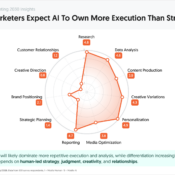
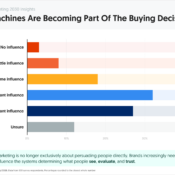
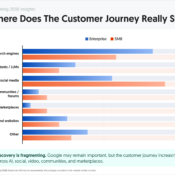
That could include subject matter expertise, proprietary research, customer experiences, first-party data, or insights from people working directly in the industry. In-house studies like the example below are a good starting point:
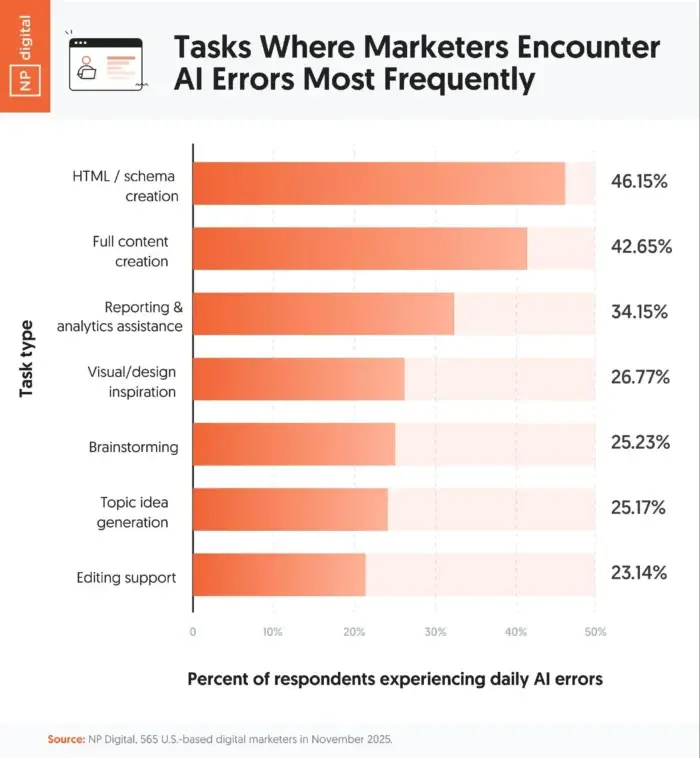
AI can help organize, adapt, and distribute that knowledge. Human experts still need to determine what is valuable, accurate, and worth sharing.
This is especially important as AI search makes original information and credible expertise increasingly valuable.
Build Repeatable AI-Enabled Workflows
AI can support multiple stages of content production, from research and ideation to drafting, adaptation, optimization, and analysis.
The important part is connecting those activities into a repeatable workflow.
For example, a team could establish a process where audience research informs content briefs, subject matter experts provide original insights, AI assists with production, editors review the final material, and performance data feeds into the next round of planning.
The specific tools can change. The workflow remains.
Connect Creation With Measurement
Measurement should be part of the content system rather than something that happens after publication.
Teams should understand which content attracts the right audiences, which topics generate engagement, and which assets contribute to business outcomes. That information can then inform future production.
McKinsey similarly emphasizes building feedback loops and tracking value rather than simply measuring AI activity.
AI Search Makes Content Systems Even More Important
The rise of AI search adds another layer to this shift.
McKinsey identifies marketing to AI agents as one of its five core capabilities. This means creating information that AI systems can interpret, trust, and use when recommending products or services. The report specifically points to machine-readable credibility signals, detailed product information, verified reviews, expert input, and consistently updated information.
That has direct implications for content teams.
Content needs to be structured clearly enough for both people and machines to understand. It also needs to demonstrate why the information is trustworthy.
That means brands increasingly need content that is:
- Easy to understand and extract
- Supported by credible expertise and original information
- Adaptable across search, AI, social, and owned channels
The result is a broader definition of content strategy. Content isn’t only being created to rank on a search results page. It is becoming part of the information systems through which audiences discover and evaluate brands.
The Competitive Advantage Is the System
The advantage won’t come from simply having access to AI. As these tools become more common, access itself becomes less differentiating.
The advantage comes from knowing how to use AI within a system that combines technology with human judgment.
Using AI as a pure scaling play for content means short-term gains at best. Building smarter systems that make every piece work harder over time is key, with human experience at every step of the process.
That human component remains important because AI doesn’t replace the need for strategy, subject matter expertise, editorial judgment, or accountability.
The strongest teams will use AI to remove repetitive work and increase their capacity while giving experts more time to focus on decisions that require experience and judgment.
How Brands Can Start Building Better Content Systems
Building a sophisticated AI-powered marketing operation doesn’t have to happen all at once.
Audit Your Existing Content Workflow
Start by mapping how content moves from idea to publication and measurement.
Look for repetitive tasks, unnecessary handoffs, production bottlenecks, and areas where teams are creating content without a clear understanding of what happened to previous assets.
This provides a starting point for deciding where AI can actually improve the process.
Identify Where AI Can Add Value
Prioritize workflows where AI can improve speed, efficiency, or analysis without removing necessary human oversight.
Research, content adaptation, formatting, performance analysis, and repetitive production tasks can all be potential starting points.
The goal should be measurable improvement rather than AI adoption for its own sake.
Create a Continuous Optimization Loop
Once AI is incorporated into the workflow, connect the resulting output back to performance data.
The process should look less like:
Plan → Create → Publish → End
and more like:
Learn → Create → Measure → Improve → Learn again
That loop allows content to become more useful over time while helping teams adapt to changing audience behavior and search environments.
AI Is Turning Content Into an Operating System
AI is making content production faster, but production speed is only one part of the change.
The bigger opportunity is building a marketing system that can continuously learn, create, distribute, and improve.
McKinsey’s five capability pillars point toward this model. Continuous insights inform decisions. Scaled creativity increases production capacity. Personalization adapts experiences. Marketing to AI agents expands discoverability. Always-on orchestration connects those capabilities into an ongoing system.
For content teams, that means moving beyond isolated campaigns and individual AI tools.
The brands best positioned for this shift will be those that connect original expertise with AI-enabled workflows and performance measurement.
FAQs
What is an AI content strategy?
An AI content strategy uses AI within a broader content operation to improve research, production, optimization, personalization, and measurement. It still relies on human expertise and oversight to establish strategy, quality, accuracy, and brand standards.
Why do marketers need content systems?<
AI can significantly increase the speed and volume of content production. Content systems give teams the processes needed to manage that output, maintain quality, connect content to business goals, and continuously improve based on performance.
Does AI replace content teams?
Not necessarily. McKinsey’s framework emphasizes a human-AI operating model in which AI supports workflows while people continue to provide judgment, creativity, expertise, and quality control.
How does AI search affect content strategy?
AI search increases the importance of content that is clear, trustworthy, structured, and supported by credible information. Brands need to consider how their content can be interpreted and used by both human audiences and AI systems.
Conclusion
AI is changing the role of content teams. The opportunity is no longer limited to producing more assets in less time. It is about building systems that make content creation, distribution, and optimization work together.
A strong AI content strategy combines human expertise with AI-enabled workflows, original information, and continuous performance measurement. Instead of treating every article, campaign, or asset as a standalone project, brands can create processes that learn from each cycle and improve what comes next.
That shift will become increasingly important as AI changes both how marketing teams work and how audiences discover information.
If you want to build a scalable content system that combines AI-enabled workflows with human expertise, reach out to the NP Digital team to learn how a smarter content strategy can support long-term growth.