 Sign In






Key Takeaways
- Conversion rate drives more revenue impact than traffic volume, but most teams still spend their effort chasing clicks instead of fixing the funnel.
- More impressions don’t guarantee more clicks, more sessions don’t guarantee more conversions, and more leads don’t guarantee more revenue.
- Conversion loss usually traces back to four sources: messaging, friction, trust, and experience problems.
- A four-step CRO framework (research, prioritize, test, scale) keeps testing systematic instead of reactive.
- People convert when uncertainty gets removed, not when a page simply looks nicer.
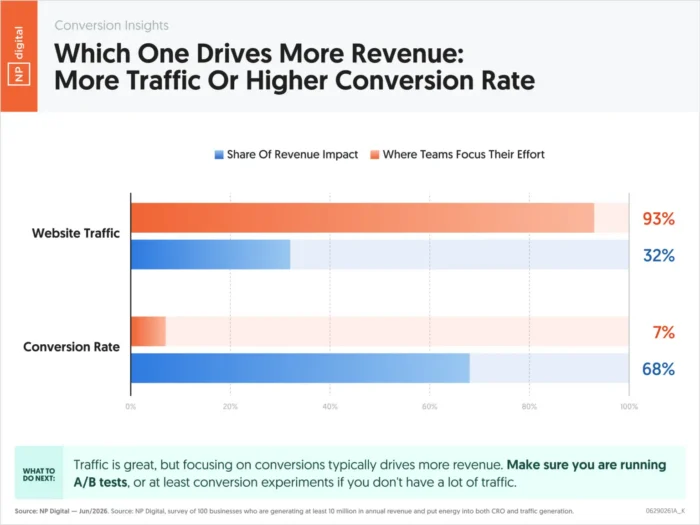
Have you been pouring more budget into traffic, only to watch revenue stay flat? You’re not alone, and it’s not a traffic problem. According to NP Digital research, for businesses generating at least $10 million in annual revenue that invest in both conversion rate optimization and traffic generation, conversion rate accounted for 68 percent with website traffic just 32 percent. Yet 93 percent of teams still put most of their effort into driving more traffic, and only 7 percent focus on conversion rate.
Most companies don’t have a traffic problem. They have a conversion problem they haven’t identified yet, and that gap is exactly where competitors are gaining ground.
The Traffic Trap
It’s easy to fall into over-fixation on traffic. Often, more traffic feels like progress. Impressions climb, sessions go up, and the dashboard looks busy. None of that guarantees revenue follows, though.
NP Digital’s research found three assumptions that consistently trip up growth teams: more impressions doesn’t mean more clicks, more sessions doesn’t mean more conversions, and more leads doesn’t mean more revenue.
Each step in that chain has its own leak point, and pushing more traffic into the top of the funnel just sends more visitors through the same broken experience.
Meanwhile, the cost of acquiring that traffic keeps climbing. Cost per click is rising across every major ad platform, competition for the same high-intent keywords keeps intensifying, and the number of touchpoints a buyer needs before converting keeps growing. Organic click-through rates are dropping as AI answers replace traditional search results, and attention spans on landing pages keep shrinking. Growth is getting harder the more you spend, which is exactly why the acquisition side of your funnel has a ceiling that conversion optimization doesn’t.
Why Conversion Is the Highest-Leverage Layer
At some point, acquisition spend hits a ceiling. Costs climb, and the extra traffic you’re buying tends to skew toward lower lead quality, so you end up with diminishing returns on the surplus. Conversion doesn’t have that same ceiling.
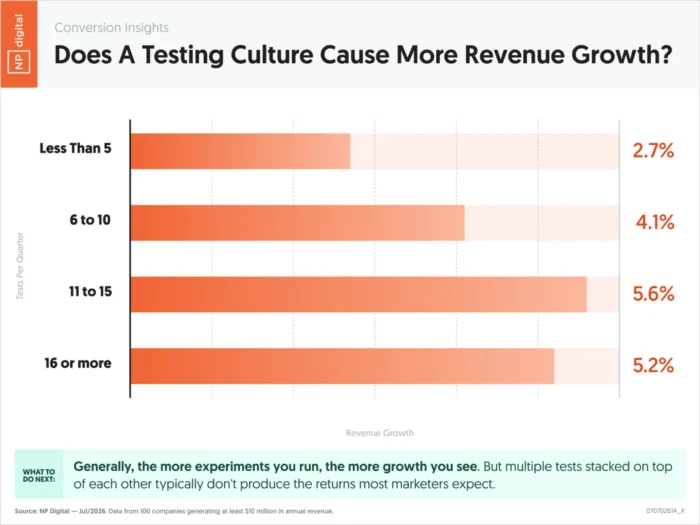
NP Digital data backs this up. Companies running fewer than five tests per quarter saw 2.7 percent revenue growth. Companies running 11 to 15 tests per quarter saw 5.6 percent, more than double. That dip points to a sweet spot of roughly four tests a month. Beyond that, teams don’t have enough time to review results and build on what they learn before the next test launches, so the extra volume stops paying off.
The reason is structural. You can only bid so high on a keyword or an audience before the math stops working. A landing page, a checkout flow, or a lead form has no such ceiling. Every percentage point of improvement compounds across every channel already sending you traffic, which is why testing your way to a higher conversion rate tends to outperform simply increasing spend.
The Four Main Sources of Conversion Loss
Most conversion problems aren’t hidden. Teams just aren’t measuring the right things. When NP Digital audits funnels across industries, the drop-off almost always traces back to one of four categories.
- Messaging problems. Visitors land on a page and can’t quickly answer three questions: What do you do? Why are you different? Why should I trust you? If a visitor has to dig for the answer, they leave before finding it.
- Friction problems. Long forms, too many steps, slow page speed, and complicated checkout flows all add resistance at exactly the moment a visitor is deciding whether to commit.
- Trust problems. Reviews, testimonials, case studies, and social proof do the work of convincing a stranger to hand over their money or their information. Skip this step and you’re asking for a decision the visitor doesn’t have enough evidence to make.
- Experience problems. Poor mobile UX, weak navigation, and confusing journeys pull visitors away from the path you built for them, even when your messaging and trust signals are solid.
NP Digital data found B2B teams lose the most ground between leads and marketing-qualified leads, at a 59.4 percent drop-off, while B2C teams lose the most between add-to-cart and checkout, at 32.8 percent.
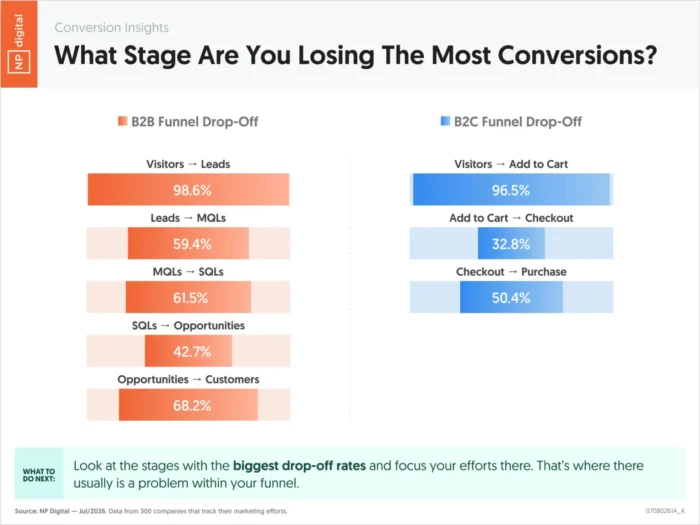
Where Conversion Problems Actually Happen
Average conversion rates vary wildly by page type. Checkout pages convert at 26.8 percent on average, lead generation pages at 4.1 percent, product pages at 2.0 percent, contact pages at 1.6 percent, and homepages at just 0.02 percent.
That split is more telling than it looks. Product and contact pages should, in theory, convert well, since the visitors landing there already want a specific product or want to talk to someone. Instead they’re among the lowest-converting page types on the list. And while a 26.8 percent checkout conversion rate sounds strong on its own, it also means nearly 75 percent of visitors who reach checkout still abandon their order, so something in that final step is working against you.
In our findings, the biggest gains from testing come from the middle of the funnel, at 49 percent for B2B and 43 percent for B2C, not the bottom.
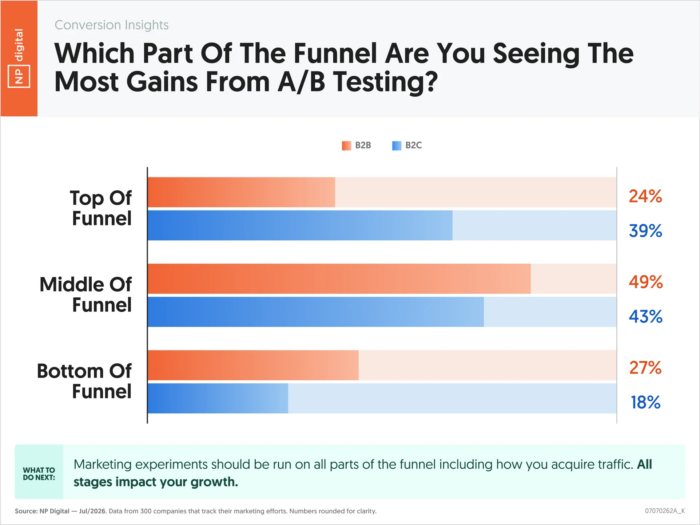
That’s a useful correction. Most teams focus their testing energy on the bottom of the funnel, since that’s where the purchase happens. But the conversion problem showing up at the bottom is frequently created higher up, in the messaging and targeting that brought the visitor there in the first place.
Conversion Is a Human Problem Before It’s a Marketing Problem
Most CRO conversations focus on buttons, colors, layouts, and A/B tests. But people don’t convert because of a design change, but because a barrier to their decision disappeared.
Four drivers move people to act:
- Clarity: what you do, who it’s for, and why it matters.
- Relevance: different landing pages by audience and different messaging by funnel stage.
- Trust: reviews, case studies, and brand authority.
- Risk reduction: guarantees, free trials, flexible contracts, and transparent pricing.
Most visitors don’t buy because they’re convinced. They buy because uncertainty has been removed.
That gap is bigger than most brands realize. In one NP Digital study, only 18 percent of visitors agree they feel a sense of trust landing on a site, while 46 percent of companies believe visitors feel that trust. A visitor who doesn’t trust what they’re reading won’t convert, no matter how strong the offer is underneath it.
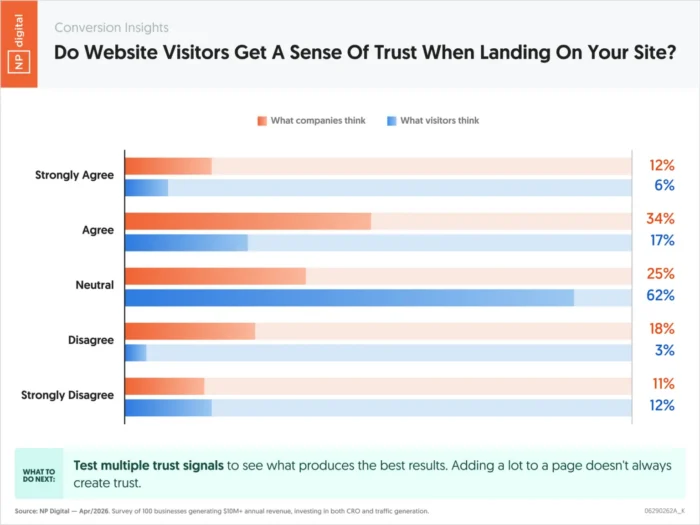
The Four-Step CRO Framework
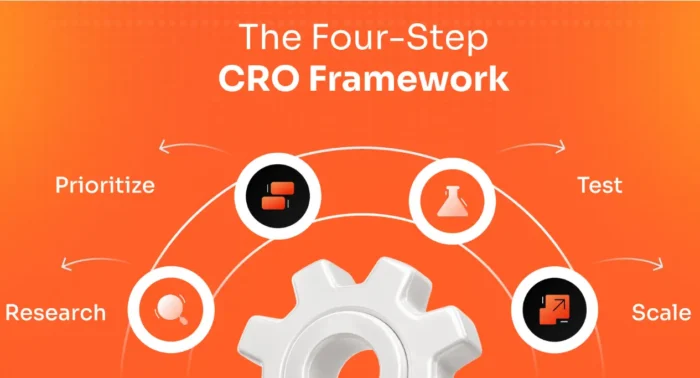
The best CRO programs rely on testing, and they run that testing through four repeatable phases.
- Research. Pull analytics insights, heatmaps, session recordings, and customer feedback to see how visitors actually move through your site, not how you assume they move through it.
- Prioritize. Rank opportunities by highest-traffic pages, largest funnel drop-offs, and effort versus impact. Fix the leak that costs you the most, not the one that’s easiest to notice.
- Test. Run experiments on headlines, offers, CTAs, form length, layouts, and pricing presentation. Test one variable at a time so you know exactly what moved the number.
- Scale. Deploy winning experiences across the rest of the funnel, not just the page where you tested them. A winning headline on one landing page is often a winning headline on five more.
The organizational barriers that stall this framework are consistent across companies: resources (not enough time, budget, or headcount), followed by lack of stakeholder buy-in and lack of in-house testing expertise. Most CRO programs not necessarily due to a bad framework, but because the organization hasn’t agreed on who owns it or why it matters.
A test isn’t automatically valid just because it hit statistical significance. Before you trust a result enough to scale it, check five things: whether bot or AI-agent traffic skewed the numbers, whether engagement with the test matched the intended experience, whether users actually followed the path to conversion you expected, whether the variant increased abandonment anywhere else in the funnel, and whether the projected revenue lift justifies the time it took to build and launch. Skipping this check is how teams end up scaling a “winner” that isn’t actually one.
Measuring CRO Success Beyond Conversion Rate
A higher conversion rate doesn’t always mean a better business. Two of the biggest mistakes here are focusing only on conversion rate and optimizing for volume instead of value.
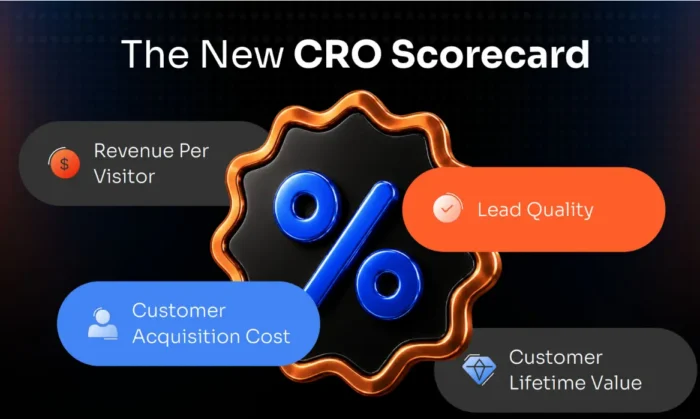
A test that lifts conversion rate by adding a discount code field, for instance, might also lower average order value or attract lower-quality leads that never close. The scorecard that actually protects revenue includes four metrics: revenue per visitor, customer acquisition cost, lead quality, and customer lifetime value.
The more of these metrics you track, the better you can tell whether a win in testing is a win for the business. Focus only on front-end conversions and you’ll optimize yourself into more leads that cost more to close and stick around for less time.
The 60-Day CRO Growth Plan
Most companies need a structured plan to remove friction and improve conversion funnel optimization rather than a fancy website redesign. Our recommended 60-day plan runs in four phases.
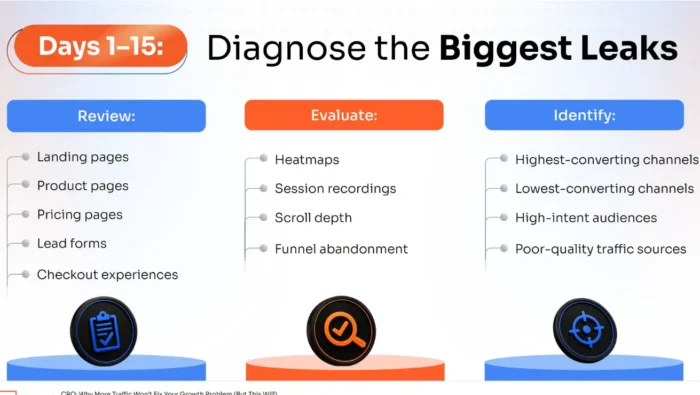
Days 1 to 15 (Diagnose): Review landing pages, product pages, pricing pages, lead forms, and checkout experiences. Evaluate heatmaps, session recordings, scroll depth, and funnel abandonment data. Identify your highest- and lowest-converting channels.
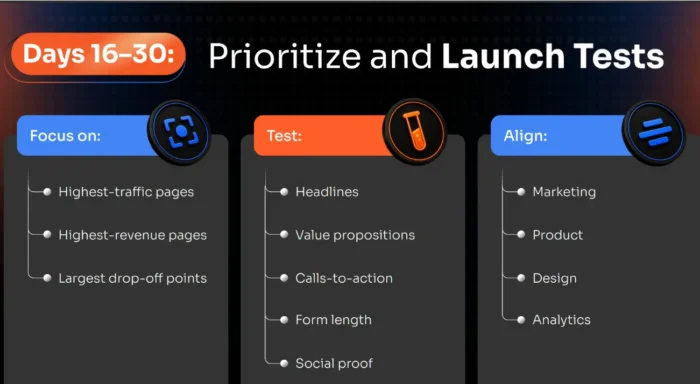
Days 16 to 30 (Prioritize and test): Focus on your highest-traffic pages, highest-revenue pages, and largest drop-off points. Test headlines, value propositions, CTAs, form length, and social proof. Align marketing, product, design, and analytics around a shared testing calendar.
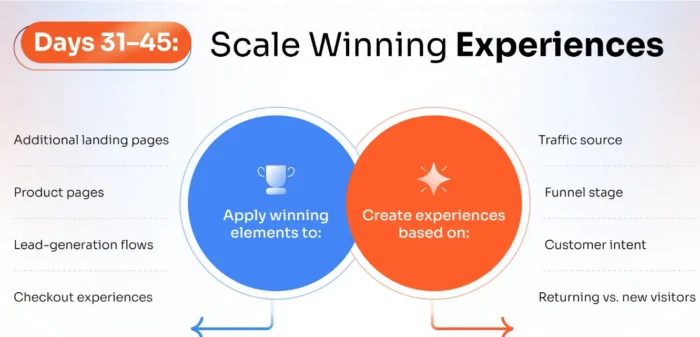
Days 31 to 45 (Scale): Apply winning elements to additional landing pages, product pages, lead-generation flows, and checkout experiences. Build variants by traffic source, funnel stage, customer intent, and visitor type.
Days 46 to 60 (Operationalize): Establish a monthly experiment calendar, a testing backlog, and a prioritization framework so testing continues past the initial 60 days. Track revenue per visitor, conversion rate, lead quality, pipeline contribution, and CAC improvements.
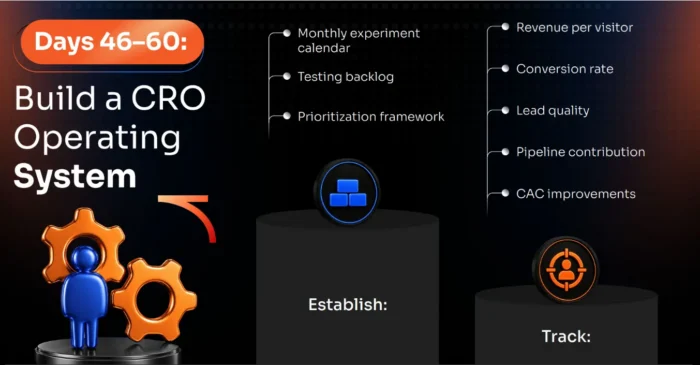
Teams that build this system early move faster in every quarter that follows, because they’re refining a working process instead of starting from scratch each time.
FAQs
What is CRO in marketing?
Conversion rate optimization (CRO) is the practice of increasing the percentage of website visitors who complete a desired action, such as making a purchase, submitting a lead form, or starting a trial. It works by identifying friction points in a funnel and testing changes that remove them.
Why isn't more traffic fixing my conversion rate?
Traffic and conversion rate solve different problems. If your funnel has messaging, friction, trust, or experience issues, sending more visitors through it just means more people encountering the same drop-off points. Fixing the funnel itself typically produces more revenue than adding volume on top of it.
What causes the most conversion loss?
Conversion loss typically comes from four sources: unclear messaging, friction in forms or checkout flows, insufficient trust signals, and poor site experience. B2B teams tend to lose the most between the lead and marketing-qualified-lead stage, while B2C teams tend to lose the most between add-to-cart and checkout.
How often should I run CRO tests?
Companies running 11 to 15 tests per quarter saw the strongest revenue growth in NP Digital’s 2026 survey. The right cadence depends on your traffic volume, since you need enough visitors per variant to reach statistically significant results.
Conclusion
More traffic doesn’t fix a broken funnel, it just sends more visitors through the same leak.
The organizations that win at growth treat CRO as an ongoing discipline.
They combine process, psychology, and measurement, and they build testing programs that compound instead of resetting every quarter. You don’t need twice the traffic, it’s better to focus on more value from the traffic you already have. If you want help finding where your funnel is leaking, talk to a CRO team that audits funnels for a living.