 Sign In







Key Takeaways
- Brands recommended by ChatGPT were 2.5x more likely to receive a website visit within seven days, according to Similarweb research.
- Most AI-influenced visits did not arrive through an identifiable AI referral.
- More than half of AI-influenced visits arrived through search, meaning the AI influence can look like ordinary organic traffic in analytics.
- Last-click attribution can therefore underestimate the role AI plays in brand discovery and consideration.
- Marketers need broader measurement frameworks that account for AI’s influence across the customer journey.
AI search is becoming an increasingly important way for consumers to discover brands. But measuring its impact is proving much harder than measuring a traditional referral.
A user might ask ChatGPT for a product recommendation, see a brand mentioned, and then search for that brand on Google several days later. Analytics will record the eventual visit, but it may have no way of knowing that an AI recommendation helped start the journey.
New research from Similarweb highlights the scale of this measurement gap. Brands recommended by ChatGPT were 2.5x more likely to receive a website visit within the following seven days, even when there was no direct referral from the AI platform.
The finding suggests that AI visibility can influence traffic without appearing as AI traffic in a standard analytics report.
For marketers, that’s an important distinction. If AI is influencing customers before they reach a website, measuring only the final click can make the channel look less valuable than it actually is.
What Similarweb Found About AI’s Downstream Impact
Similarweb’s research tracked real user journeys to understand what happens after a brand is recommended in ChatGPT.
AI Recommendations Can Lead to More Website Visits</h3>
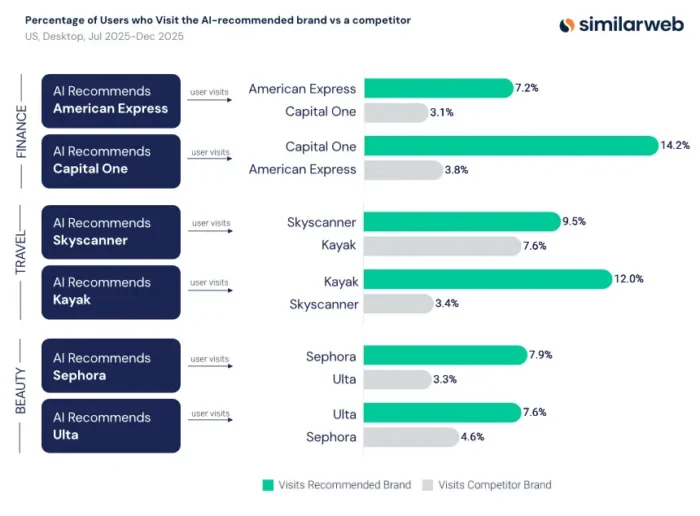
Similarweb followed users who asked ChatGPT an industry-related question and received a specific brand recommendation. It then tracked their behavior over the following seven days.
Across finance, travel, and beauty, users who received an AI recommendation for a brand were 2.5x more likely to visit that brand’s website than users who received a recommendation for a competing brand.
The research focused on users who had not previously visited the recommended brand and had not already mentioned that brand in their prompt. This helped Similarweb measure the downstream effect of a recommendation rather than simply tracking people who already knew about a company.
The result provides a useful signal for marketers investing in AI visibility. Being mentioned in an AI answer can influence what consumers do afterward, even when the AI platform doesn’t send the eventual website visit.
Most of the Traffic Doesn’t Look Like AI Traffic
This is where traditional measurement becomes complicated.
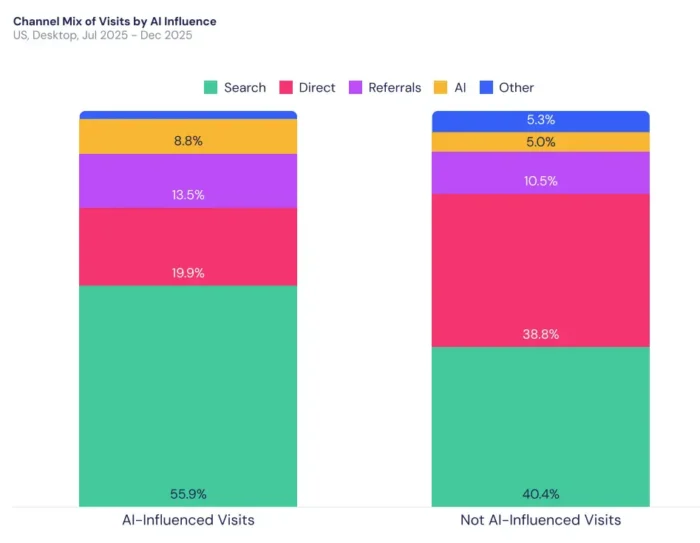
Similarweb found that 55.9% of AI-influenced visits arrived through search, compared with 40.4% of visits without AI influence.
In practice, that means a user could see a brand recommendation in ChatGPT, remember the name, and later search for it on Google.
That visit would likely be attributed to organic search.
The AI interaction that helped create the interest would receive no credit.
This is the core AI attribution problem. The measurable traffic is real, but the original source of influence can disappear somewhere between discovery and conversion.
Why Last-Click Attribution Misses AI’s Influence
Last-click attribution works reasonably well when a customer journey is relatively direct. But discovery through AI can introduce additional steps that aren’t captured by traditional referral reporting.
The AI Interaction Happens Before the Measurable Visit
Consider a simple journey.
A consumer asks an AI platform which software tools are best for their business. The platform recommends a brand. The consumer doesn’t click a link. Instead, they continue researching, then return to Google two days later and search for the brand by name.
From an analytics perspective, the final visit may look like a branded organic search.
From the customer’s perspective, however, the journey started with AI.
This distinction matters because the first interaction helped put the brand into consideration.
AI Visibility Can Influence Branded Search
Branded search is often treated as a direct expression of existing brand awareness. Similarweb’s findings suggest there can be another layer behind some of that demand.
If a consumer discovers a brand through AI search and later searches for it directly, the branded query becomes the measurable part of a journey that began elsewhere.
That doesn’t mean every increase in branded search should be attributed to AI. Similarweb’s research shows an association between AI recommendations and later visits, rather than proving that every subsequent visit was directly caused by the recommendation.
The broader point is that marketers need to account for influence that happens before the click.
What This Means for SEO and GEO
The attribution challenge creates a particular problem for SEO and GEO. Both strategies increasingly involve earning visibility before a user visits a website.
AI Visibility Is Becoming Part of Brand Discovery
A brand doesn’t need to receive a referral from an AI platform to benefit from appearing in its answers.
The recommendation itself can influence consideration. Similarweb found that AI-influenced visitors also engaged more deeply after arriving, viewing nearly twice as many pages and spending roughly twice as much time on site as other visitors.
That makes AI visibility more than a visibility metric. It can be an early-stage influence on the customer journey.
SEO Attribution Needs a Broader View
The same principle applies to SEO.
A customer may discover a brand through an AI answer, search for the brand through Google, and eventually convert through another channel. A last-click report may assign credit to the final interaction without showing how earlier discovery contributed to the decision.
This doesn’t make existing attribution models useless. It means marketers should be cautious about using them as the only measure of SEO or GEO performance.
How Marketers Can Measure AI’s Influence
The solution isn’t to invent a perfect AI attribution model overnight. Instead, marketers can start looking for signals that appear downstream from AI visibility.
Track Branded Search Alongside AI Visibility
Monitor changes in branded search demand alongside your visibility in AI answers.
If AI visibility increases and branded search, direct traffic, or other downstream indicators change at the same time, that can provide useful context.
These metrics shouldn’t be treated as proof of causation, but they can help reveal relationships that referral reporting misses.
Look Beyond Referral Traffic
AI referral traffic is still worth tracking, but it represents only one part of the picture.
Marketers should also consider direct visits, branded search growth, engagement, and downstream conversions when evaluating the potential impact of AI visibility.
The goal is to understand whether appearing in AI answers is contributing to meaningful customer behavior, even when the final visit arrives through another channel.
Build Measurement Around the Customer Journey
AI can influence a customer before they ever interact with a brand’s website.
That means measurement needs to account for discovery, consideration, and eventual conversion rather than focusing exclusively on the final interaction.
AI shapes the decision before the click, so marketers need measurement models that value influence, not just last click attribution.
AI Influence Is Bigger Than the Referral in Your Analytics
Similarweb’s research offers an important reminder about the limits of conventional analytics.
A brand recommendation in ChatGPT can lead to a website visit days later, but that visit may arrive through Google or directly through the brand’s website. The measurable interaction is there. The original influence isn’t.
That creates a challenge for marketers trying to evaluate the business case for AI search, SEO, and GEO.
As AI becomes a larger part of how people research products and services, brands will need to measure more than direct referrals. Visibility can influence what customers remember, search for, and eventually choose.
FAQs
What is AI attribution?
AI attribution is the process of measuring how exposure to AI-generated recommendations or answers contributes to later customer actions, such as website visits, branded searches, or conversions.
Why is AI attribution difficult?
AI platforms may influence users without generating a trackable referral. A person can discover a brand through an AI answer and later visit the website through branded search or direct traffic, making the original influence difficult to identify in standard analytics.
Does AI visibility drive website traffic?
Similarweb found that users who received a brand recommendation in ChatGPT were 2.5x more likely to visit that brand’s website within seven days. The majority of AI-influenced visits arrived through search rather than a direct AI referral.
How should marketers measure AI visibility?
Marketers should look beyond AI referral traffic and monitor related signals such as branded search, direct traffic, engagement, and downstream conversions. These metrics can provide additional context around the influence of AI visibility.
Conclusion
AI is becoming an important part of how consumers discover and evaluate brands, but traditional analytics aren’t always equipped to show its full impact.
Similarweb’s research demonstrates why. Brands recommended by ChatGPT were more likely to receive a website visit within seven days, yet much of that activity appeared as search traffic rather than an AI referral.
For marketers, the takeaway is to treat AI visibility as part of the customer journey rather than simply another traffic source. Tracking branded search, direct visits, engagement, and conversions alongside AI visibility can provide a more complete picture of how AI influences demand.
As AI search continues to grow, the brands that can connect visibility with downstream behavior will be better positioned to understand the value of their SEO and GEO investments.
If you want to better understand how AI visibility is influencing your organic performance, reach out to the NP Digital team to build a measurement strategy that looks beyond the last click.