 Sign In







How Mature Is Your AI Search Strategy? Most Teams Are Still Testing.
Info
-
Source: NP Digital
-
Date: August 2026
-
Category: AI & GEO Optimization
-
Study Methodology: Source: NP Digital, August 2026. Data from 1,000 people surveyed. Numbers rounded to the closest whole number.
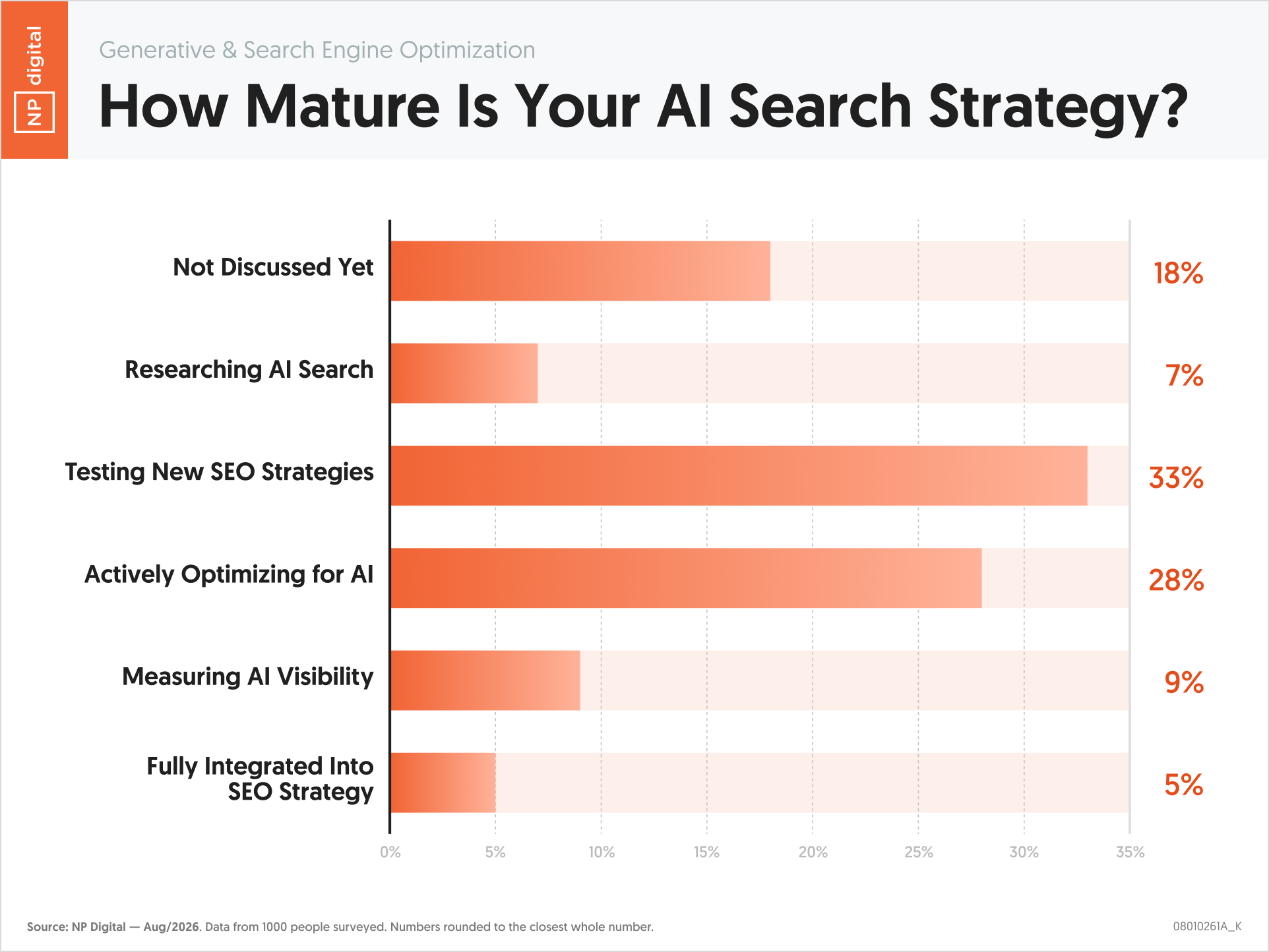
Most organizations are somewhere in the middle of AI search strategy development: aware of the shift, experimenting with responses, but not yet systematically optimizing or measuring. This survey of 1,000 respondents maps the distribution across six AI search strategy maturity stages, from not discussed through fully integrated. The results show a market that has largely moved past the denial and research phases but has not yet reached systematic optimization or measurement for the majority of practitioners.
Essential Statistics
- 33 percent of respondents are testing new SEO strategies in response to AI search, the largest single maturity stage in the dataset.
- 28 percent are actively optimizing for AI search, the second-largest stage.
- 18 percent have not yet discussed AI search strategy, the third-largest group.
- 9 percent are measuring AI visibility as a dedicated activity.
- 7 percent are researching AI search without yet testing, and 5 percent have fully integrated AI search into their SEO strategy.
- Only 14 percent of respondents are at or beyond the measuring AI visibility stage, suggesting that systematic AI search measurement remains the minority approach.
Key Takeaways
- The 33 percent testing stage as the largest single cohort reflects where most AI search strategy efforts currently are: experimenting with tactics without a fully defined framework or measurement system. This is a productive but transitional stage that often precedes either more systematic investment or de-prioritization if early tests do not produce clear results.
- The 18 percent not yet discussed group is notably large for a channel that has received extensive industry coverage. This likely reflects small and mid-size businesses that have awareness of AI search at a general level but have not translated that awareness into a strategic conversation internally.
- The 9 percent measuring AI visibility and 5 percent fully integrated together represent only 14 percent of respondents who have reached the stages where systematic AI search investment produces compounding returns. This small percentage represents both the competitive frontier and the group most likely to build durable AI search advantages.
- The active optimizing cohort at 28 percent without a corresponding measurement cohort suggests that a significant portion of AI search investment is happening without the evaluation infrastructure to assess whether it is working. Optimizing without measuring produces effort but not compounding learning.
- Strategy maturity distributions of this kind are self-reported and may skew toward higher stages than actual practice reflects, since respondents tend to describe their aspirational stage rather than their current operational reality.
Actionable Insights
- If you are in the testing stage, define what a successful test looks like before running more experiments. The 33 percent testing cohort is the largest group, but testing without defined success criteria produces activity without learning. Identify two or three specific hypotheses about AI visibility that your tests are designed to evaluate, and document what evidence you would need to see to confirm or refute each one.
- If you are in the actively optimizing stage, build a measurement layer before scaling investment. The gap between 28 percent actively optimizing and 9 percent measuring suggests that many teams are investing in AI search optimization without the evaluation infrastructure to assess returns. Even a basic monthly query testing protocol that tracks which AI platforms cite your content on your top 20 target queries provides the measurement foundation that transforms optimization from activity into learning.
- If you have not yet discussed AI search strategy internally, frame the first conversation around the business impact rather than the technology. The 18 percent not yet discussed group is often not resistant to AI search investment but has not connected it to revenue or growth implications that would justify prioritization. Presenting internal leadership with data on AI-driven brand discovery, referral traffic patterns, and competitive visibility is more likely to initiate the strategy conversation than presenting technical GEO concepts.
- Use the 5 percent fully integrated benchmark as a long-term target and a competitive differentiation opportunity. In most categories, fewer than 1 in 20 competitors have fully integrated AI search into their SEO strategy. Moving into that 5 percent ahead of category peers produces visibility advantages that will be progressively harder to close as more organizations reach full integration.
- Build your AI search strategy maturity as a documented internal benchmark rather than relying on industry surveys to assess your position. Define what each of the six maturity stages means for your specific organization, assess your current stage honestly, and commit to the specific actions needed to advance one stage in the next quarter. Self-assessed maturity with a concrete advancement plan is more actionable than where you fall in an industry distribution.
Thirty-three percent are testing, 28 percent are actively optimizing, and 9 percent are measuring. The gap between optimizing and measuring is where most AI search investment disappears without accountability. If you are in the 28 percent optimizing without measuring, the next step is not more optimization. It is building the measurement system that tells you whether your optimization is working.’ – Neil Patel