 Sign In










SEO vs. LLM Citations: Which Shows Results Faster?
Info
-
Source: NP Digital
-
Date: April 2026
-
Category: AI & GEO Optimization
-
Study Methodology: Data from 20 websites running SEO and GEO campaigns simultaneously. Weekly tracking of indexed SEO traffic score and AI citation score over eight weeks.
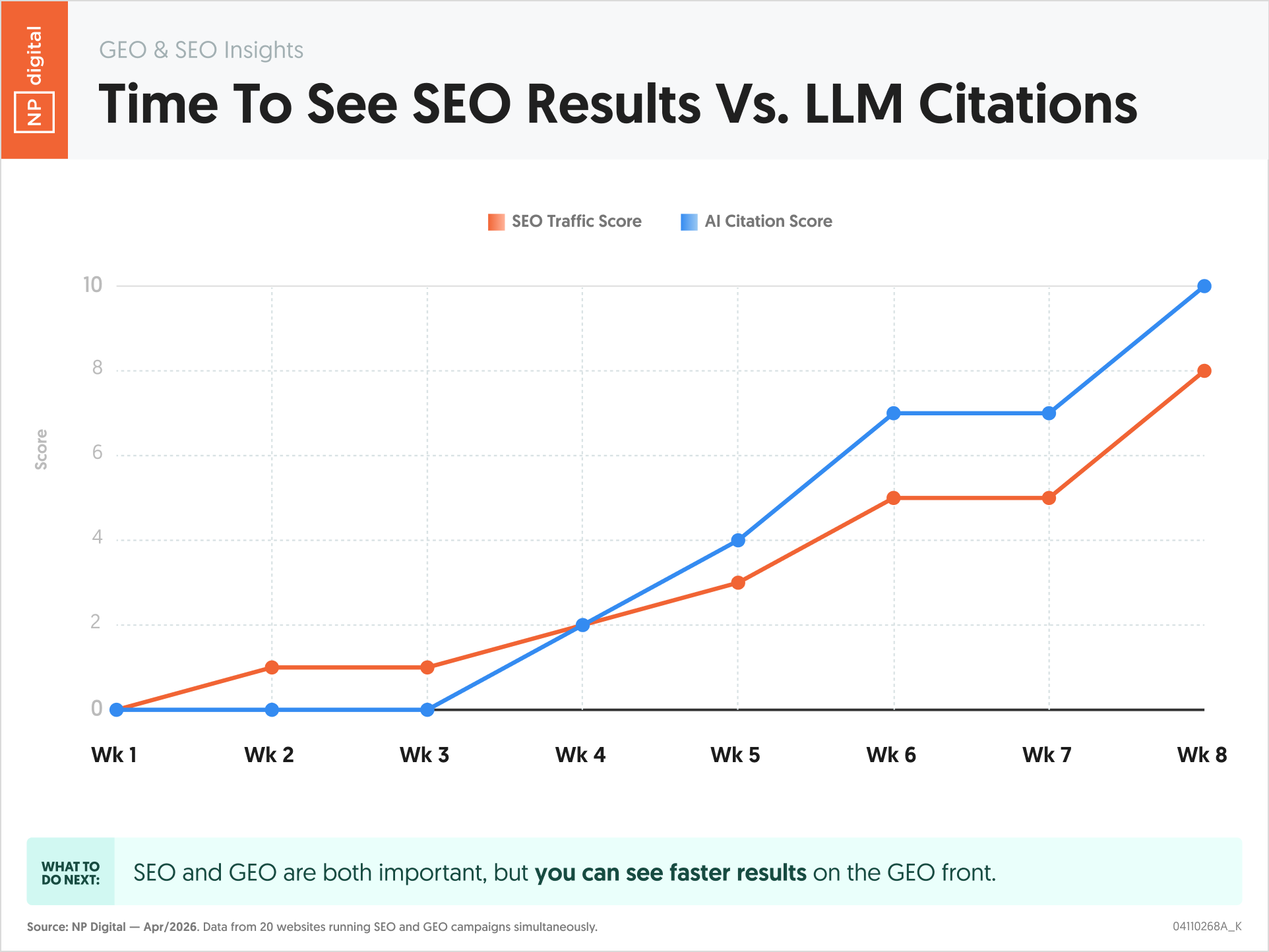
One of the most persistent questions in GEO strategy is how long it takes to see results compared to traditional SEO. This chart tracks both metrics simultaneously across 20 websites over eight weeks, and the trajectory answers the question directly. LLM citation scores start later but accelerate faster, overtaking SEO traffic scores by week six and widening the gap through week eight. For brands debating whether to prioritize GEO or SEO, the data shows it is not a choice between fast and slow. It is a choice between two different timelines with different shapes.
Essential Statistics
- SEO traffic scores showed modest early gains, reaching approximately 1 by week two and remaining near 1 through week three before beginning to climb.
- LLM citation scores showed no measurable movement through week three before beginning a steep acceleration starting in week four.
- By week five, LLM citation scores reached approximately 4, matching or slightly exceeding SEO traffic scores at the same point in time.
- By week six, LLM citation scores reached approximately 7, clearly surpassing SEO traffic scores which stood near 5 at the same week.
- By week eight, LLM citation scores reached 10 while SEO traffic scores reached approximately 8, maintaining a widening gap in favor of GEO performance.
- The LLM citation curve shows steeper acceleration after week four compared to the more gradual SEO traffic curve across the full eight-week period.
Key Takeaways
- GEO and SEO have different result timelines, not simply different speeds. SEO produces earlier small gains that grow gradually. GEO produces no visible early gains before accelerating steeply. Understanding the shape of each curve helps set realistic expectations and prevents premature abandonment of GEO efforts during the silent weeks three and four.
- The LLM citation score overtaking SEO at week six is the critical data point for GEO investment cases. After six weeks, new GEO investment on a site already running SEO produces higher incremental returns than an equivalent SEO investment would, based on the trajectory shown in this dataset.
- The flat LLM citation line through week three is a common failure point. Teams that evaluate GEO results at the four-week mark and see nothing are likely abandoning a strategy just before the acceleration phase begins. The eight-week view is the minimum frame for evaluating GEO campaign performance.
- The fact that both curves continue to rise through week eight without flattening suggests that neither SEO nor GEO results have plateaued at the end of this measurement window. Longer-term data would likely show continued divergence favoring GEO.
- Running SEO and GEO simultaneously, as the 20 sites in this study did, is the right strategy. The early SEO gains provide measurable short-term results while GEO compounds toward its higher later-stage returns.
Actionable Insights
- Set your GEO campaign evaluation window at a minimum of eight weeks before making performance judgments. The data shows LLM citations are near zero through week three. A four-week check-in will consistently produce misleading conclusions about whether GEO is working. Build the eight-week evaluation window into your campaign brief before launch.
- Use the SEO curve’s early small gains as the short-term performance story while GEO builds. For brands managing internal reporting pressure, the SEO component of a combined SEO and GEO campaign provides the early-stage metrics that demonstrate activity and progress.
- Present the week-six crossover point as the inflection argument for sustained GEO investment. After week six in this dataset, GEO produces higher incremental returns than SEO for equivalent effort. That crossover is the data-backed answer to any stakeholder question about when GEO investment starts to pay off relative to continuing to invest only in SEO.
- Do not reduce GEO investment between weeks three and five when results appear flat. The curve shows this is the buildup period before acceleration, not evidence that the strategy is not working. Pre-briefing stakeholders on the shape of the GEO result curve prevents budget cuts during the period when the foundation for week-six-plus performance is being built.
- Use the 20-site dataset as a planning benchmark for your own eight-week GEO launch. If your LLM citation scores are not beginning to move by week four or five, that is an early signal to review your content structure, schema markup, and citation eligibility before the acceleration phase should begin.
“The LLM citation curve is flat for three weeks and then it takes off. That shape is exactly why most teams give up on GEO too early. They check results at four weeks, see nothing, and pull the budget. But the data from 20 sites shows that weeks three and four are just before the acceleration starts. Staying in through week eight is not patience. It is the strategy.” – Neil Patel