 Sign In





Rankings Up, Traffic Down: What AI Search Is Doing to SEO
Info
-
Source: NP Digital
-
Date: May 2026
-
Category: AI & GEO Optimization
-
Study Methodology: Sample size: 14 marketers and business owners. Some businesses had seasonal variation. Both series are indices (rankings as ratio of baseline, sessions as percentage of baseline). Collection method: Index-based tracking from January 2023 to December 2025.
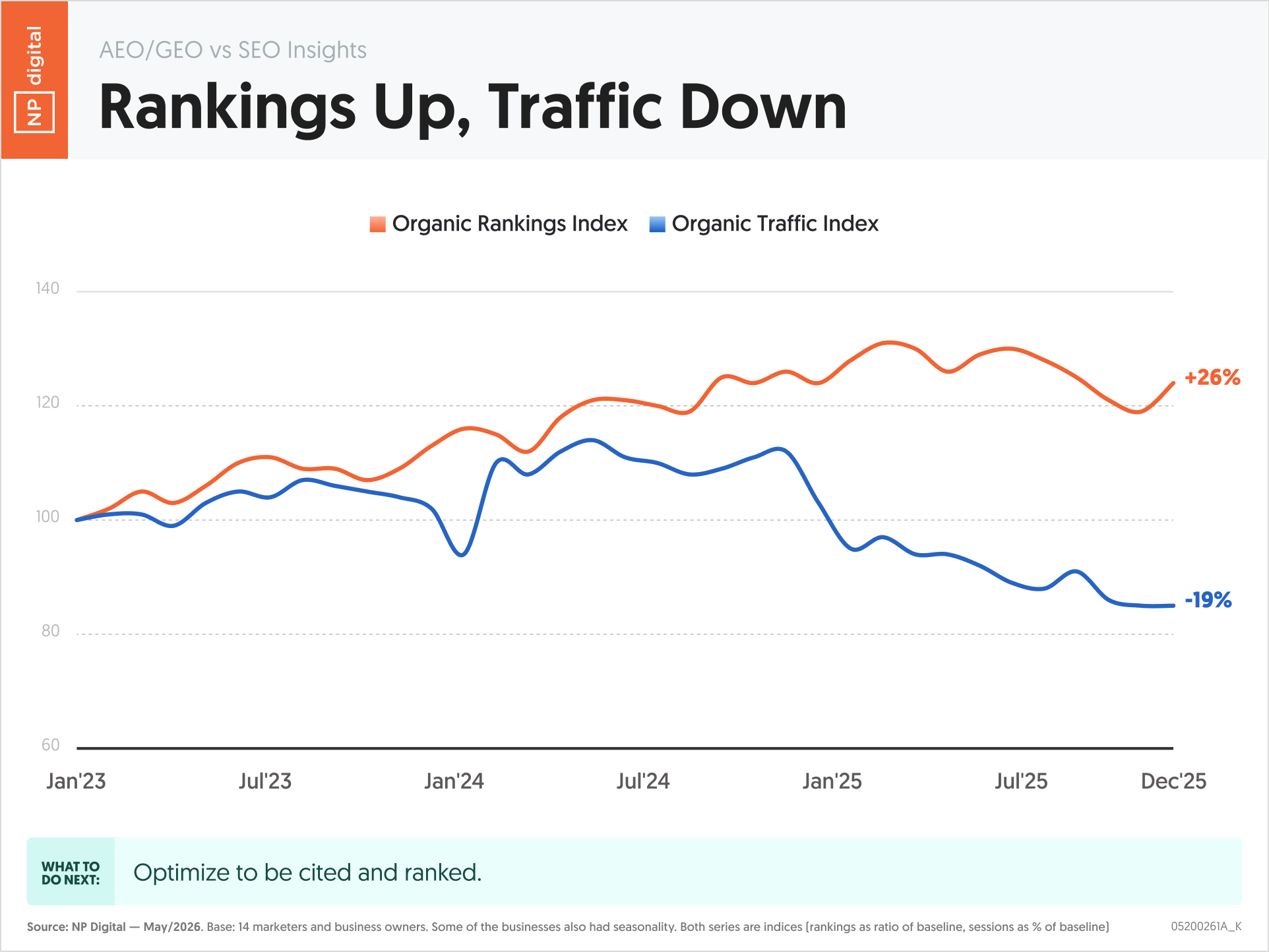
Rankings and traffic have historically been reliable proxies for each other. When rankings improve, traffic follows. That relationship has broken down. This chart tracks two indices from January 2023 through December 2025: organic rankings climbed 26 percent while organic traffic fell 19 percent over the same period. The divergence reflects a structural change in how search results are consumed. AI-generated answers are answering more queries directly, absorbing clicks before users reach ranked results. For teams still reporting SEO performance through rankings and traffic in isolation, this chart is a diagnosis of why those two metrics are no longer telling the same story.
Essential Statistics
- Organic rankings rose by 26 percent from January 2023 to December 2025, measured as a ratio to baseline performance.
- Organic traffic fell by 19 percent over the same period, measured as sessions as a percentage of baseline.
- Rankings and traffic tracked closely through early 2024, moving in near-parallel before diverging significantly.
- The divergence between the two indices began accelerating in mid-2024, coinciding with the broader rollout of Google AI Overviews.
- The combined gap between the rankings index and traffic index reached approximately 45 index points by December 2025.
Key Takeaways
- A 45-point divergence between rankings and traffic over three years is a structural signal about how the search channel has changed. Rankings measure position in search results. Traffic measures whether users in those results actually click through. AI Overviews are answering an increasing share of queries at the top of the results page, reducing the click-through rate of ranked results even when those results maintain their position.
- The timing of the divergence is instructive. Rankings and traffic moved in near-parallel through early 2024, then split. This timeline correlates with the phased rollout of Google AI Overviews, which began testing in mid-2023 and expanded significantly through 2024. Teams that noticed traffic declining in late 2024 despite stable rankings were experiencing the direct effect of AI Overview absorption.
- The traffic decline is not uniform across all query types, and this distinction is critical for strategy. Informational queries are the most heavily absorbed by AI answers because they are the easiest for AI to answer directly. Transactional and navigational queries still generate clicks because AI answers are less useful than the actual destination. Intent segmentation of the keyword portfolio is now essential for understanding which rankings still generate traffic and which are at risk.
- Teams measuring SEO success exclusively through rankings are systematically overestimating the channel’s current performance. A rising rankings index against a falling traffic index means the SEO program is becoming less efficient on getting actual visits even as it appears to be succeeding by the most commonly used leading indicator.
- The brands most protected against traffic erosion from AI Overview absorption are the ones that have invested in brand authority and direct brand searches. When users search for a brand by name rather than a category query, AI Overviews are less likely to intercept the click because the navigational intent is clear. Building branded search volume is now a traffic resilience strategy, not just a brand awareness objective.
Actionable Insights
- Segment your keyword portfolio by query intent and run a separate traffic analysis for informational, transactional, and navigational query clusters. The 45-point divergence is concentrated in informational queries that AI Overviews are most capable of answering directly. Pull the top 50 keywords driving your organic traffic, classify each by intent, and measure the traffic-per-impression trend for each cluster over the past 18 months. The informational cluster will show the steepest decline in CTR despite stable or improving rankings.
- Add AI citation tracking to your SEO reporting stack alongside your standard rankings and traffic data. The 45-point divergence means rankings no longer tell you whether you are winning or losing visibility. Tracking how often your brand and content are cited in AI Overviews and chat-based answer engines gives you the visibility metric that fills the gap rankings have left. Run weekly manual checks for your top 20 keywords across Google AI Overviews, ChatGPT, Gemini, and Perplexity, and log whether you appear, in what context, and with what framing.
- Structure the content on your highest-traffic pages to include a clear, direct answer to the primary query within the first 150 words of each major section. AI Overviews pull from content that is easy to extract. Adding a concise direct-answer paragraph at the top of each major section does not require rewriting the full page. It creates citation-ready content while preserving the depth that supports rankings.
- Build branded search volume as a parallel traffic strategy alongside your standard organic SEO program. The traffic component of the rankings-traffic divergence is most severe for non-branded informational queries. PR coverage, community engagement, email newsletters, and any channel that drives people to search for your brand by name builds a traffic base that is structurally protected from AI absorption.
- Show the rankings and traffic trends on the same dashboard for leadership visibility and use them to build the business case for investing in AEO alongside traditional SEO. Most SEO reporting separates rankings and traffic into different views. Showing them together makes the divergence undeniable and immediately communicable to stakeholders who are not close to search channel dynamics.
“Rankings are going up, traffic is going down. That is the chart that should end the conversation about whether AI search is affecting business metrics. It is. Teams still reporting SEO performance through rankings alone are measuring themselves by a standard that no longer reflects the actual outcome.” – Neil Patel