 Sign In






 Ubersuggest
  AnswerThePublic
 How Confident Are Marketers That AI Understands Their Brand?
Info
-
Source: NP Digital
-
Date: April 2026
-
Category: AI In Marketing
-
Study Methodology: Data from 1,000 marketers surveyed.
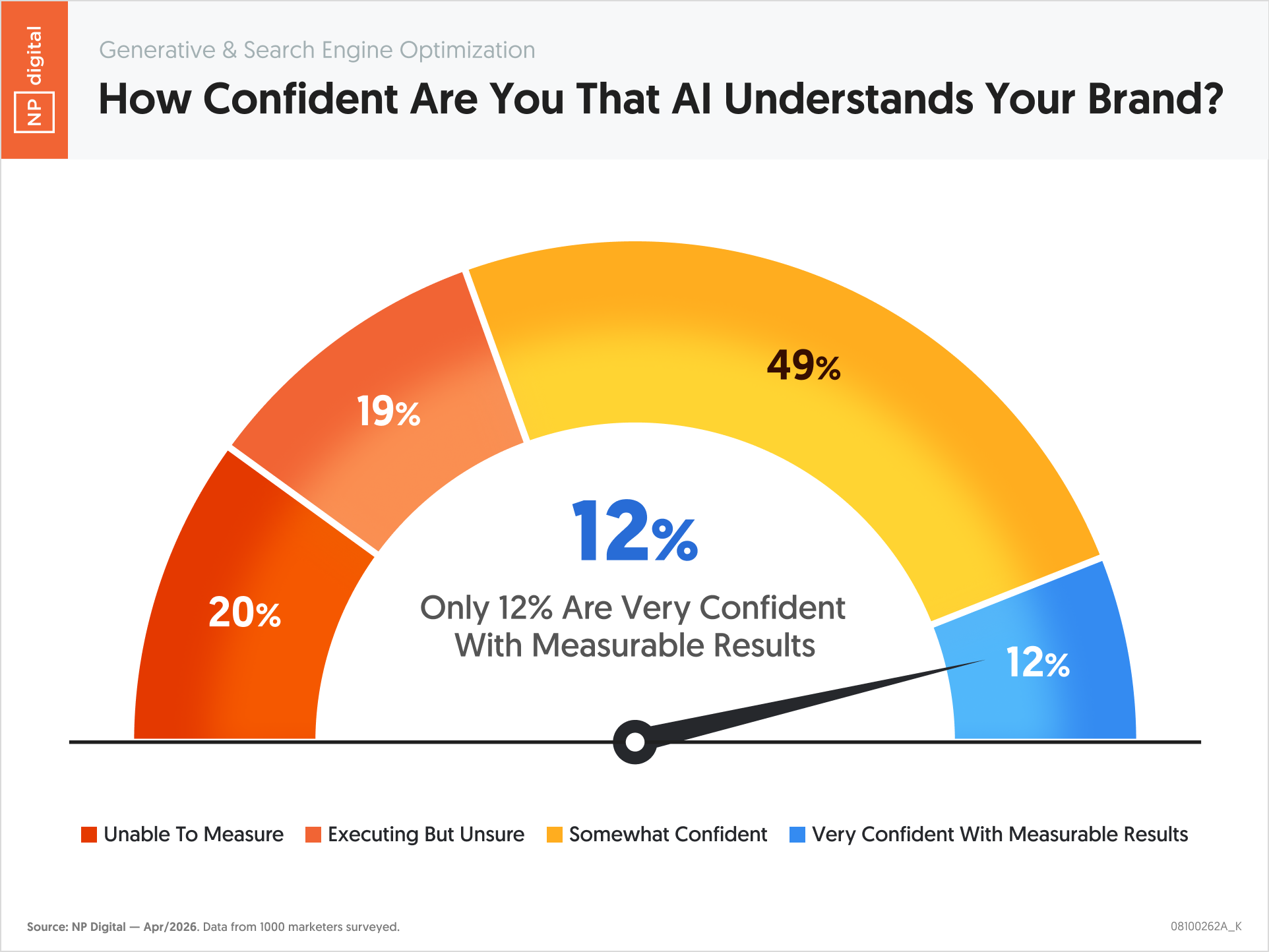
Most marketers are not confident that AI platforms accurately understand and represent their brand. This survey of 1,000 marketers shows that only 12 percent report being very confident with measurable results, while 49 percent are only somewhat confident and 39 percent are either executing without certainty or unable to measure at all. The low confidence levels likely reflect both genuine uncertainty about how AI systems represent brands and a lack of measurement infrastructure for evaluating AI brand perception.
Essential Statistics
- Only 12 percent of marketers report being very confident that AI understands their brand with measurable results, the highest confidence level in the dataset.
- 49 percent report being somewhat confident, the largest single response category.
- 19 percent report executing AI visibility efforts but remaining unsure whether AI understands their brand accurately.
- 20 percent report being unable to measure how AI understands their brand at all.
- Combined, 39 percent of marketers are either executing without confidence or unable to measure their AI brand representation, suggesting a significant measurement gap across the market.
Key Takeaways
- The 12 percent very confident rate likely reflects both the genuine difficulty of measuring AI brand representation and the early stage of GEO measurement infrastructure across most organizations. Very few teams have built the systematic query testing and citation monitoring needed to confidently evaluate how AI platforms represent their brand.
- The 49 percent somewhat confident majority is a reasonable baseline for a channel this early in its measurement maturity. These are practitioners who have done enough testing to have a general sense of their AI brand representation but have not built the infrastructure for systematic measurement.
- The 20 percent unable to measure reflects teams that have not yet invested in even basic AI visibility monitoring. For this group, the most actionable step is establishing a measurement baseline rather than investing in optimization activities whose impact cannot be evaluated.
- The 19 percent executing but unsure group is worth noting because it represents teams that are investing in AI visibility activities without being able to confirm whether those activities are producing accurate brand representation. This is a particularly risky position if the activities are generating AI responses that misrepresent the brand.
- Confidence levels will naturally vary by category and brand size. Brands with high review volume, frequent media coverage, and strong community presence likely have more signal for AI systems to draw from, which may produce more accurate brand representation even without deliberate GEO investment.
Actionable Insights
- Establish a basic AI brand audit before optimizing for AI visibility. For the 20 percent who cannot measure, this means manually testing 10 to 20 brand-relevant queries across ChatGPT, Gemini, and Perplexity and documenting what each platform says about your brand, products, and competitive position. This is a starting point, not a comprehensive measurement system, but it is more actionable than optimizing blindly.
- Build a quarterly AI brand query testing protocol if you are in the somewhat confident majority. Somewhat confident often means you have done ad hoc testing but not systematic monitoring. A defined set of 20 to 30 queries tested monthly or quarterly against multiple AI platforms produces the trend data needed to move from somewhat confident to very confident with measurable results.
- For teams executing but unsure whether AI understands their brand accurately, prioritize evaluating AI accuracy before scaling GEO investment. If AI platforms are generating incorrect, outdated, or incomplete brand information, additional visibility investment may amplify inaccurate representations. Identifying and correcting the most significant factual gaps should precede visibility scaling.
- Treat the 12 percent very confident benchmark as a realistic medium-term target rather than an immediate goal. Building the measurement infrastructure, query testing protocols, and citation monitoring systems needed to achieve genuine confidence with measurable results takes time. A 12-month roadmap that moves from unable to measure through somewhat confident to very confident is more realistic than expecting rapid progress.
- Connect AI brand understanding evaluation to your existing brand health measurement processes rather than treating it as a separate workstream. Many organizations already run brand tracking surveys and share-of-voice monitoring. Adding AI platform testing to those existing processes leverages established measurement workflows rather than building entirely new ones.
Only 12 percent of marketers are very confident that AI understands their brand with measurable results. That low number is partly a measurement infrastructure problem and partly a genuine reflection of how early this field is. The most important first step for most teams is not optimization. It is measurement. You cannot improve what you are not tracking.’ – Neil Patel