 Sign In





How Much ChatGPT Citation Traffic Is Actually Trackable?
Info
-
Source: NP Digital
-
Date: March 2026
-
Category: AI & GEO Optimization
-
Study Methodology: Data from analyzing ChatGPT citations across 119 conversations. Writesonic. Methodology reflects categorization of citation traffic as trackable brand traffic versus third-party traffic across three ChatGPT model versions.
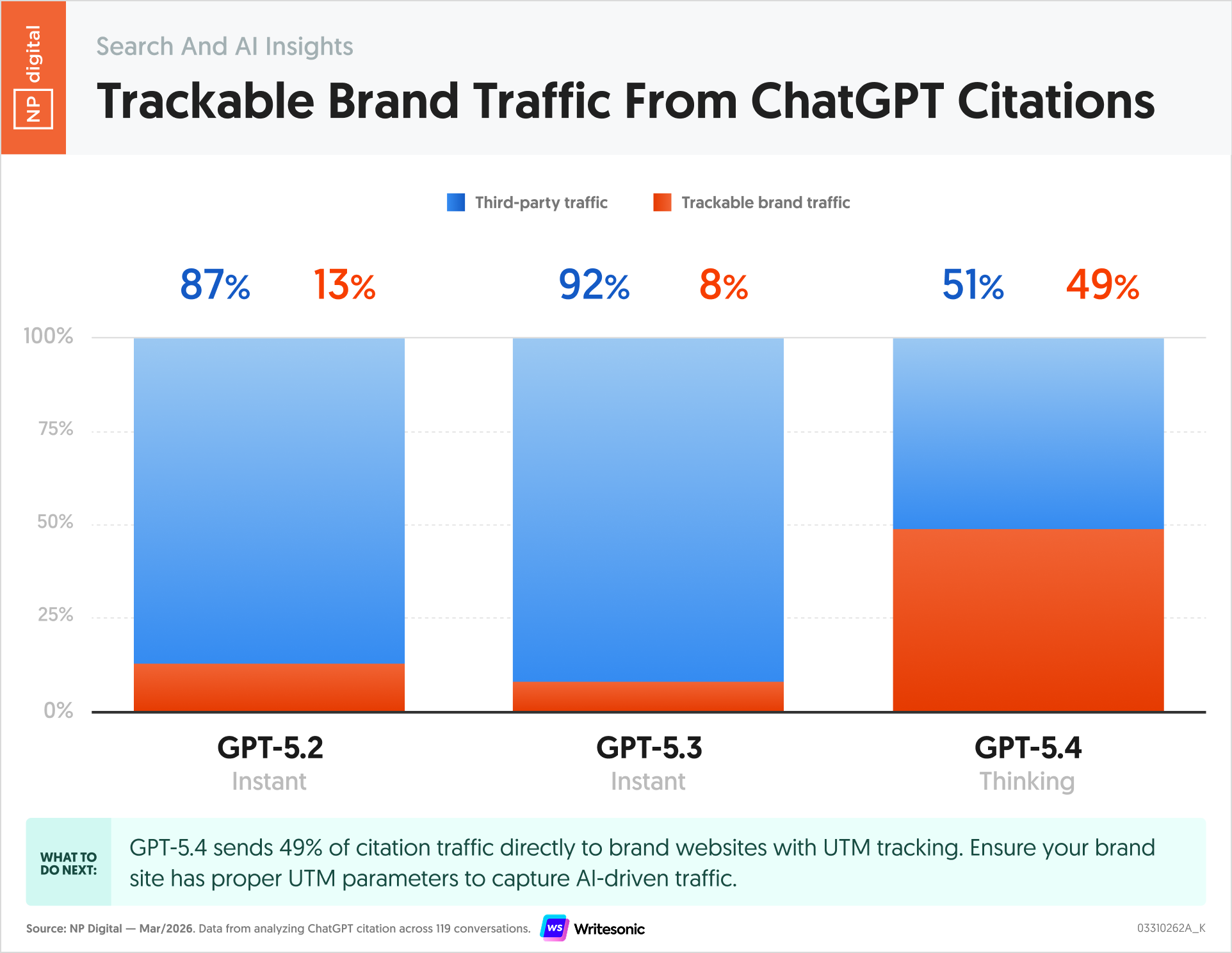
One of the most persistent frustrations in AI marketing measurement is that ChatGPT traffic is difficult to track. That frustration is becoming less valid with each model iteration. This chart shows how trackable brand traffic from ChatGPT citations has changed across three model versions, from GPT-5.2 to GPT-5.4, and the trajectory is dramatic. The thinking model in GPT-5.4 sends nearly half of its citation traffic directly to brand sites with trackable parameters.
Essential Statistics
- GPT-5.2 Instant sent 13 percent trackable brand traffic and 87 percent third-party traffic from citations across 119 conversations.
- GPT-5.3 Instant showed a slight decline to 8 percent trackable brand traffic and 92 percent third-party traffic.
- GPT-5.4 Thinking sent 49 percent trackable brand traffic and 51 percent third-party traffic, a dramatic improvement from prior model versions.
- The jump from 8 percent in GPT-5.3 to 49 percent in GPT-5.4 represents more than a sixfold increase in trackable brand citation traffic across a single model generation.
- GPT-5.4’s thinking mode architecture appears to fundamentally change how citations are structured and attributed compared to instant-mode predecessors.
Key Takeaways
- GPT-5.4 Thinking is a materially different citation model than its predecessors. The jump to 49 percent trackable brand traffic is not a marginal improvement. It represents a structural change in how the model handles attribution and external linking.
- The decline from 13 percent in GPT-5.2 to 8 percent in GPT-5.3 before the spike to 49 percent in GPT-5.4 suggests the thinking mode architecture is the primary driver of improved trackability, not incremental model improvements.
- Brands that have written off ChatGPT as an untrackable traffic source need to update that assumption. At 49 percent trackable traffic, GPT-5.4 Thinking is now approaching the trackability level of more traditional referral sources.
- Third-party traffic at 51 percent in GPT-5.4 still represents a significant share of citations flowing through intermediary sites rather than directly to brand domains. Earning citations on authoritative third-party sites remains valuable for both AI visibility and referral traffic capture.
- The model version dependency of trackability rates means that marketers need to monitor which version of ChatGPT their audience primarily uses, as traffic from different model versions will show dramatically different attribution patterns in analytics.
Actionable Insights
- Audit your UTM parameter coverage immediately for all brand URLs that could appear in ChatGPT citations. GPT-5.4 sends 49 percent of citation traffic with trackable parameters, but your analytics only captures that traffic if your destination URLs are set up to receive and report it. Run a UTM audit across your most-cited pages before the next reporting cycle.
- Create a ChatGPT referral traffic segment in your analytics platform that separates GPT-5.4 Thinking sessions from other AI referral sources. The dramatic difference in trackability between model versions means aggregating all ChatGPT traffic into a single segment will produce misleading trends as usage shifts toward GPT-5.4.
- Use the 49 percent trackable traffic benchmark to set a minimum expected ChatGPT attribution rate in your reporting. If your analytics shows ChatGPT driving significantly less than that proportion of tracked sessions relative to estimated citation volume, you have a UTM or referral parameter gap that is suppressing your AI attribution data.
- Continue investing in third-party authority sites as citation targets, not just your own domain. With 51 percent of GPT-5.4 citations still flowing through third-party sources, earning mentions and links from high-authority external sites captures brand traffic that direct-to-site optimization misses entirely.
- Monitor which ChatGPT model version your target audience primarily uses and weight your attribution expectations accordingly. As GPT-5.4 Thinking becomes more widely adopted, trackable brand traffic from ChatGPT citations should increase across your analytics. A flat or declining trend in that context would indicate a citation share problem, not a tracking problem.
“GPT-5.4 Thinking sent 49 percent of its citation traffic directly to brand sites with trackable parameters. That is not a rounding error from the 13 percent we saw in GPT-5.2. It is a fundamental change in how the thinking model handles attribution. The ‘ChatGPT traffic is untraceable’ argument is running out of runway.” – Neil Patel