 Sign In







The CRO Maturity Assessment: Where Does Your Program Stand?
Info
-
Source: NP Digital
-
Date: July 2026
-
Category: Website Performance
-
Study Methodology: Surveyed 300 companies to assess their CRO program stage. Self-reported response to: How would you describe your organization's CRO program?
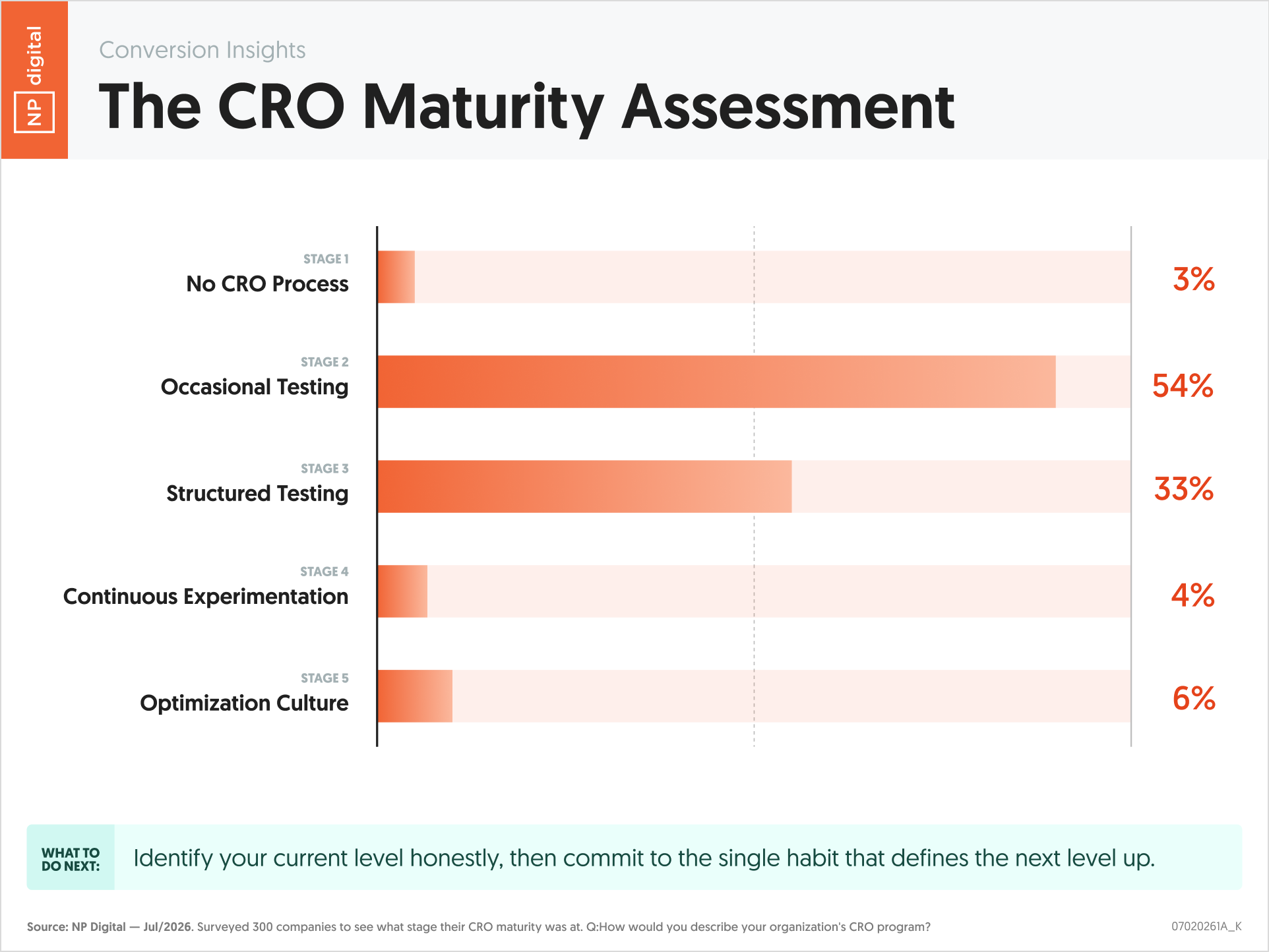
CRO maturity is not evenly distributed. This survey of 300 companies maps the distribution across five stages, from no CRO process through a full optimization culture, and the results show a market concentrated heavily in the middle. More than half of companies are running occasional tests without a structured program, while only 10 percent have reached the stages where CRO produces compounding returns through continuous experimentation or embedded optimization culture.
Essential Statistics
- Stage 2, occasional testing, accounts for 54 percent of companies, the most common CRO maturity stage by a wide margin.
- Stage 3, structured testing, represents 33 percent of companies, the second most common stage.
- Stage 1, no CRO process at all, accounts for only 3 percent of companies, confirming that most have started some form of testing activity.
- Stage 4, continuous experimentation, and Stage 5, optimization culture, account for 4 percent and 6 percent respectively, together representing just 10 percent of companies.
- The bottom two stages, no process and occasional testing, together account for 57 percent of all companies surveyed.
Key Takeaways
- The 54 percent concentration at Stage 2 confirms that occasional testing is the default state for the majority of companies that have started CRO. Occasional testing produces some results but lacks the infrastructure, cadence, and hypothesis discipline of a structured program, which means most of the value from testing is being left unrealized.
- The 33 percent at Stage 3 represents the largest group that has moved beyond ad hoc testing into something resembling a repeatable process. For this group, the next meaningful step is building the frequency and velocity needed to reach Stage 4 continuous experimentation.
- Only 10 percent of companies at Stages 4 and 5 are generating compounding returns from CRO. These are the organizations where testing infrastructure, organizational alignment, and analytical sophistication combine to produce ongoing conversion improvement rather than episodic gains.
- The 3 percent at Stage 1 suggests that virtually every company has attempted at least some form of conversion testing, even if it is not systematic. The problem is not awareness of CRO as a practice but depth of commitment to it.
- The distribution indicates that the highest-leverage transition for most companies is from Stage 2 to Stage 3: moving from occasional, unstructured tests to a program with a defined hypothesis backlog, testing calendar, and measurement framework.
Actionable Insights
- Identify your current stage honestly before investing in CRO tooling or hiring. The five-stage framework in this chart is most useful as a diagnostic. If you are at Stage 2, the priority is building process, not adding technology or headcount. A structured hypothesis backlog and a testing calendar cost nothing but time and discipline to implement.
- If you are at Stage 2, commit to one structural change that defines Stage 3: a documented hypothesis for every test. The distinction between occasional and structured testing is not frequency alone. It is whether each test is grounded in a specific, falsifiable hypothesis tied to observed user behavior. Requiring a hypothesis template for every test is the single habit that separates Stage 2 from Stage 3.
- If you are at Stage 3, focus on increasing test velocity before improving test sophistication. Moving from Stage 3 to Stage 4 requires running more tests per period, not necessarily more complex ones. Identify what slows your current testing cycle, whether it is design bottlenecks, development dependencies, or approval processes, and systematically remove those constraints before attempting more sophisticated multivariate or personalization testing.
- Use the 10 percent Stage 4 and 5 figure as a competitive framing tool. In your industry, approximately 10 percent of competitors are compounding CRO gains continuously while the other 90 percent test occasionally or sporadically. That gap is a durable competitive advantage for the 10 percent and a compounding disadvantage for everyone else.
- Build CRO maturity stage as a reported internal metric alongside conversion rate itself. Most teams track whether their conversion rate improved but not whether their testing program matured. Tracking stage explicitly, and committing to one stage advance per half-year, creates the accountability structure that most occasional testing programs lack.
”Fifty-four percent of companies are at Stage 2, occasional testing. That is the most expensive place to be in CRO. You are running tests, spending time on them, but not yet building the infrastructure to compound the learnings. The move from Stage 2 to Stage 3 is the highest-leverage CRO investment most companies can make right now.” – Neil Patel’