 Sign In






 Ubersuggest
  AnswerThePublic
 Which AI Email Initiative Drives the Greatest Business Impact?
Info
-
Source: NP Digital
-
Date: July 2026
-
Category: Email Marketing
-
Study Methodology: Data from 193 companies and survey results of 820 marketers.
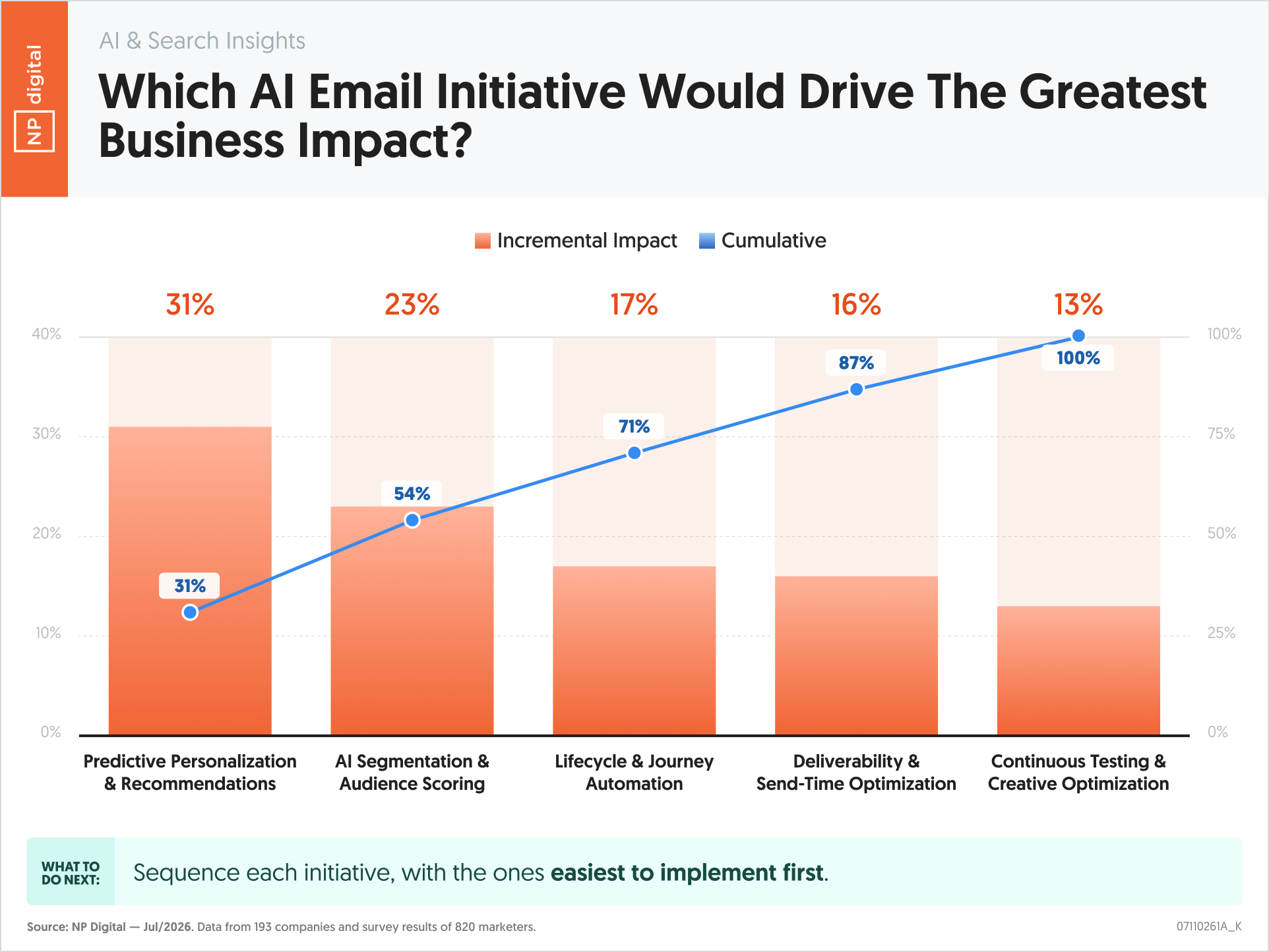
Not all AI email investments produce the same return. This survey of 193 companies and 820 marketers ranks five AI email initiatives by incremental business impact, using a Pareto-style analysis that shows both individual contribution and cumulative coverage. The results show that the first two initiatives, predictive personalization and AI segmentation, account for more than half of total AI email business impact, making them the natural starting point for any team deciding where to apply AI to email first.
Essential Statistics
- Predictive personalization and recommendations rank first with 31 percent incremental business impact, the highest individual contribution among the five initiatives.
- AI segmentation and audience scoring rank second at 23 percent incremental impact, bringing the cumulative total to 54 percent after two initiatives.
- Lifecycle and journey automation rank third at 17 percent, bringing the cumulative total to 71 percent.
- Deliverability and send-time optimization rank fourth at 16 percent, bringing the cumulative total to 87 percent.
- Continuous testing and creative optimization rank fifth at 13 percent, completing the full 100 percent of cumulative impact.
- The first two initiatives together account for 54 percent of total AI email business impact, reflecting a Pareto-style concentration of value in the highest-ranked applications.
Key Takeaways
- Predictive personalization leading at 31 percent reflects the commercial logic of AI-driven email: the ability to recommend the right product or content to the right person at the right moment produces measurably higher revenue per email than static or segment-based approaches.
- AI segmentation at 23 percent confirms that audience quality matters as much as content quality in email performance. Sending the right message to the wrong audience produces poor results regardless of how well-crafted the message is. AI segmentation addresses the audience quality problem at scale in ways that manual rule-based segmentation cannot.
- The sequencing guidance in the chart, start with the initiatives easiest to implement first, is important context for the impact ranking. Predictive personalization may have the highest impact but is not necessarily the easiest to implement. Teams should map their current data infrastructure against what each initiative requires before committing to an implementation sequence based purely on impact rank.
- Deliverability and send-time optimization at 16 percent is often the highest-return initiative for teams whose deliverability is poor or whose send timing is based on convention rather than data. For teams with deliverability issues, fixing them produces a base-level improvement that multiplies the impact of every other initiative above it.
- Continuous testing and creative optimization ranking last at 13 percent does not mean it is unimportant. It means that, at the margin, the other four initiatives produce more incremental impact than additional creative testing. For teams already running active testing programs, this confirms that their next incremental investment should likely focus on personalization and segmentation rather than more tests.
Actionable Insights
- Audit your current data infrastructure before committing to predictive personalization as your first AI email investment. In this dataset, it is the highest-return initiative, but it requires clean behavioral data, purchase history, and ideally a product catalog or content taxonomy for recommendations to be meaningful. If your data infrastructure is not ready, start with AI segmentation, which has a lower data maturity requirement and still accounts for 23 percent of total AI email impact.
- Implement AI segmentation as the first initiative if you are currently using manual rule-based segments. Moving from rule-based to AI-driven audience segmentation is the highest-leverage step for teams whose current segmentation is based on static criteria like demographics or past purchase category. AI segmentation identifies behavioral patterns that manual rules miss and adjusts in real time as subscriber behavior changes.
- Address deliverability before layering personalization or segmentation improvements. If your current inbox placement rate is below 85 percent, fixing deliverability multiplies the impact of every other AI email initiative. A personalized email that lands in spam produces zero return regardless of how well-targeted it is. Deliverability fixes belong first in your implementation sequence, even though they rank fourth in incremental impact among teams with already-healthy deliverability.
- Use the cumulative impact curve to set a realistic AI email implementation roadmap. Implementing the first two initiatives achieves 54 percent of total available AI email impact. The next two bring the total to 87 percent. Planning a 12-month roadmap that implements the first two initiatives in Q1 and Q2, then the next two in Q3 and Q4, captures most of the available impact within one planning cycle.
- Present the impact ranking to leadership as a sequencing framework rather than a feature wishlist. The chart’s explicit sequencing guidance and cumulative impact curve give you a defensible prioritization argument. Rather than requesting budget for all five initiatives simultaneously, presenting them as a sequenced investment with cumulative impact milestones is more likely to receive approval and easier to track against.
”Predictive personalization and AI segmentation together account for 54 percent of all AI email business impact. If you are deciding where to start with AI in email, that is your answer. Fix the audience quality problem with AI segmentation first, then add predictive personalization once your data infrastructure can support it. Everything else in the stack builds on those two.” – Neil Patel