
 Sign In










Content marketers beware:
- The battle you fight for attention is hard and getting harder.
- Customers don’t know what content they’re looking for (or even that they’re looking for content). They simply want answers.
- While a company blog is a smart content marketing play, it’s probably not enough.
- Consistently creating and publishing great content can be insanely difficult.
What’s a content hub?
If you were to search the phrase “content hub” and begin scouring the results for its definition, you may get confused fast. The term gets thrown around quite a bit and is interpreted in various ways.
The definition for “content hub” we’re going to use (and the proven approach I’m going to tell you about) is:
A content hub is a destination where website visitors can find branded, curated, social media, user-generated, or any type of content related to a topic.
You might think… Isn’t that a website? Or isn’t that a blog? It could be.
However, a content hub is generally smaller than a website and bigger than a blog. The best ones—and I’ll show you examples—are microsites or branded resource centers published to help visitors find the information they seek in the form they prefer.
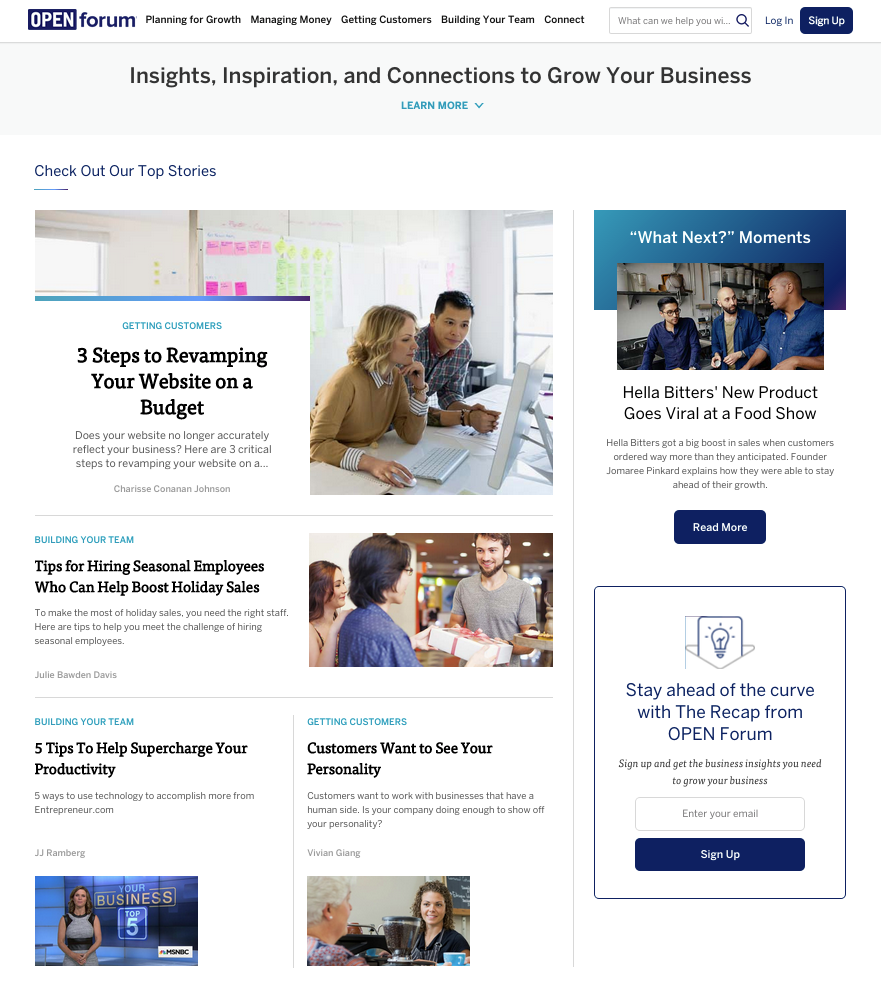
American Express is considered a pioneer of the content hub. Their hub, OPENforum, is filled with advice from experts to help small business owners thrive. Readers submit questions and get answers from the forum’s experts.
6 benefits of content hubs
It’s awfully hard to create a sustainable business today if you’re not pulling people into your website. It’s your main medium—your connection center.
Is your website magnetic? A value-packed content hub is your best bet for creating a digital media magnet.
Let’s examine the benefits:
1. Authority
Online buyers put their trust in authorities. Consistently publishing trustworthy content is a proven route to building thought leadership and is amongst the most important benefits of hosting a stellar content hub.
2. Visibility and traffic
Succeeding with search, the largest source of traffic on the web, calls for having great content. Search engines index billions of pages and are very good at determining the quality of content on them. If you want traffic, you need your content hub to be a collection of attractive pages.
3. Engagement
Your website could be ultra-magnetic, but not all that successful. Great sites do more than generate traffic; they inspire engagement. Content hubs foster engagement (as in reading, sharing, signing-up, trying, buying, attending, and so on) more than sales pages ever could—or can.
4. Control
Social networks are ever-changing and the changes don’t always benefit members who rely on them for content distribution. Traffic on your content hub is far more meaningful because you control the experience. You tailor the experience. Your objectives come first.
5. Leads
Content hubs enable you to generate leads and sales. When visitors find value in the information you offer, they’ll invest more time there. You’ll create opportunities to “feed the funnel” with tactics such as lead capture, progressive
profiling, and contextual calls-to-action (CTAs).
6. Marketing insights
Your content hub will give your company detailed analytics reports. The metrics you’ll gather inform your content creation team as to what does and doesn’t excite readers. With more insights into what users deem valuable, you’ll become a more effective publisher.
House a more appealing media mix
Your hub can be 100% blog-based, but a diverse media mix—from a variety of sources—will raise the bar and appeal to a wider range of media consumers.
A content hub is a flexible forum where you can publish whatever you like (or more importantly, whatever your audience likes). The media mix may include video, audio, infographics, slides, articles, papers, or any digital media.
Your hub centralizes all that you publish to provide its visitors a more interactive and valuable experience.
Content may be:
- Homegrown—Content produced by internal resources
- Curated—Content from companies or media sources you deem to be credible and authoritative.
- Social media—Content published on your hub and promoted via social media to drive traffic to your website.
- User-generated—Content created by customers and partners
- Advertising—Offers from your company and sponsors
Content hubs look sharp
Content hubs often take a cue from websites like ultra-popular mega-hubs on the social web such as Pinterest and SlideShare. They’re presented “tile style” or magazine-like.
They’re highly graphic with a simple structural form, which makes them easy on the eyes and easy to skim. Content hubs usually present social media share stats at a glance, which tends to promote sharing.
Create a publishing plan
Assess your prospects’ needs—The foundation of your editorial plan is to create content to deliver the answers to your prospects’ questions.
Examine the competition—Dive into the content your competition delivers to determine how you can do things better or differently.
Audit existing content—Closely review existing assets such as email, FAQs, presentations, webinars, RFPs, case studies, research, sales pages, and brochures. Look to find what might be revisited and turned into helpful articles, blog posts, infographics, videos, eBooks, podcasts, etc.
Tap search and social—Focus on things your target market does and says online. Try the following:
- Research search activity with the free Google Keyword Planner tool.
- Examine website data with Google Analytics.
- Look at questions posed on Q&A sites, online forums, and LinkedIn Groups.
- Conduct hashtag searches on relevant social media.
- Monitor conversations about your market on social networks and set up Google Alerts based on your important keywords.
- Consider changes soon to affect your industry.
Hire the right talent—Consider hiring a content strategist to take the lead and a managing editor. Hiring freelancers is a practical strategy to fill voids, round out the team and maintain a steady publishing schedule.
With a content hub, a single person with editorial skills may be capable of writing, editing and curating content to manage all your needs.
Design an attractive hub—Your content hub should be user-friendly and smartly branded. Bring a graphic design professional on board to give your content hub a branded look and feel and serve its audience well.
Create promotion plans—Make distribution and promotion part of your plan from the get-go considering paid, earned and owned channels.
Get the tools you need—To host a content hub, you’ll need a couple of tools:
- Content management system (CMS)—A CMS platform makes creating, publishing, optimizing and maintaining web pages simple. WordPress is by far the most popular CMS.
- A content hub manager—Scoop.it Content Director is the most affordable and simple platform I’ve discovered for delivering a turnkey approach for planning, sourcing, and distributing content.
Feeling like toast?
Every day thousands of companies join the content marketing parade and thousands more bail. Do you know why? They don’t have the resources to stay the course.
Like most, they understood if they consistently published the valuable content readers actually want to read, watch, listen to and look at, the content marketing dream would be realized. And like most, after awhile they’re toast. Burnt.
You don’t want to suffer the same fate.
Consider creating a content hub and populating it regularly not only with blog posts or homegrown content but with curated, user-generated, or co-created content.
About the Author: Barry Feldman operates Feldman Creative and provides clients with content marketing strategies that rock and creative that rolls.