 Sign In








 Ubersuggest
  AnswerThePublic
 The Search Marketing Forecasting Inputs That Matter Most
Info
-
Source: NP Digital
-
Date: June 2026
-
Category: Measurement & Strategy
-
Study Methodology: Predictability and forecast impact rated 1-5 by surveyed marketing teams. Total survey size was 210 marketers.
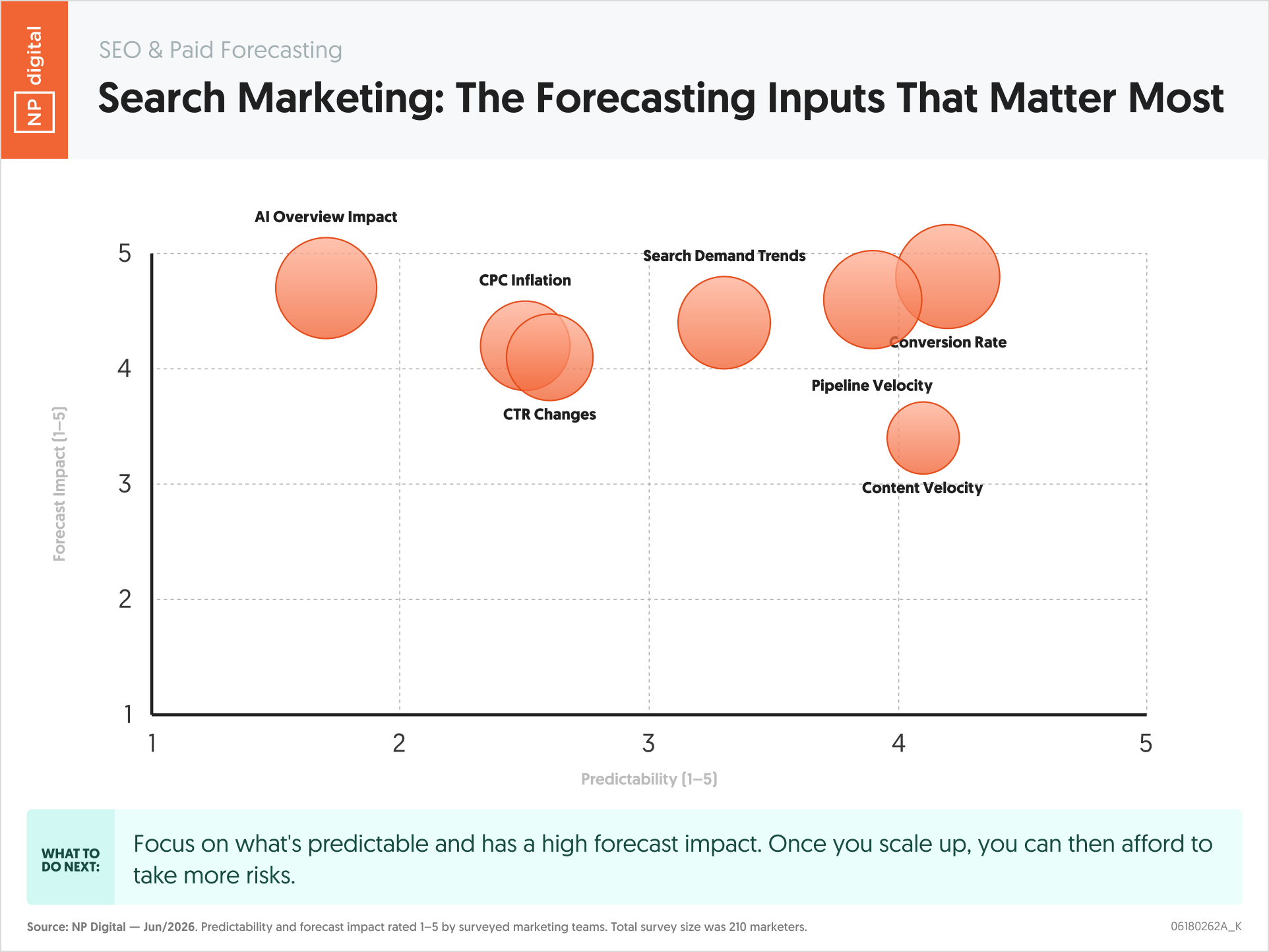
Not all forecasting inputs deserve equal attention. This bubble chart from 210 marketing teams maps eight search marketing inputs against two dimensions: forecast impact on the vertical axis and predictability on the horizontal. The most valuable inputs are those that are both high-impact and predictable. The data reveals that search demand trends and conversion rate sit in that ideal zone, while AI Overview impact and CPC inflation carry high impact but low predictability, requiring different treatment in any responsible forecast model.
Essential Statistics
- Search demand trends scores approximately 4.8 on forecast impact and 3.2 on predictability, placing it in the high-impact, moderate-predictability zone.
- Conversion rate scores approximately 4.5 on forecast impact and 4.0 on predictability, the closest input to the high-impact, high-predictability ideal in the dataset.
- AI Overview impact scores approximately 4.8 on forecast impact and 1.8 on predictability, the highest impact but lowest predictability input in the dataset.
- CPC inflation scores approximately 4.2 on forecast impact and 2.5 on predictability, indicating high impact but only moderate predictability.
- CTR changes score approximately 4.0 on forecast impact and 2.7 on predictability, adjacent to CPC inflation in the impact-predictability space.
- Pipeline velocity and content velocity score in the moderate impact range at approximately 3.5 and 3.0 respectively, both at higher predictability levels around 4.0.
Key Takeaways
- Conversion rate sitting in the high-impact, high-predictability zone is the most directly actionable finding. Unlike AI Overview impact or CPC inflation, conversion rate can be modeled from historical data with reasonable confidence and has a large direct effect on forecast outcomes. Teams that do not track conversion rate by channel and traffic source are missing the most predictable high-impact variable available to them.
- AI Overview impact being the highest-impact and lowest-predictability input in the dataset is the defining forecasting challenge of the current environment. This input cannot be modeled with precision because AI Overview expansion rate, query type coverage, and CTR effects on specific keyword portfolios are all subject to rapid change. The appropriate response is scenario modeling rather than point estimates for any forecast heavily dependent on AI Overview-affected traffic.
- CPC inflation and CTR changes clustering together in the moderate-predictability, high-impact zone confirms what the paid media forecast failure data shows: these two inputs are the primary drivers of paid forecast inaccuracy because they carry large impact but limited predictability from historical data alone.
- Pipeline velocity and content velocity at moderate impact and high predictability represent underutilized inputs in many forecast models. These variables can be estimated with reasonable confidence and improve pipeline-level forecast accuracy when included, even though they are lower impact than the top-tier inputs.
- The bubble size in the chart, though not explicitly quantified, appears to reflect the relative importance weighting of each input. The largest bubbles cluster around search demand, conversion rate, and AI Overview impact, confirming that these three inputs drive the most forecast variance and deserve the most modeling attention.
Actionable Insights
- Build your forecast foundation on the two highest-impact, highest-predictability inputs: conversion rate and search demand trends. These inputs offer the best combination of forecast influence and modeling confidence. A forecast model anchored to well-measured conversion rates and demand trend data will outperform one built primarily around lower-predictability inputs like AI Overview impact or CPC inflation, because the foundation is stable even when other variables are volatile.
- Treat AI Overview impact as a scenario variable rather than a point estimate input. Its position as the highest-impact, lowest-predictability input means that any forecast assigning a precise AI Overview impact number is introducing false precision into the model. Build three AI Overview impact scenarios, low expansion, expected expansion, and aggressive expansion, and model their revenue implications separately rather than averaging them into a single blended estimate.
- Track conversion rate by traffic source at a granular enough level to feed your forecast model with source-specific conversion rates rather than blended site averages. The high predictability of conversion rate as a forecast input assumes you are tracking it accurately. A blended site conversion rate obscures the significant differences between AI-referred traffic at 5.97 percent and educational blog traffic at 0.2 percent that the companion data in this batch reveals. Source-specific conversion rates produce more accurate forecasts than site averages.
- Add AI Overview trigger rate to your forecast as a leading indicator for CTR change impact. AI Overview trigger rate is more predictable at the category and keyword level than its overall impact on traffic, because you can measure which of your top queries currently trigger AI Overviews and model CTR reduction from there. This converts the low-predictability AI Overview impact input into a series of more tractable, query-level calculations that improve overall forecast accuracy.
- Review your forecast for inputs that are currently missing from the model and rank them by the impact-predictability scores in this chart before deciding which to add first. Most forecast models include CPC and traffic but exclude conversion rate by source, AI Overview trigger rate, and search demand trend signals. Adding the highest-impact, highest-predictability missing input first produces the greatest accuracy improvement per unit of modeling effort.
“Conversion rate is high impact and high predictability. AI Overview impact is high impact and low predictability. Those two facts define your forecasting strategy. Anchor your model on conversion rate data you can measure with confidence, and treat AI Overview impact as a scenario variable you model in ranges rather than a point estimate you model as a fixed assumption.” – Neil Patel