 Sign In




Forecast Accuracy Drops as AI Overviews and Zero-Click Rates Rise
Info
-
Source: NP Digital
-
Date: June 2026
-
Category: Measurement & Strategy
-
Study Methodology: Data from Sparktoro, Ubersuggest, NP Digital, TechCrunch, Search Engine Journal, and Ahrefs. Forecasting data from 210 businesses.
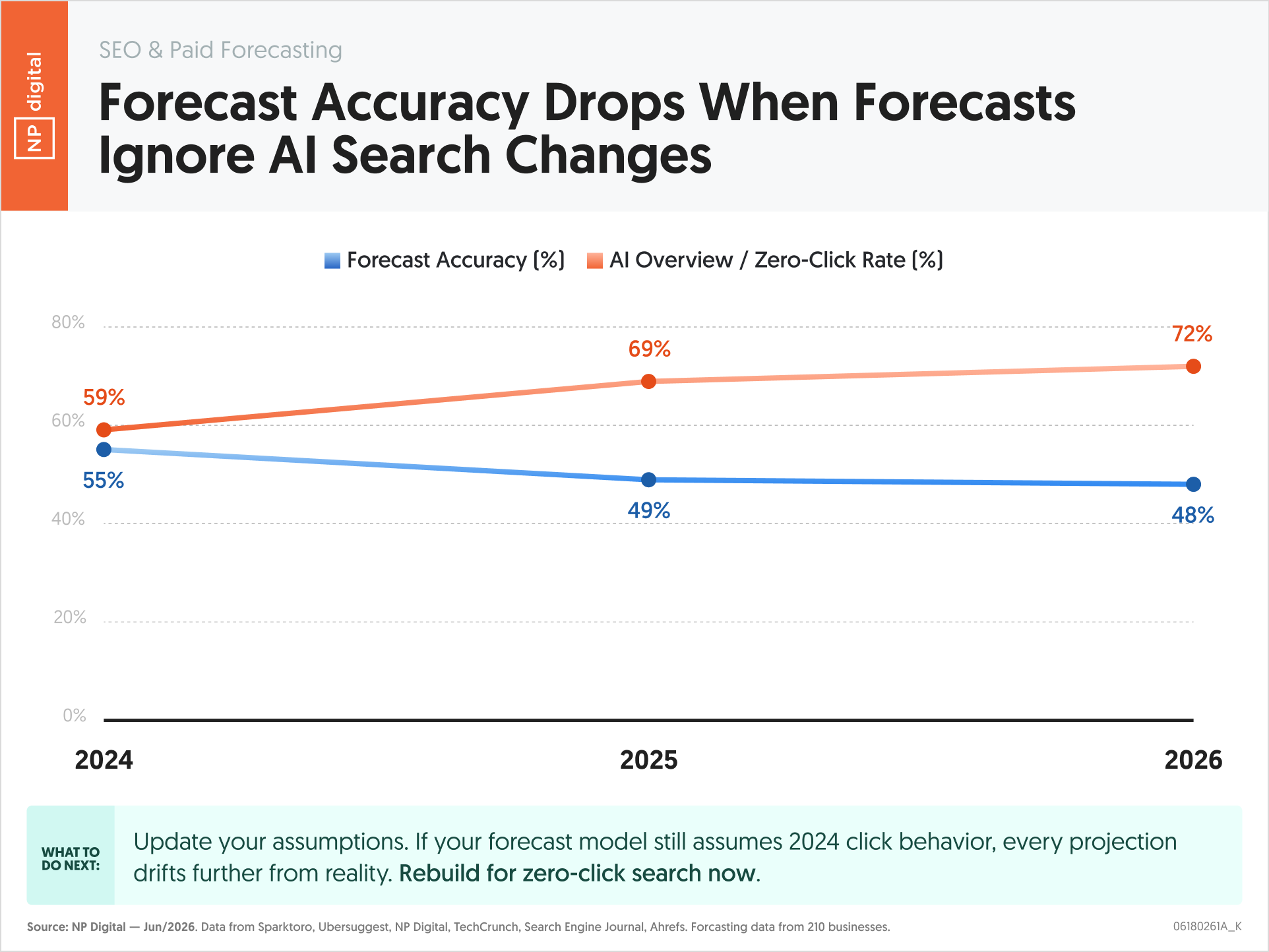
Marketing forecasts built on 2024 assumptions are becoming less accurate every quarter. This chart from 210 businesses tracks two converging lines: forecast accuracy declining from 55 percent to 48 percent, and the AI Overview and zero-click rate rising from 59 percent to 72 percent. The inverse relationship is direct. As more search queries resolve without a click, forecasts that assume 2024-era click behavior produce projections that diverge further from reality. The model is not broken. The assumptions feeding the model are.
Essential Statistics
- Forecast accuracy among 210 businesses stood at 55 percent in 2024, meaning the average forecast landed within 10 percent of actual revenue slightly more than half the time.
- Forecast accuracy declined to 49 percent in 2025 and 48 percent in 2026, a 7-point decline over two years.
- The AI Overview and zero-click rate was 59 percent in 2024, meaning nearly 6 in 10 search queries already resolved without a click at that point.
- The zero-click rate rose to 69 percent in 2025 and 72 percent in 2026, an increase of 13 percentage points over the same period.
- The inverse relationship between the two lines confirms that forecast accuracy declines as zero-click rates rise, with the two trends moving in opposite directions at a consistent pace across the three years measured.
Key Takeaways
- The core problem this chart identifies is an assumption gap, not a data gap. The 210 businesses in this dataset have access to the same information as high-performing forecasters. The ones with declining accuracy are applying click-behavior assumptions from a search environment that no longer matches current reality.
- A 72 percent zero-click rate in 2026 means that the relationship between search impressions and website sessions that most forecast models were calibrated against has fundamentally changed. A forecast model that projects traffic from impression share using 2024 CTR rates will overshoot actual traffic because those CTR rates no longer hold when 72 percent of queries resolve without a click.
- The 48 percent accuracy rate in 2026 means the average forecast in this dataset misses actual revenue by more than 10 percent more than half the time. That accuracy level is below the threshold needed for reliable planning. Budget decisions made on forecasts this inaccurate are systematically biased toward the assumptions that no longer reflect current search behavior.
- The fact that accuracy was already only 55 percent in 2024 confirms that even before significant AI Overview expansion, click-behavior-based forecasting was an imprecise foundation. The AI Overview expansion has accelerated a problem that already existed rather than creating a new one.
- The trend line shows no sign of reversing. The zero-click rate is not plateauing at 72 percent in available data, and forecast accuracy has not begun recovering. Teams that rebuild their forecast models around zero-click assumptions now will avoid additional accuracy erosion as AI Overview coverage continues to expand.
Actionable Insights
- Audit every assumption in your current traffic forecast that is based on a CTR rate and replace it with a CTR rate adjusted for your current AI Overview trigger rate. The mechanism driving forecast inaccuracy is straightforward: if 72 percent of queries resolve without a click, applying a pre-AI Overview CTR of 3 to 5 percent to your impression estimates will overproject traffic by a significant margin. Use the AI Overview trigger rate data from your specific category to build an adjusted CTR assumption before building any forward-looking traffic projection.
- Add zero-click rate as a standing input variable in your SEO forecast model rather than treating it as a fixed assumption. The data shows the zero-click rate changing from 59 percent to 72 percent in two years. A forecast model that hardcodes click behavior assumptions will drift further from accuracy with each percentage point increase in zero-click rate. Building zero-click rate as an adjustable variable with a quarterly review creates the self-correcting mechanism that prevents compounding accuracy loss.
- Shift your SEO forecast KPI from organic sessions to organic revenue contribution to reduce the impact of zero-click rate changes on forecast accuracy. A session-based forecast breaks when CTR assumptions change. A revenue-based forecast, anchored to conversion rates and average transaction value, is more resilient to search behavior changes because it focuses on the traffic that does click and convert rather than modeling total click volume. This approach also aligns with the leadership KPI shift from organic traffic to pipeline and revenue contribution identified in this batch.
- Test your current forecast model against the last three quarters of actuals using the forecasting approach you currently use. Calculate your own accuracy rate using the same definition in this chart: what percentage of your forecasts landed within plus or minus 10 percent of actual revenue. If your accuracy rate is below 60 percent, the gap is large enough to justify a full forecast methodology review rather than incremental adjustments.
- Rebuild any forecast with a horizon longer than 90 days using zero-click rate scenarios rather than point estimates. The two-year trend shows zero-click rates rising consistently, which means any forecast assuming current zero-click rates will be too optimistic about traffic by the end of a 12-month forecast horizon. A scenario range that models 72 percent current, 78 percent expected, and 84 percent adverse zero-click rates gives you the planning flexibility to make budget decisions that remain valid across a range of AI Overview expansion outcomes.
“Forecast accuracy is at 48 percent while zero-click rates are at 72 percent and rising. Those two trends are connected. Every time the zero-click rate ticks up, a forecast model built on 2024 click behavior gets less accurate. The fix is not better data. It is updated assumptions. Rebuild your forecast model for zero-click search now, before the gap widens further.” – Neil Patel