 Sign In






 Ubersuggest
  AnswerThePublic
 What’s Stopping You From Optimizing Conversion Rates?
Info
-
Source: NP Digital
-
Date: July 2026
-
Category: Measurement & Strategy
-
Study Methodology: Surveyed 300 companies to see what they struggle with most in CRO. Self-reported barrier selection.
Most companies know their conversion rate needs work. What stops them is rarely a lack of will. This survey of 300 companies identifies the organizational barriers that get in the way of CRO in practice, and the results show a clear pattern: the biggest obstacles are internal, not technical. Resources, buy-in, and expertise account for nearly 80 percent of reported barriers, while technology, the factor most often cited as the reason for poor testing, ranks last.
Essential Statistics
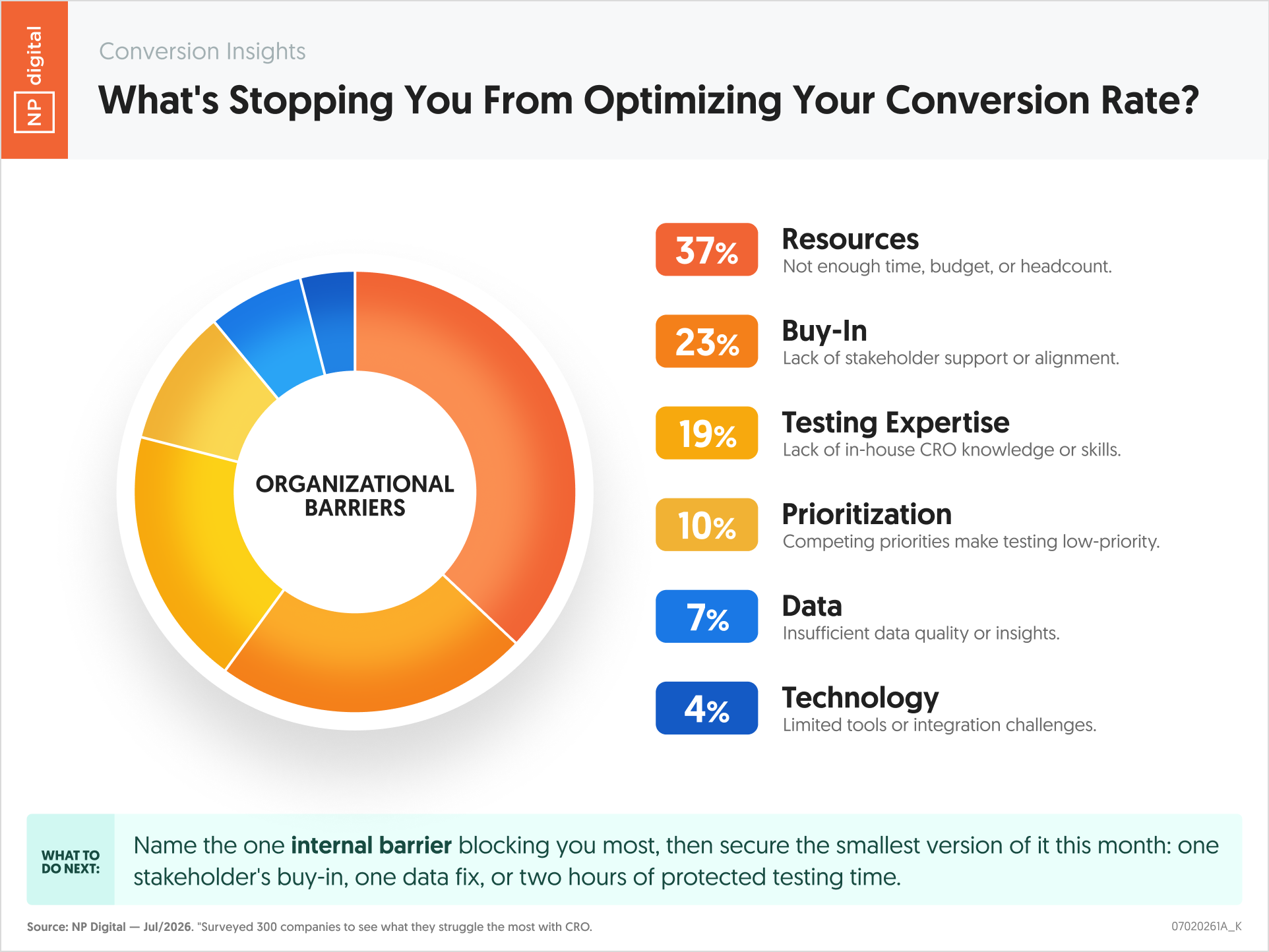
- Resources, defined as insufficient time, budget, or headcount, are cited by 37 percent of companies as their primary CRO barrier, the top-ranked obstacle in the dataset.
- Buy-in, defined as lack of stakeholder support or alignment, accounts for 23 percent of reported barriers.
- Testing expertise, defined as insufficient in-house CRO knowledge or skills, represents 19 percent of barriers.
- Prioritization, defined as competing priorities making testing low-priority, accounts for 10 percent.
- Data quality issues account for 7 percent and technology limitations for only 4 percent of reported barriers.
- The top three barriers, resources, buy-in, and expertise, together account for 79 percent of all reported CRO obstacles.
Key Takeaways
- Resources leading at 37 percent reflects a common pattern in CRO investment: testing programs are treated as discretionary rather than foundational, which means they are the first thing cut when budgets or headcount are constrained. This framing is what keeps most companies stuck at occasional testing rather than structured programs.
- Buy-in at 23 percent reveals that CRO is not a leadership priority in some situations. Without stakeholder alignment, testing programs lack the political support to survive organizational friction, failed tests, or resource competition from other initiatives.
- Testing expertise at 19 percent is the most directly solvable barrier in the list. Unlike resource or buy-in problems, skills gaps can be addressed through hiring, training, or agency partnerships without requiring organizational change.
- Technology ranking last at 4 percent directly contradicts the common assumption that better tools are the primary barrier to CRO progress. Most companies have access to sufficient testing technology. The barriers that actually stop progress are organizational, not technical.
- The 7 percent data quality barrier suggests that while data problems exist, they are a secondary issue for most teams. Data quality becomes a bottleneck only after the higher-ranked organizational barriers are addressed.
Actionable Insights
- Reframe CRO investment as a revenue protection argument rather than a marketing expense. Presenting leadership with a revenue-per-conversion-rate-point calculation, based on your current traffic volume and average order or deal value, converts the resource conversation from a cost discussion to a return discussion.
- Secure buy-in by starting with a test that solves a problem leadership already cares about. Demonstrate value on a priority that leadership already owns, rather than asking for support for a new CRO initiative from scratch. Find a page or funnel stage that leadership is actively concerned about and run your first test there.
- Address the expertise gap with a structured skills audit before hiring or outsourcing. TTesting expertise is the third-largest barrier and the most controllable one. Map your current team’s capabilities against the skills required for your target testing cadence, then decide whether to build internally or bring in external capability based on the specific gaps identified.
- Protect testing time by building it into sprint or project structures rather than treating it as ad hoc work. Even two hours per week per team member dedicated specifically to testing hypothesis development and analysis maintains program momentum better than larger but irregular blocks of time.
- Do not invest in new testing technology before addressing the higher-ranked barriers. If your team lacks the time, skills, or stakeholder support to run tests, adding a new tool will not produce better outcomes. Solve the organizational barriers first, then evaluate whether your current technology stack is adequate.
”Resources and buy-in together account for 60 percent of CRO barriers. Those are not technology problems. They are organizational problems that require organizational solutions. Fix how CRO is positioned internally before spending another dollar on testing tools.” – Neil Patel’