 Sign In









AI vs Human Content: Which Performs Better on Social?
Info
-
Source: NP Digital
-
Date: August 2026
-
Category: AI-Generated Content
-
Study Methodology: Data from surveying 100 companies. Numbers rounded for clarity.
Social platforms are full of AI-generated posts now, but volume and engagement aren’t moving in the same direction. A survey of 100 companies compared AI-generated, AI-modified, and human-generated content across likes, shares, and saves. Human-generated content makes up the smallest share of what companies publish, yet it consistently pulls ahead on nearly every engagement metric measured. That mismatch is worth sitting with if your social strategy has leaned into AI-first publishing.
Essential Statistics
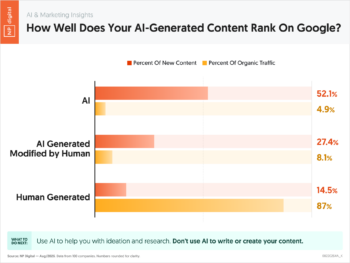
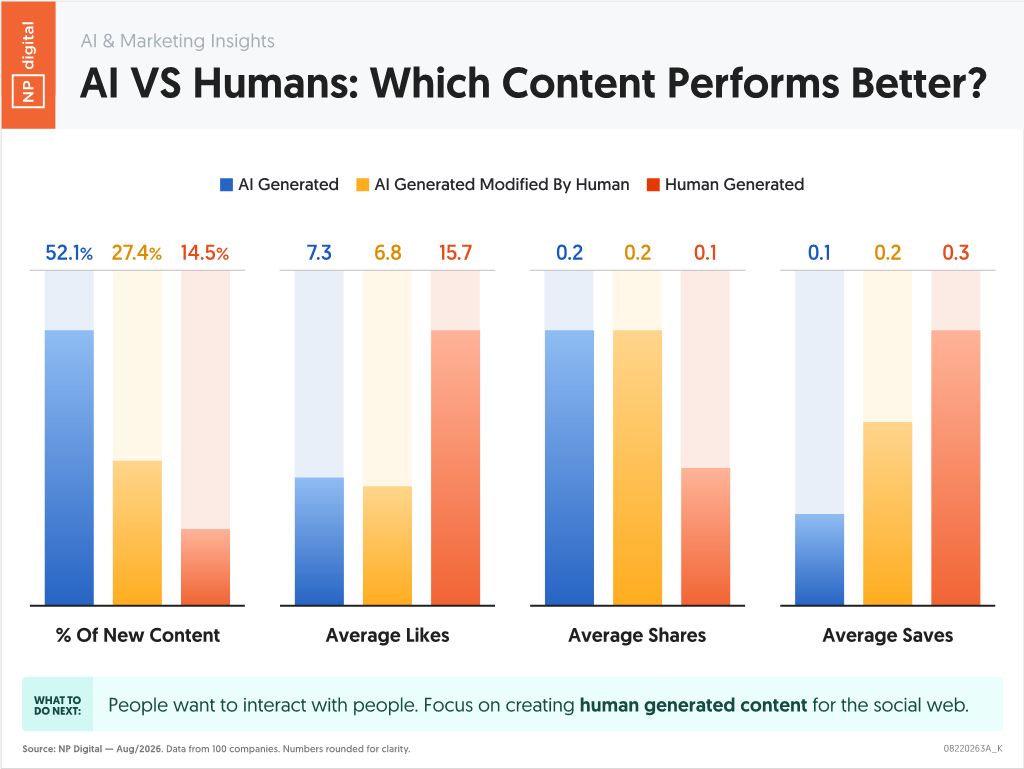
- AI-generated content accounts for 52.1% of new content published, the largest share of any type.
- Human-generated content accounts for only 14.5% of new content, the smallest share, yet averages 15.7 likes per post, more than double the AI-generated average of 7.3.
- AI-generated content modified by a human averages 6.8 likes per post, slightly below fully AI-generated content.
- Average shares are close across all three content types, with AI-generated and AI-modified content both at 0.2 and human-generated content slightly lower at 0.1.
- Human-generated content leads in average saves at 0.3, ahead of AI-modified content at 0.2 and AI-generated content at 0.1.
Key Takeaways
- Human-generated content earning more than double the average likes despite representing the smallest share of published content suggests engagement quality, not publishing volume, is what’s actually driving results here.
- AI-modified content underperforming fully AI-generated content on likes is a somewhat counterintuitive result and suggests light human editing alone may not be enough to close the engagement gap on social platforms.
- Shares staying roughly flat across all three content types suggests format origin has less influence on share behavior than it does on likes or saves.
- Human-generated content leading in saves suggests audiences may see it as more worth returning to, which is a meaningful signal for content meant to build longer-term brand affinity.
- The gap between publishing share and engagement share for human content suggests brands may be underinvesting in the format that performs best on the platforms where this data was collected.
Actionable Insights
- Compare your own social content performance by content origin, AI-generated, AI-modified, and human-generated, over the next reporting period. If you see a similar engagement gap favoring human content, that’s worth using to rebalance your content mix.
- Don’t assume AI-modified content automatically outperforms fully AI-generated content. This data suggests a light editing pass isn’t consistently enough to boost likes, so treat editing depth, not just editing presence, as the variable to test.
- Increase the share of human-generated posts in your social calendar, particularly for content meant to drive saves, since this format leads there by a clear margin in this data.
- Use engagement metrics beyond likes, particularly saves, when evaluating whether AI content is actually working on social. Saves may be a better indicator of content that resonates rather than content that simply gets seen.
- Reserve AI-generated content for higher-volume, lower-stakes social posts rather than your primary engagement-driving content, given how consistently human-generated posts outperform it here.
People want to interact with people, not with a caption generator. If your best-performing content is human-made and you’re publishing the least of it, that’s backwards. – Neil Patel