 Sign In






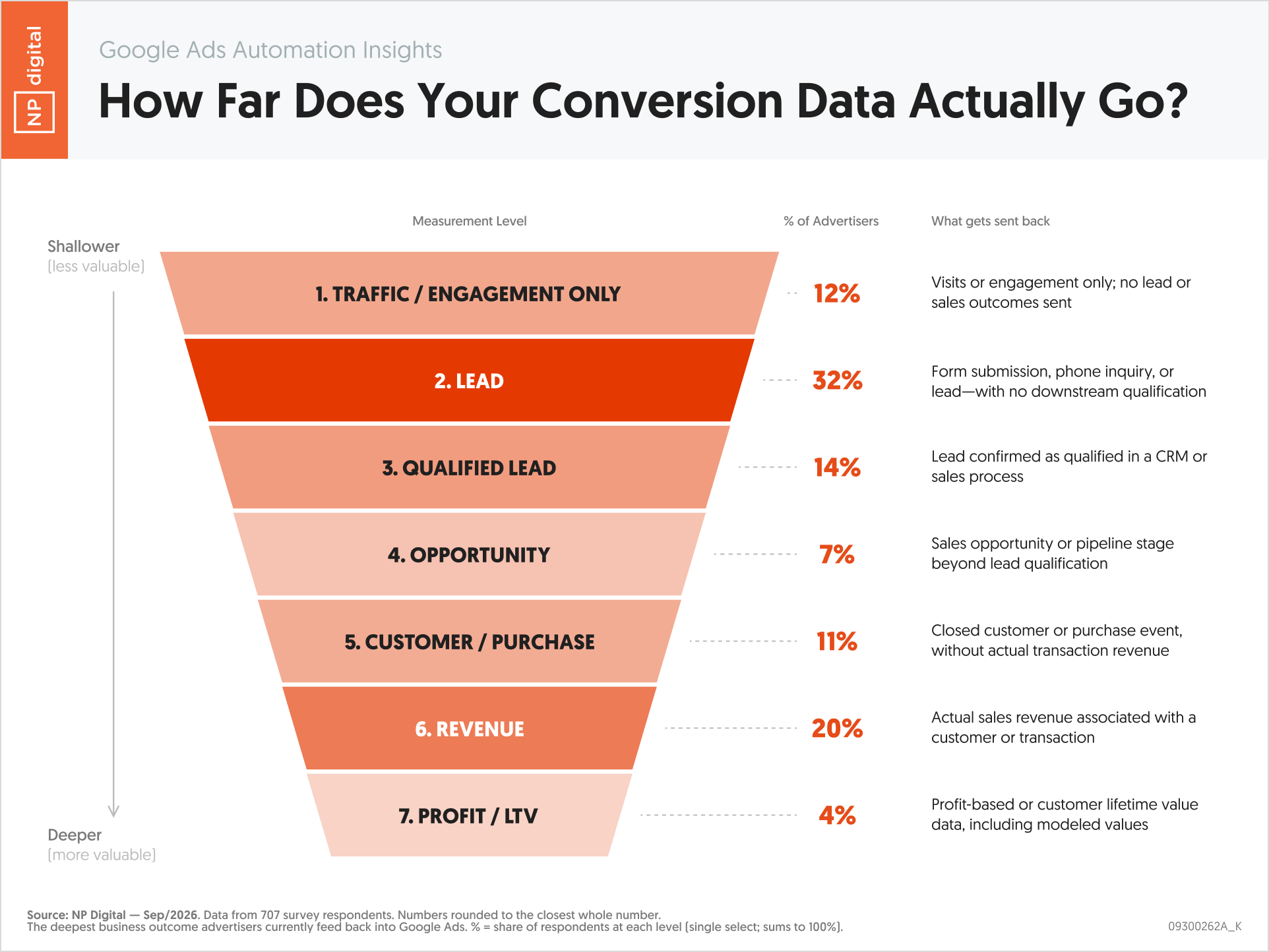
How Far Does Your Conversion Data Actually Go?
Info
-
Source: NP Digital
-
Date: September 2026
-
Category: Paid Ads
-
Study Methodology: Data from 707 survey respondents. The deepest business outcome advertisers currently feed back into Google Ads.
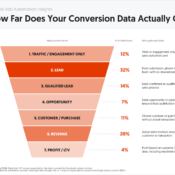
The value of automation in Google Ads depends heavily on how far downstream the conversion data feeding it actually goes, and for most advertisers, that data doesn’t go very far. A survey of 707 marketers found that nearly a third stop at the lead stage, sending no qualification data back to Google at all. Only a small share connect automation all the way to revenue or profit, the data that would actually tell the system what a good outcome looks like.
Essential Statistics
- 12% of advertisers feed back only traffic or engagement data, with no lead or sales outcomes sent.
- 32% feed back lead-level data only, with no downstream qualification.
- 14% feed back qualified lead data confirmed in a CRM or sales process.
- 20% feed back actual sales revenue associated with a customer or transaction.
- Only 4% feed back profit-based or customer lifetime value data, the deepest level measured.
Key Takeaways
- Nearly a third of advertisers stopping at raw lead data suggests a large share of automated bidding systems are optimizing toward a signal that doesn’t actually reflect business value.
- Only 4% reaching profit or lifetime value data suggests most advertisers haven’t connected their ad platform to the metrics that matter most for long-term growth.
- The drop-off between qualified leads and actual revenue suggests a meaningful data gap exists between marketing and sales systems at many organizations.
- Twenty percent reaching the revenue level is a meaningful improvement over lead-only tracking, but it still falls short of profit-based optimization.
- This pattern suggests closing the gap between ad platform data and actual business outcomes may be one of the higher-leverage improvements available to most advertisers right now.
Actionable Insights
- If your organization currently sends only lead or traffic data back to Google Ads, prioritize connecting at least qualified lead or sales data next, since this represents the single most common gap in this data.
- Work with your sales or CRM team to pass qualified lead and revenue data back into your ad platform’s conversion tracking, since this connection is what allows automated bidding to optimize toward outcomes that actually matter.
- If you’ve already connected revenue data, consider the additional step of feeding back profit or lifetime value data, since very few advertisers have reached this level and it could represent a real competitive edge.
- Audit your current conversion data setup against these six levels to identify exactly where your organization sits and what the next achievable step would be.
- Treat deepening your conversion data pipeline as an ongoing priority rather than a one-time project, since automated systems can only optimize as well as the data they’re given.
‘If all Google Ads knows is that someone filled out a form, that’s all it’s going to optimize for. Feed it revenue, and it starts working for your business instead of just your form count.’ – Neil Patel