 Sign In







Which Customer Questions Do Larger Competitors Answer Poorly?
Info
-
Source: NP Digital
-
Date: October 2026
-
Category: Brand & Reputation
-
Study Methodology: Data from 812 survey respondents. % rating how well the largest brands in their category answer each question type.
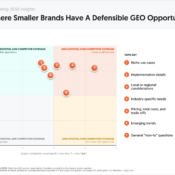
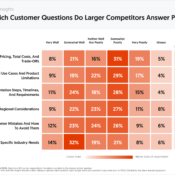
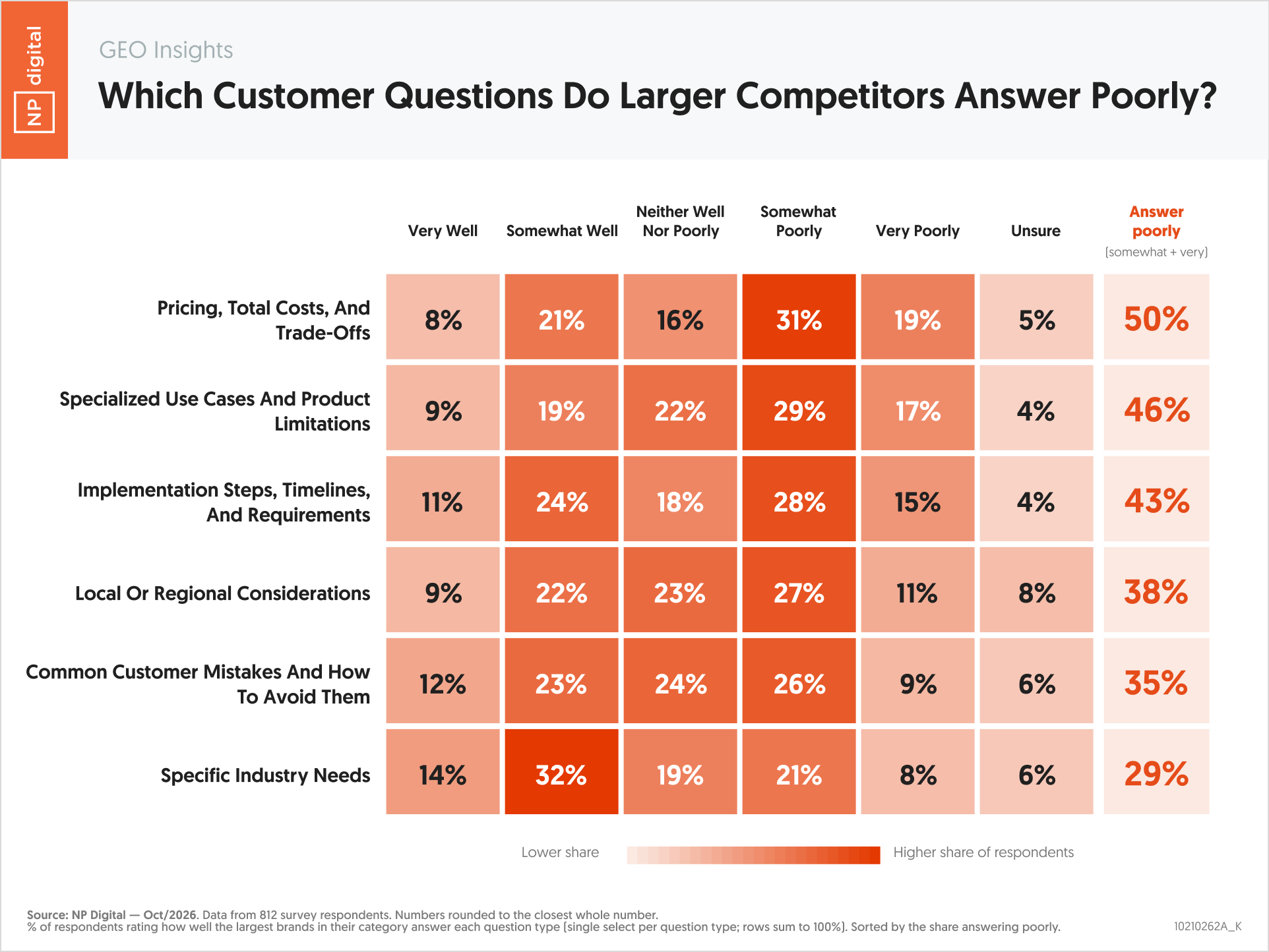
Larger competitors aren’t equally strong across every type of customer question, and a survey of 812 marketers pinpoints exactly where they fall short. Half of respondents say the largest brands in their category answer pricing, total costs, and trade-off questions poorly, the weakest performance of any question type measured. Specific industry needs, by contrast, see the strongest performance from larger competitors.
Essential Statistics
- 50% of marketers say larger competitors answer pricing, total costs, and trade-off questions poorly, the highest poor-performance rate measured.
- 46% say the same about specialized use cases and product limitations.
- 43% say the same about implementation steps, timelines, and requirements.
- 38% say the same about local or regional considerations.
- Only 29% say the same about specific industry needs, the lowest poor-performance rate, where 32% instead rate larger competitors as answering somewhat well.
Key Takeaways
- Pricing and trade-off questions showing the weakest performance from larger competitors suggests transparency around cost and value remains a significant, specific gap smaller brands can target directly.
- Specialized use cases and product limitations ranking second suggests larger, broader-market players may struggle to address edge cases that smaller, more focused brands handle routinely.
- Implementation steps and timelines also scoring poorly suggests practical, how-it-actually-works content remains an underserved area even from established competitors.
- Specific industry needs showing the strongest performance from larger competitors suggests this is an area where size and resources may genuinely give bigger brands an edge, making it a tougher area for smaller brands to win.
- This pattern suggests smaller brands have a clear, data-backed shortlist of question types where filling the gap left by larger competitors is most achievable.
Actionable Insights
- Create detailed, transparent pricing and trade-off content, since this is the question type larger competitors handle most poorly according to this data.
- Publish content specifically addressing specialized use cases and known product limitations, since this ranks as the second weakest area for larger competitors.
- Build detailed implementation guides covering timelines, steps, and requirements, since this is another area where larger competitors underperform according to this data.
- Be cautious about trying to out-compete larger brands on specific industry-need content, since this is the one area where they’re rated as performing comparatively well.
- Use this ranking to prioritize your content roadmap, starting with pricing transparency and specialized use cases before tackling areas where larger competitors already perform reasonably well.
‘Big brands are bad at pricing honesty and edge cases. That’s not an accident, it’s a side effect of serving everyone. Smaller brands can own both of those gaps directly.’ – Neil Patel