 Sign In



Where Consumers Turn At Each Stage Of The Buying Journey
Info
-
Source: NP Digital
-
Date: October 2026
-
Category: Ecomm & User Behavior
-
Study Methodology: Data from 983 survey respondents. % of consumers likely to use each platform at each stage of researching a purchase; columns exceed 100%.
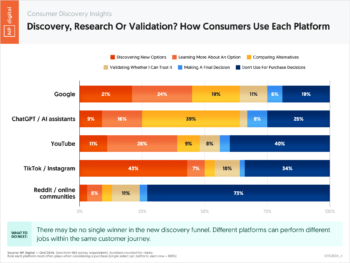
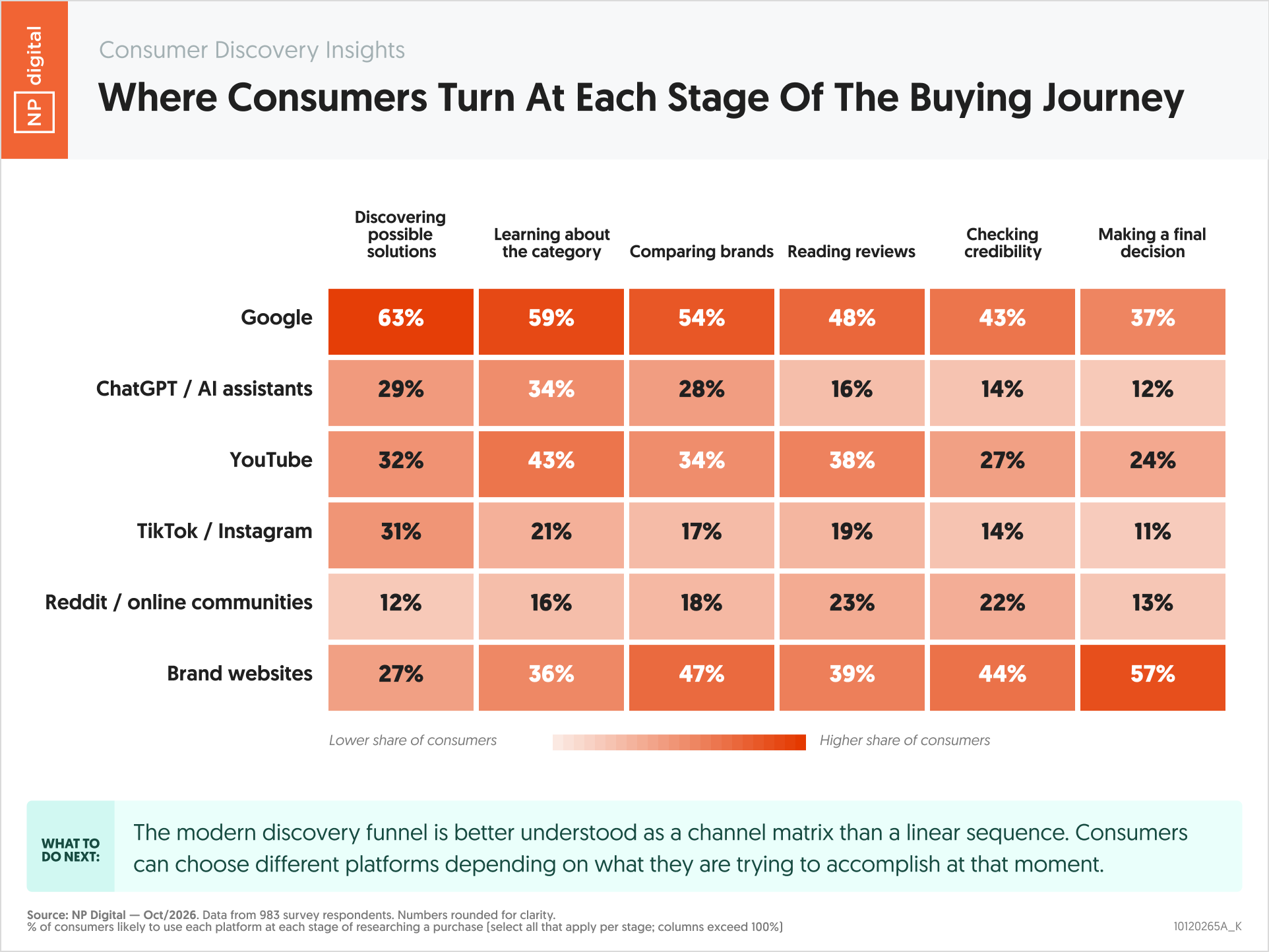
Consumers don’t use the same platform the same way at every stage of a purchase decision, and a survey of 983 consumers maps out exactly how that usage shifts. Google leads at nearly every single stage, but its dominance shrinks steadily from discovery through to final decision, while brand websites show the opposite pattern, growing in relevance as the decision gets closer. ChatGPT and other AI assistants peak specifically during the category-learning stage rather than at the very start or the very end.
Essential Statistics
- 63% of consumers use Google when discovering possible solutions, its highest share across any stage.
- 57% use brand websites when making a final decision, the highest share for that platform.
- 34% use ChatGPT or AI assistants when learning about a category, the highest share for that platform across any stage.
- Google’s share declines steadily from 63% at discovery to 37% at final decision, a 26-point drop across the journey.
- TikTok and Instagram peak at the discovery stage at 31% and fall to 11% by the final decision stage.
Key Takeaways
- Google’s steady decline from discovery to decision suggests its role shifts from primary research tool to one input among several as a purchase gets closer to being finalized.
- Brand websites growing in relevance toward the final decision stage suggests these are functioning as a trust and confirmation checkpoint rather than a discovery tool.
- ChatGPT and AI assistants peaking specifically at the category-learning stage suggests consumers see these tools as especially useful for understanding a space, more than for final comparison or decision-making.
- TikTok and Instagram’s sharp decline from discovery to decision suggests these platforms play a strictly top-of-funnel role in the purchase journey.
- This pattern suggests the modern discovery funnel is better understood as a channel matrix than a straight line, with different platforms doing different jobs at different moments.
Actionable Insights
- Invest in Google visibility specifically for early-stage, discovery-oriented content, since this is where it shows its strongest relative advantage over other platforms.
- Strengthen your brand website’s final-decision content, like detailed product information, guarantees, and trust signals, since this is where website relevance peaks in this data.
- Create category-education content optimized for AI assistants specifically, since this is the stage where ChatGPT and similar tools show their highest usage.
- Treat TikTok and Instagram as top-of-funnel discovery tools and avoid over-investing in them for bottom-of-funnel conversion content, given their sharp decline by the final decision stage.
- Map your own content and channel investment against this stage-by-stage breakdown to ensure you’re matching the right platform to the right moment in the journey rather than using one channel strategy throughout.
‘Google wins at the start and fades by the end. Your website does the opposite. If you’re using the same channel strategy at every stage, you’re fighting the data.’ – Neil Patel