 Sign In







Where Smaller Brands Have A Defensible GEO Opportunity
Info
-
Source: NP Digital
-
Date: October 2026
-
Category: AI & GEO Optimization
-
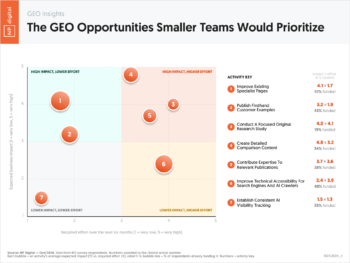
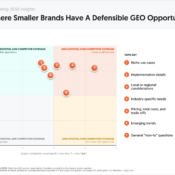
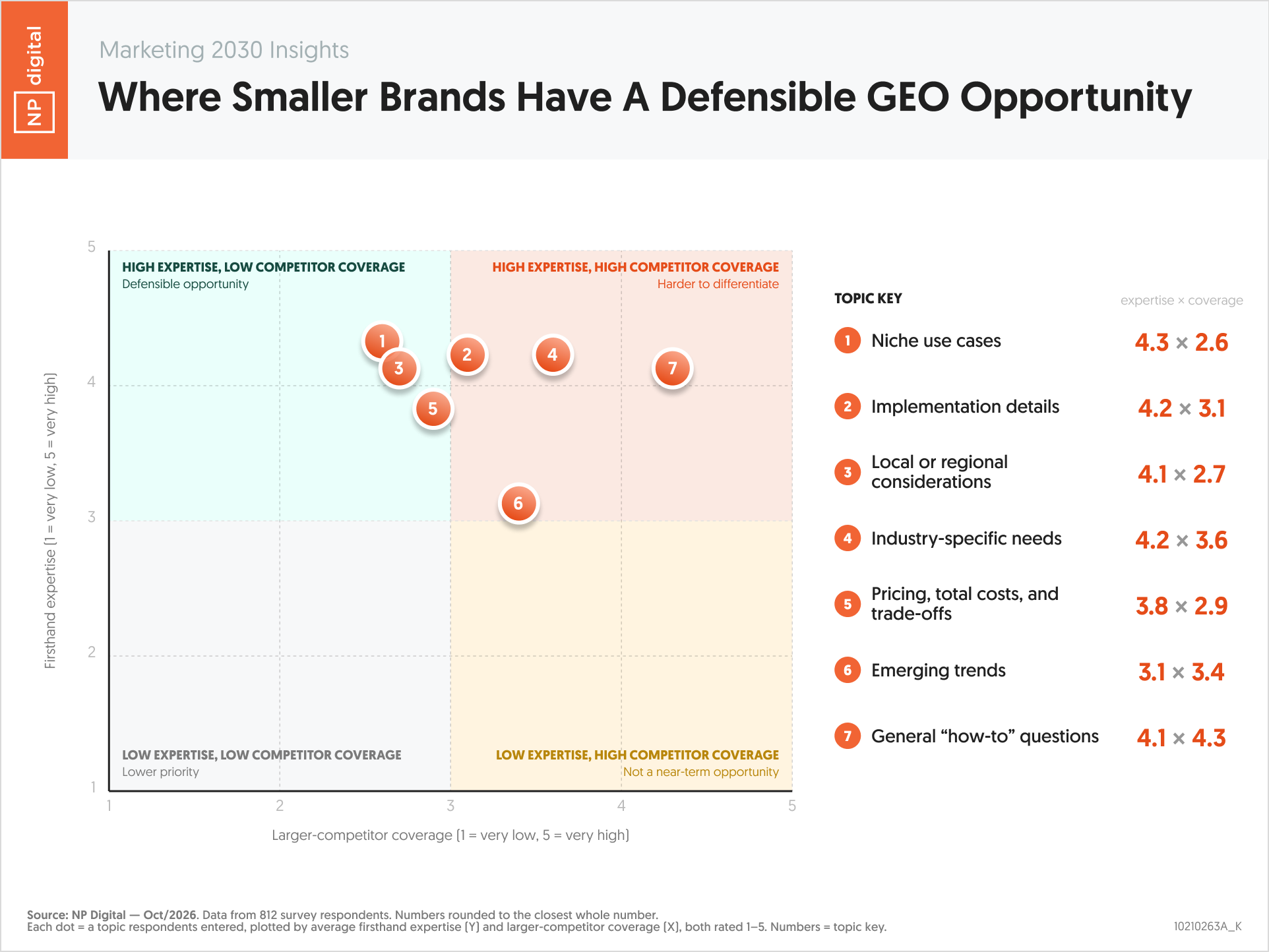
Study Methodology: Data from 812 survey respondents. Each dot represents a topic plotted by average firsthand expertise and larger-competitor coverage, both rated 1 to 5.
Not every topic where a smaller brand has deep expertise is actually worth fighting for, since some of those topics are already heavily covered by larger competitors too. A survey of 812 marketers plotted seven topic types by firsthand expertise versus how much coverage larger competitors already have, and niche use cases stand out as the clearest defensible opportunity, combining high expertise with low competitor coverage. General how-to questions sit at the opposite extreme, well covered by competitors despite still scoring reasonably high on expertise.
Essential Statistics
- Niche use cases score 4.3 in firsthand expertise against only 2.6 in larger-competitor coverage, the clearest high-expertise, low-coverage combination measured.
- Local or regional considerations score 4.1 in expertise against 2.7 in competitor coverage, also landing in the defensible opportunity zone.
- Implementation details score 4.2 in expertise against 3.1 in competitor coverage, sitting just at the edge of the defensible zone.
- General how-to questions score 4.1 in expertise but 4.3 in competitor coverage, the highest competitor coverage of any topic measured.
- Emerging trends score lowest in expertise at 3.1, against a moderate 3.4 in competitor coverage.
Key Takeaways
- Niche use cases combining the highest expertise with the lowest competitor coverage suggests this is the clearest, most defensible opportunity for smaller brands to claim authority.
- Local and regional considerations landing in a similar zone suggests geographic specificity remains an underexploited advantage for smaller, more localized brands.
- General how-to questions showing both solid expertise and the highest competitor coverage suggests this topic area is already crowded, making it a harder space to stand out in regardless of expertise level.
- Emerging trends scoring lowest in expertise suggests smaller brands may feel less equipped to speak authoritatively on newer, less established topics.
- This mapping suggests smaller brands should prioritize topics where their expertise is strong and competitor coverage is thin, rather than chasing topics where competitors already dominate regardless of their own capability there.
Actionable Insights
- Prioritize content around niche use cases specific to your product or service, since this combination of high expertise and low competitor coverage represents the clearest defensible opportunity in this data.
- Build out local or regional content if that’s relevant to your business, since this topic area also lands in the high-expertise, low-coverage zone.
- Approach implementation details carefully, since this topic sits near the edge of the defensible zone and may require closer monitoring of competitor activity over time.
- Deprioritize general how-to content unless you can bring something genuinely differentiated, since this topic shows the highest competitor coverage of any area measured, making it the hardest to stand out in.
- Use this expertise-versus-coverage framework to evaluate any new topic before investing content resources, prioritizing the quadrant where your knowledge is strong and competition is still thin.
‘Everyone wants to write the big how-to guide. That’s also the most crowded space on this map. The real opportunity is the niche use case nobody bothered to cover yet.’ – Neil Patel