 Sign In









 Ubersuggest
  AnswerThePublic
 Is Claude Code Helping Marketers See Revenue Growth?
Info
-
Source: NP Digital
-
Date: April 2026
-
Category: AI In Marketing
-
Study Methodology: Data from surveying 100 marketers. Comparison of revenue growth self-report between marketers currently using Claude Code and marketers not using it.
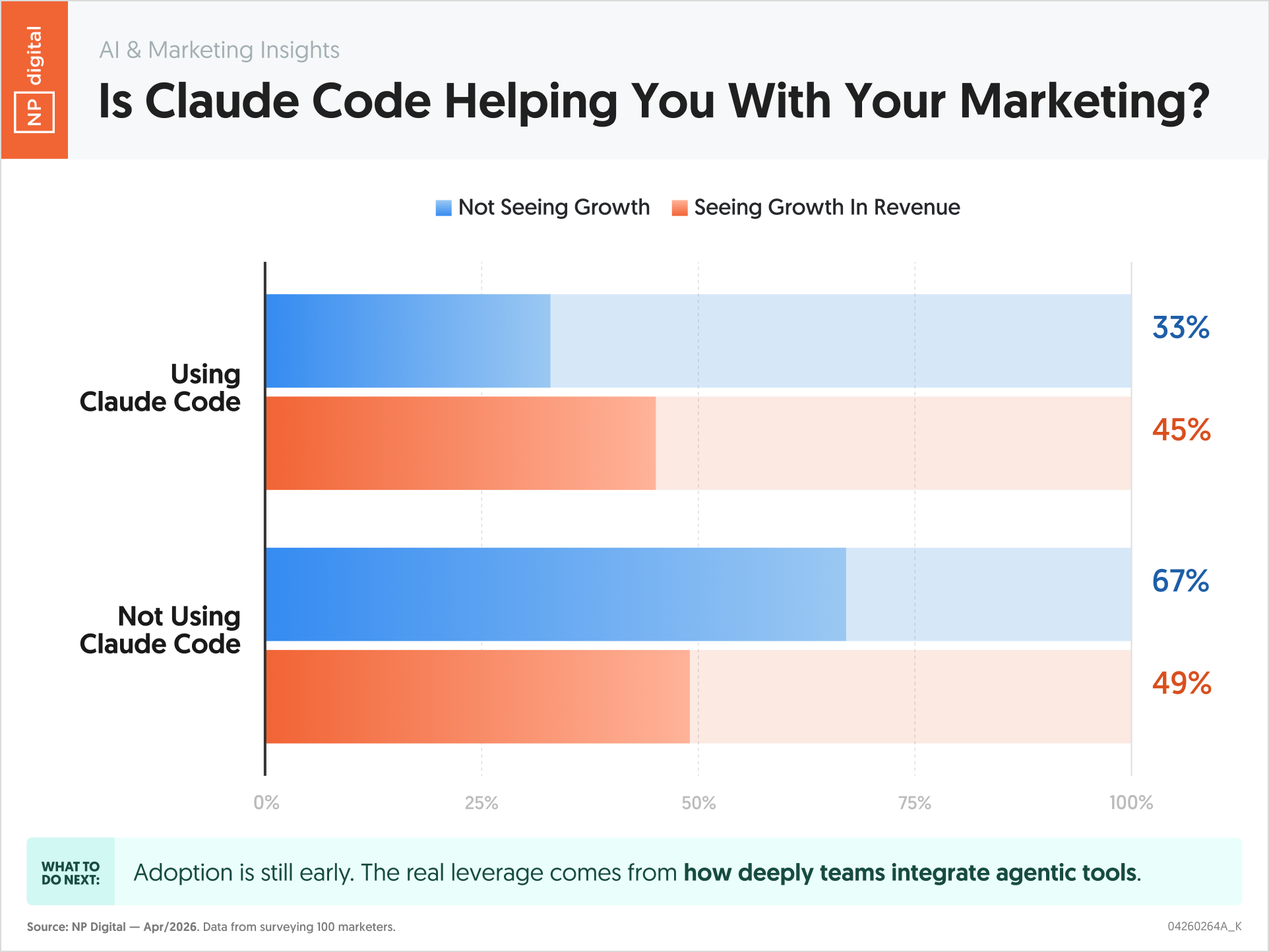
Adoption of a tool and getting value from it are two different things. This chart splits 100 marketers into Claude Code users and non-users, then measures what share of each group report seeing revenue growth. The result is closer than most would expect: 45 percent of Claude Code users report growth versus 49 percent of non-users. The gap is narrow enough to confirm that adoption alone does not produce revenue outcomes. How deeply teams integrate the tool into their workflows is what determines whether it delivers commercial results.
Essential Statistics
- 45 percent of marketers using Claude Code report seeing growth in revenue, compared to 49 percent of marketers not using Claude Code who report the same outcome.
- 33 percent of Claude Code users report not seeing growth, compared to 67 percent of non-users who report not seeing growth.
- The revenue growth gap between users and non-users is narrow at 4 percentage points, suggesting that adoption stage alone does not produce a significant performance advantage.
- Claude Code users show a meaningfully lower rate of not seeing growth at 33 percent versus 67 percent for non-users, indicating users may have fewer negative outcomes even if growth rates are comparable.
- The survey reflects 100 marketers at an early adoption stage where most users are still developing workflows and integration depth rather than operating mature Claude Code implementations.
Key Takeaways
- The near-equal revenue growth rates between users and non-users confirm that adoption does not automatically produce commercial results. The real leverage comes from how deeply teams integrate agentic tools, not from adoption itself.
- The more striking finding is the not-seeing-growth disparity: 33 percent of Claude Code users report not seeing growth versus 67 percent of non-users. If that gap is directionally real, Claude Code users may be avoiding poor performance outcomes at a higher rate than non-users, even if they are not yet producing better top-line results.
- Early adoption surveys consistently understate eventual performance gaps because most early adopters have not yet built the deep integrations that produce compound advantages. The revenue growth picture from Claude Code users at six or twelve months of deep integration will likely look different from what a three-month adoption snapshot shows.
- The narrow growth gap is also a useful internal argument: adopting Claude Code is not a risk in terms of performance outcomes. Users are not underperforming non-users on revenue growth while they learn the tool, which lowers the stakes for teams deciding whether to start.
- The companion adoption data showing one in three marketers now using Claude Code means the non-user group will shrink over time. As Claude Code becomes standard practice, the performance comparison between users and non-users will shift from adoption advantage to integration depth advantage.
Actionable Insights
- Do not measure Claude Code ROI by comparing revenue growth rates at adoption stage. The data shows the growth gap at early adoption is narrow, which means revenue-based ROI measurement during the first three months of use will consistently understate the tool’s eventual value. Instead, measure efficiency gains, time saved on specific tasks, and workflow automation depth as leading indicators of future performance impact.
- Focus integration depth over adoption breadth in your Claude Code rollout. The real leverage comes from how deeply teams integrate agentic tools. One team member using Claude Code for five workflows will produce more commercial value than five team members using it for one workflow each. Prioritize depth of use for the early adopters before expanding to the broader team.
- Even if the revenue growth rates are similar, users appear less likely to report negative performance outcomes. In contexts where leadership is risk-averse about new tool adoption, framing Claude Code as a performance floor protection rather than a growth accelerator at the early stage is a more accurate and persuasive argument.
- Build a six-month integration roadmap before starting Claude Code adoption rather than treating it as a point tool. Teams that approach Claude Code as a capability layer to be integrated progressively into core workflows will reach the deep integration threshold where performance advantages compound faster than teams that use it opportunistically for individual tasks.
- Revisit your revenue growth measurement at the six-month and twelve-month marks after adoption begins. The current data reflects an early adoption snapshot. The performance picture for teams with six months of deep integration will be more predictive of long-term value than the three-month comparison shown here.
“The revenue growth rates between Claude Code users and non-users are close right now because most users are still in early adoption. The gap that matters is the 33 percent of users not seeing growth versus 67 percent of non-users. Users appear to avoid poor performance outcomes at a higher rate even when they are not yet seeing better growth. The performance advantage from deep integration comes later, and it compounds.” – Neil Patel