
 Sign In









 Ubersuggest
  AnswerThePublic

Just imagine being able to write a 2000-word perfect blog in 2 hours.
You could create more content, drive high-quality traffic with search engine optimization, and generate more leads.
For over 5 years, I’ve been writing and all along, I’ve tried to get faster at it. I know that you want to improve your speed and content quality, as well, because I get emails every week from readers and fans, all asking me to share my writing secrets. Today, I am doing just that.
How do you start a new post and complete it with perfect spelling and grammar in two hours or less?
Google favors detailed content. According to SerpIQ, successful blog posts should contain a minimum of 2000 words, if you want it to rank in Google’s top 10 organic positions.

The 5 strategies below will supercharge your writing and improve your SERP results.
Step #1: Flip Your Script
Marie Forleo says that if you want to write faster, you’ve got to flip your script. Believe that you can do it and you will do it. You Are A Writer, says Jeff Goins.
Reevaluate whatever’s stopping you from writing – those things are just a mirage. Deal with them. The reality is there is no perfect blog, readers will forgive simple errors in a blog post and you will still achieve positive search engine optimization results.
How? Start writing.

If you want to make a living as a digital marketer, then you’ve got to recognize that taking responsibility is the key. You can’t make excuses and money at the same time.

No question, creating high-quality content takes time. But, if you can write a blog post from within, you can dramatically cut the time required to complete a 2000-word article.
Marie says that if you want to change anything – including writing an article that will help others – ask yourself, “what story am I telling myself?” If your story is that you “can’t write,” you won’t write. It’s as simple as that.
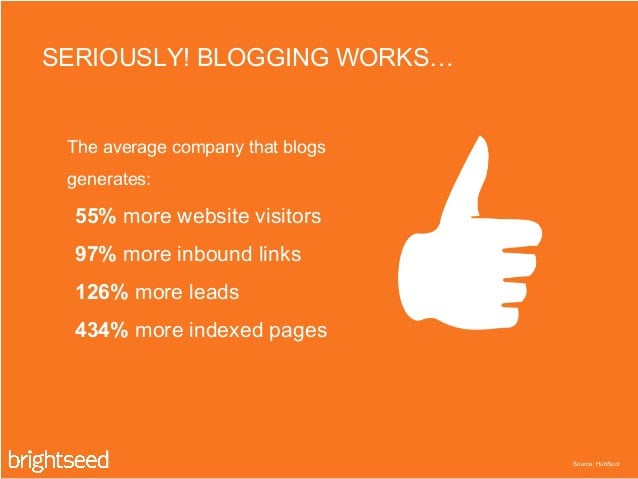
You’ll never become an expert if you keep making excuses. Let the benefits of consistent blogging inspire you to do more if you want more leads and inbound links.
Step #2: Get Your Facts Ready
Project managers perform several important tasks – chief among them is requirement gathering. Without assembling the required resources, the project will fail.
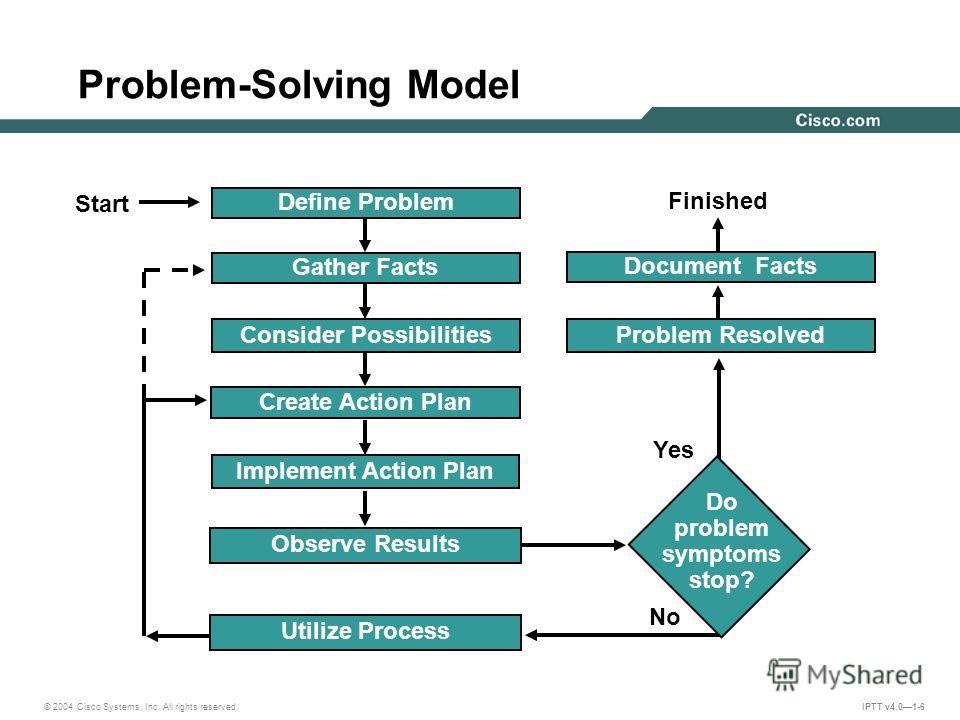
So, according to Cisco’s Problem Solving Model, once you’ve defined the problem, the next step is to gather facts.
One of the reasons why people struggle to write a 2000-word article is that they lack the facts to develop the new post.
Writing isn’t all about typing – you’ve got to know what you’re writing about. For example, before I started writing this article, I first researched and collected lots of resources on how to write more easily and quickly.
Your facts will form the outline that you’ll expand on later.
It’s also important to update your resources for a great blog. If you write based on what was true six months or a year ago, your article may be wrong. This is especially for topics like SEO, PPC advertising and content marketing, things change fast and often.
When you base your blog content around what worked in the past, you’re making assumptions that may no longer be true. Jodi Flynn, the founder of Luma Coaching, defines assumptions as “beliefs that are based on the premise that because something happened in the past, it is automatically going to happen again.”
Going the extra mile to get accurate facts for your content is critical. You can’t write an effective blog post if your points aren’t supportable by current, accurate facts. Assumptions can destroy your creativity, so gather your facts before you start writing that new post.
Gathering facts for your subheadings, bullet points and outline builds your foundation for a solid article.
However, you don’t have to be perfect at this “fact-gathering” stage. Your goal is to assemble enough factual support for your points, then move on.
This means that planning is an integral part of the writing process, but the real work comes in the revision stage, which is where you perfect your writing.
There are several ways to gather facts for your article and lots of sources where you can find the best information for your article. A few of them are:
Check online publications: Online publications, such as magazines, newspapers, brochures, journals, and catalogs, are great sources for writers. This will also later help with backlinks for search engine optimization, so keep a record of them.
A great site that helps you find online magazines and publications in diverse niches is Issuu.com. All of the publications there are free to use, which makes them a great resource for writers. Follow these steps to find the facts that you need for your article:
Go to Issuu.com: On the homepage, type your main keyword (e.g., “digital marketing”) into the search box and hit enter:
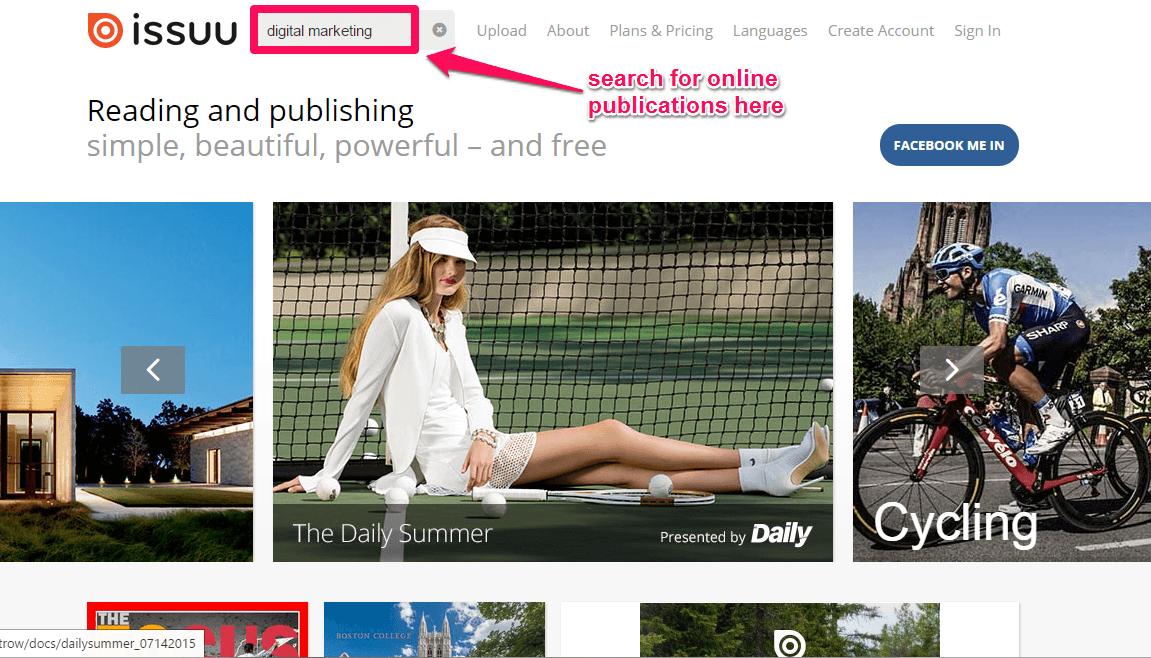
Flip through the publication: Issuu is a powerful online publication search engine that takes your keyword and finds relevant magazines that you can read for free. Click the cover of your chosen magazine to help develop great blog ideas.
Extract your facts: Once you’ve clicked the magazine cover, flip through the pages and extract the facts or ideas that will help you write a high-quality article. For example, while flipping the magazine entitled “A New Era of Marketing,” here’s a checklist that I found:
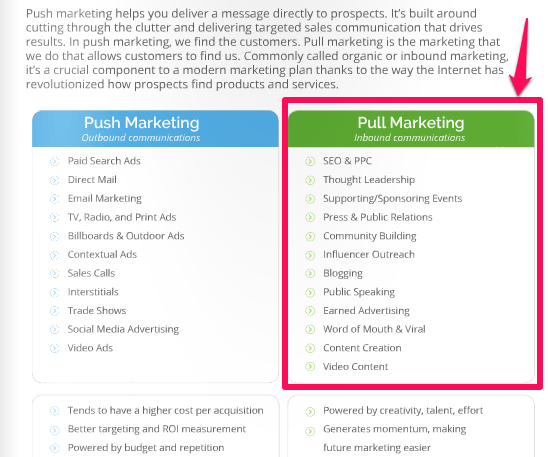
If I want to write a 2000+ word new post on the topic of “push marketing vs. pull marketing,” these checklists will come in handy. Let’s focus on the pull marketing checklist since that’s what content marketing is.
Here are some of the headlines that could work for an article like that:
- 12 Effective Pull Marketing Techniques You Should Use in 2015
- 12 Pull Marketing Strategies for Generating Email Leads
- How to Use Pull Marketing to Persuade Customers and Increase Sales
- What Are the 12 Techniques Used to Pull Customers to Your Business?
When it comes to writing the article for any of the headline ideas above, you can simply expand on the pull marketing techniques listed (i.e., SEO & PPC, thought leadership, community building, influencer outreach, blogging, earned advertising, etc.).
Leverage research data: “Your business depends on finding, understanding and connecting with your best customers,” says Nielsen. There are several research institutes, centers and agencies that have done extensive research on those customers. Most of them post their findings on their blogs or package them into a special report or ebook that you can download.
Sites such as MarketingSherpa, HubSpot and ChicagoBooth.edu share documented findings and data. Let’s see an example of marketing data from HubSpot:

HubSpot’s page above is a compilation of data from several different reliable sources. If you scroll down the page, you’ll find all of the data that you need for search engine optimization, social media marketing, blogging, email marketing, and related topics.
So, when it’s time to write that perfect blog pertaining to SEO, for example, you could start by integrating one of the statistics from HubSpot.
Remember that when you’re creating a 2000-word article, you’ve got to back up your points with data, because your opinions may not be enough. What your readers and customers want is proven, reliable solutions to their problems. That means your writing has to be well-sourced and credible for search engine optimization and user longevity.
Industry blogs: No matter what niche you’re in, you should have a list of industry-related blogs belonging to influential personalities and thought leaders.
For example, Copyblogger and MarketingProfs are two of my favorite blogs in the content marketing industry. Choose a category (e.g., “marketing strategy”) and you’ll see a lot of blog posts that you can use as fact sources.
Each of these content marketing blogs can help you in your quest for facts and ideas for your own successful blog post.
And what about those ideas? You can improve your writing speed by more quickly generating and choosing underlying ideas. Here are a few ways to do that:
1). Begin with the end in mind: Ideas can come from anywhere. As a writer, your duty is to recognize that no idea is entirely useless.
In his classic book, 7 Habits of Highly Effective People, author Stephen Covey said that one thing highly successful people have in common is that they “begin with the end in mind.”

This simply means that before you start a project, you should know how to finish it or what the final iteration will look like. Marie Forleo agrees, in this “how to write faster” video.
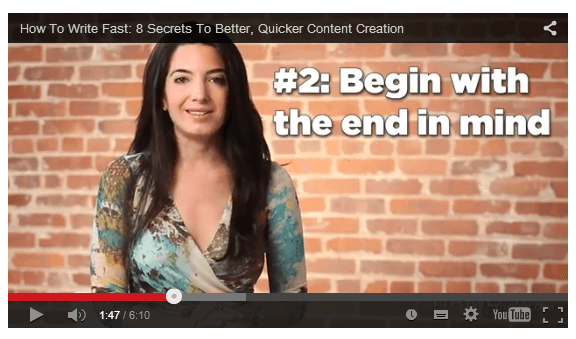
Specifically, Marie says, you should think about what you want readers to walk away with, in other words, the result you want them to achieve or feel after reading your article.
So, for example, if you want to teach blog owners how to get 500 email subscribers in 30 days, keep that end goal in mind from the very beginning.
Your headline could look similar to either of these:
- How to Get 500 Email Subscribers in 30 Days
- The Step-by-Step Guide for Adding 500 Email Subscribers in One Month
Then, your introduction would address the end result and flow from there:
Adding quality email subscribers to your list is hard, especially when you’re just starting out. In this article, I’ll show you how to add 500 or more subscribers to your email list using a simple step-by-step method.
I always begin with the end in mind, when I write a blog post. For example, in an early post on my blog, I promised to show my readers how to increase page views by 23.52%. I focused on the result and made sure that every word and sentence aligns with that promise:

No matter what type of content you plan to create, this approach works – not just for articles or text-based content, but also for infographics, podcasts, and ebooks.
With infographics, you may not have the opportunity to include an introduction in the design, but you can write a 200 – 300-word post before embedding the infographic.
Chris Ducker knows how to engage the user with infographics by starting with the end in mind:
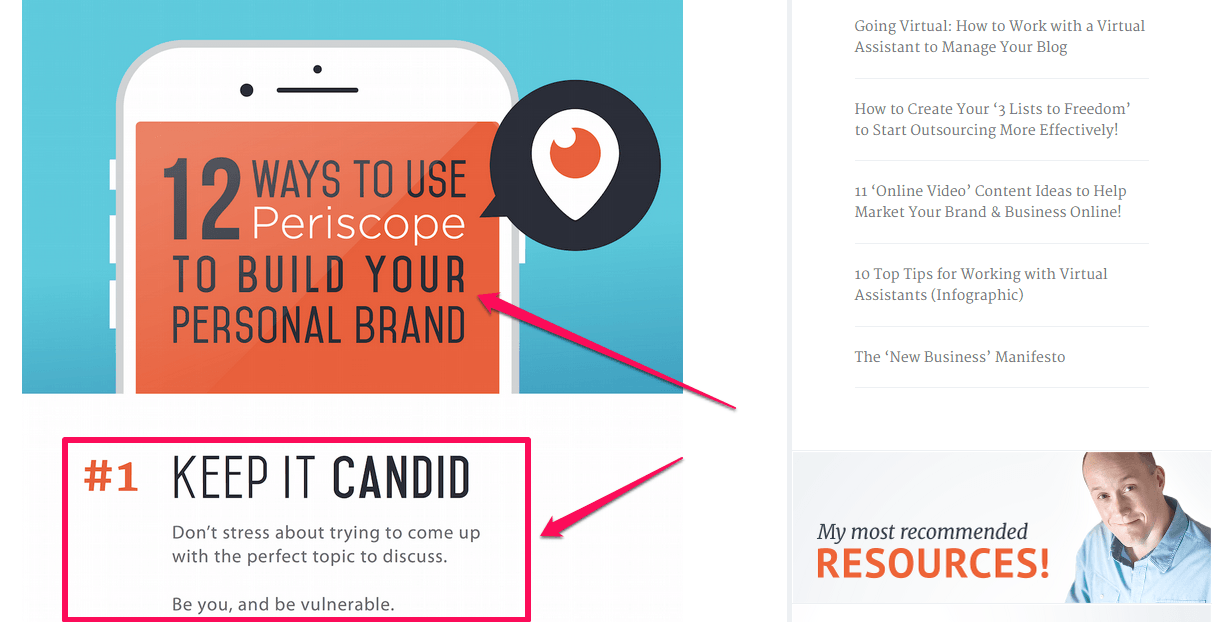
If you want your landing page to convert visitors into leads and your sales copy to draw customers in, tell people the end result and walk them through the process of getting there.
Keep a topic list: Steven Johnson gave a powerful TED talk on the topic, “Where Good Ideas Come From.” Since 2010, this clip has been viewed by over 3,000,000 people around the world.
Why? Because everyone is desperately searching for good ideas.
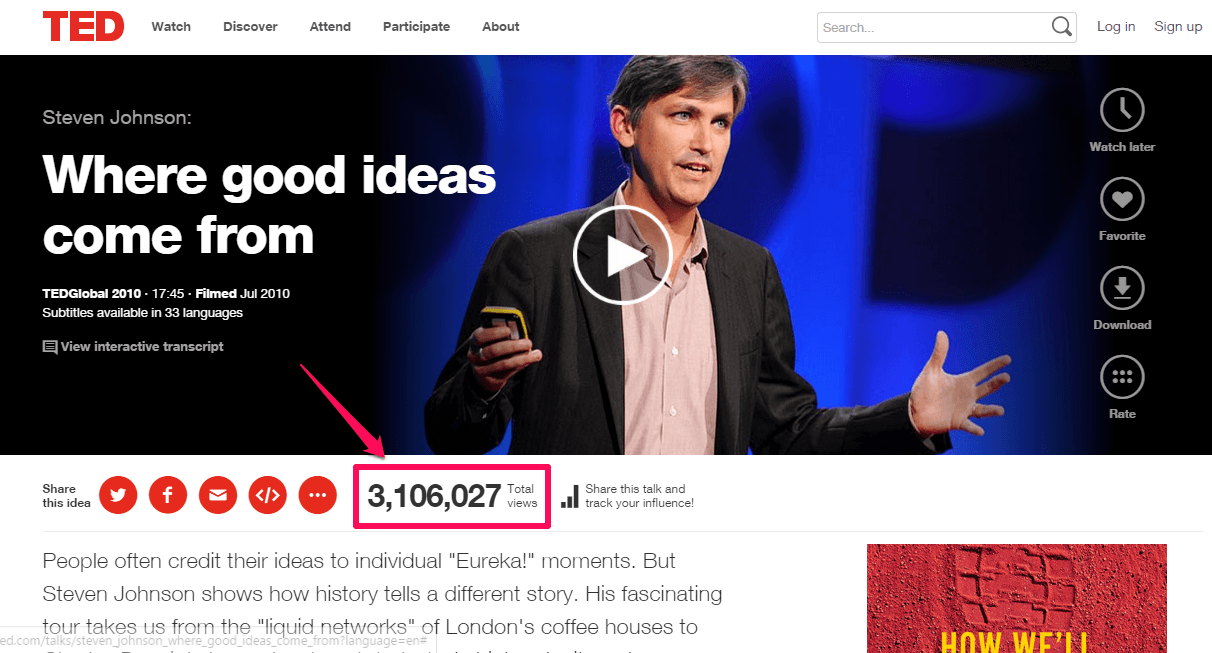
We all need good (preferably great) ideas for blog posts, projects, webinars, and products. Most people are looking in the wrong places for their ideas.
According to Caleb Wojcik, co-founder of Fizzle, “great ideas come when you aren’t trying to think of them.”
Your responsibility, therefore, is to be open and ready for new ideas. Wherever you go, have something – a notebook, smartphone, app – with you at all times. Evernote is my favorite, but you could also use a writing pad and pen. If you are perusing social media, you might note a post that captured your attention.

When ideas come to you, don’t immediately dismiss or edit them. Write them down on an ongoing topic list.
You could even create a template on your writing pad where you can fill in the blank spaces with topics and ideas that occur to you, like this:

It’s a lot easier to design and develop an editorial calendar using your topic list. But, even if no ideas come to you and you don’t know what to write about, you can leverage a tool.
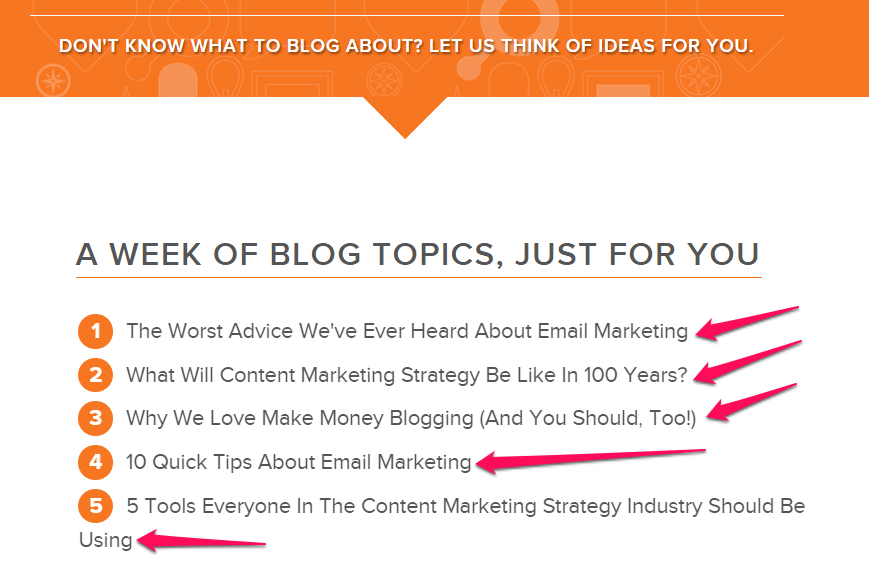
Simply go to HubSpot’s Blog Topic Generator and plug your topic into the box. Then, click the “Give Me Blog Topics” button.

The software will generate 5 headline ideas that you can write a new post about.
Step #3: Bring Your Facts to Life
If you want to be a writer, you’ll have to start writing eventually. There’s no way around that. Begin to write and you’ll learn and improve as you go. Like a surfer in search of the perfect wave, be in search of the perfect blog.
Taking action is more valuable than the latest, greatest ideas. Unfortunately, human beings usually want to take action only when the task seems easy. It’s your job to convince them to act.
That means you must learn to bring your ideas to life. Don’t procrastinate. Get to work. Don’t aim to write a masterpiece – that might happen, but it’s more likely that you’ll never finish even one article. A successful blog aims for high-quality content knowing writing will improve with more practice.
Expand your outlines: In order to bring your facts to life and write your article, you have to expand on your outlines. For example, if your headline is “3 Ways to Generate Leads,” your outline could look like the following, with each item a separate subheading:
- Reach the right audience
- Create useful and practical content
- Develop a relationship funnel
In expanding your outlines, what you’re basically doing is taking each of the subheadings and explaining them. This will also play into the meta tag when you sit down to publish your great blog piece.
Tell the reader how to “reach the right audience” – what methods to use and how to do it. Since you’ll be writing a 2000-word article, it’s even better to capture screenshots that will show the user the exact process.
A perfect example of a blogger who understands how to expand an outline is Brian Dean, founder of Backlinko.com. Take a look at his recent in-depth article:
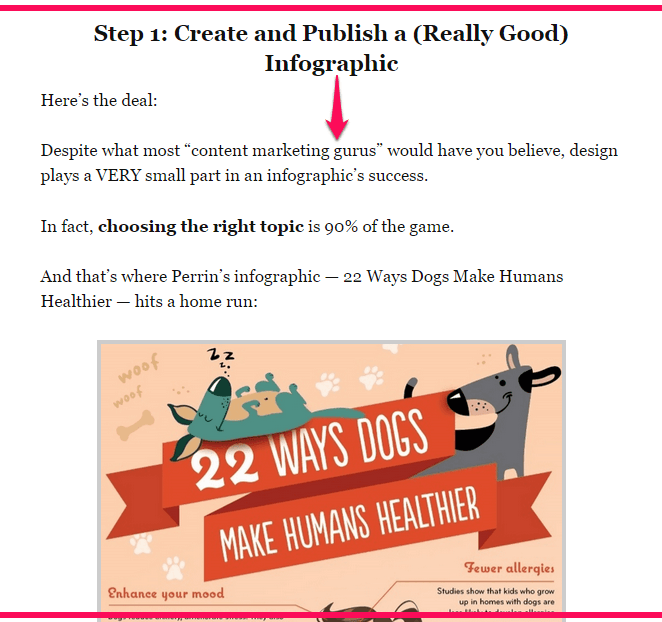
I also use this technique when writing my articles. In one post, I shared the 15 types of content that drive traffic. The article required a long outline. I realized that if I wanted users to benefit from the article, I had to expand each outline point and show how it works.
Don’t write and edit at the same time: This is the basic rule of writing effectively. The truth is that writing is quite different from editing.
Content rules the web. If you want to have a successful blog, you’ve got to write content and promote it to the right audience.
One of the reasons why they struggle is because writing itself is hard.
There’s no question that you can make writing fun and enjoy the process.
But when you edit, you’re using an entirely different set of skills.
Daphne Gray Grant, a publication coach, knows exactly why editing-and-writing is so destructive. She discovered that slow writing is a result of looking over your words and sentences to ensure that they’re correct as you’re writing them.
Editing while writing slows you down and distracts you from your purpose and points in new post development.
For almost every writer, the first draft is never great. It’s the process of revision that makes it great. The famous Ernest Hemingway said it succinctly:

If this is you, you’re not alone. A lot of writers still struggle with this impulse. Social media blog post writers are no different.
So how do you deal with it? Well, Daphne Gray Grant says that you should “monitor your self-talk and tell yourself you’ll do it later.”
The main challenge is to discipline yourself to write and to not let your distracting thoughts pull you off-task. It requires discipline and there’s no shortcut.
Write shorter sentences: If you want to speed up your writing speed and craft an interesting, easy to read and useful article, then write shorter sentences.
A recent study found that reading on the screen hurts the human eye. For this reason, people read 25% slower on a computer screen compared to print. Writing shorter sentences will help your readers assimilate your ideas and put them to work.

Your sentences don’t have to be short, staccato bursts. You just need to balance the longer phrases and sentences with shorter ones.
The best writers don’t waste time. They give you what you need and no more. Jonah Berger, author of Contagious: Why Things Catch On, knows how to captivate the reader in this way.
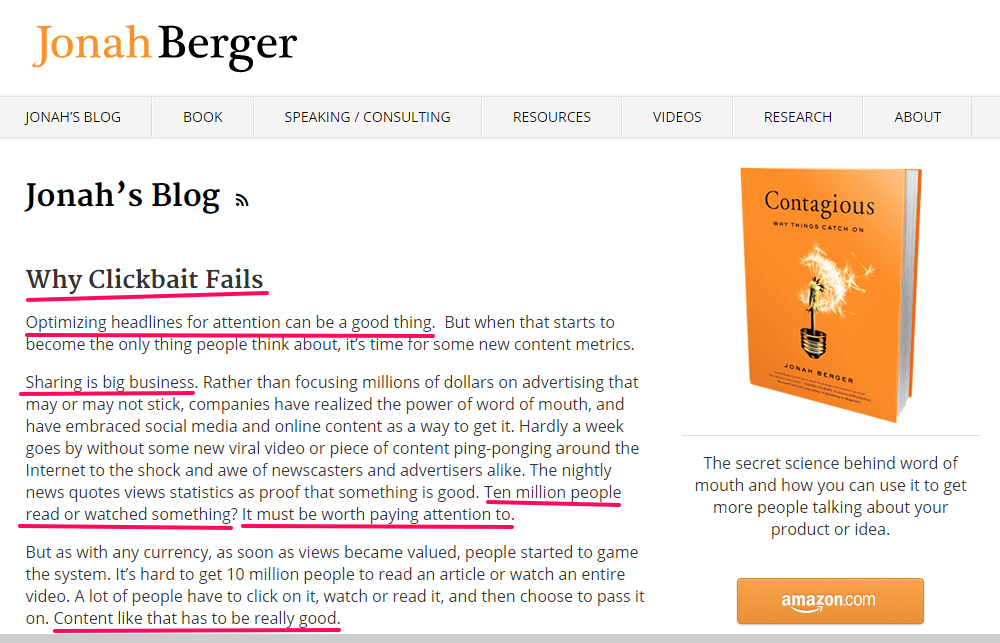
Chris Brogan, the famous social media strategist and founder of Owner Media Group, also writes shorter sentences. He tells stories using strong and vivid analogies, but they’re still easy to read.
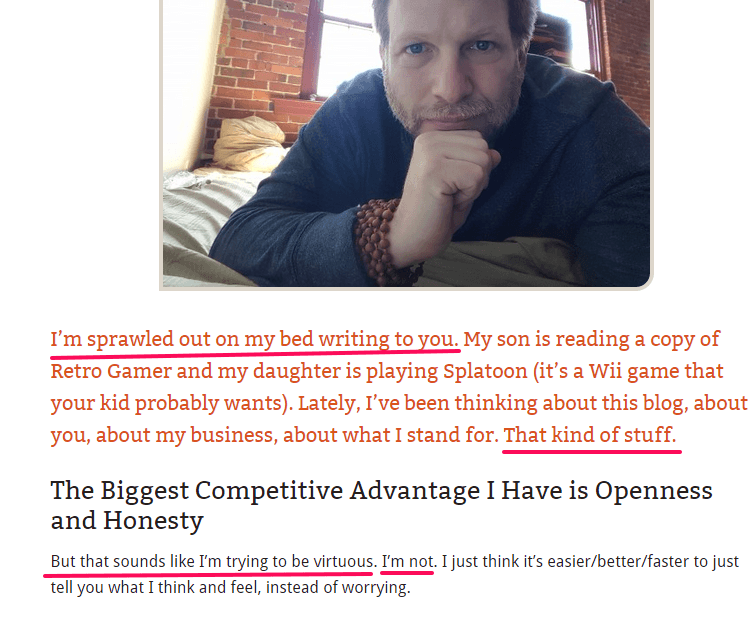
Don’t pad your words or try to sound clever. Write with clarity. Successful blog writers use common words. Write to teach and inspire people, not to sound like a retired English professor.
Use a timer: The next time you sit down to write, grab a timer. Using the Pomodoro Technique™ and set the timer to 25 minutes.
Write at a solid clip without checking your phone, watching TV, or anything else. Stay focused. Turn off your social media and Skype notifications, log out from your email account and just write new post sentences, one after the other.
These are the 5 steps in the Pomodoro Technique™:
- Decide in advance what you want to write about.
- Set the timer to 25 minutes.
- Work on the task with full concentration until the timer rings.
- Take a short break (3–5 minutes).
- After four 25-minute sessions, take a longer break (15–30 minutes).
Focus is the #1 habit that can speed up your writing. Here are some other benefits of using the Pomodoro technique:
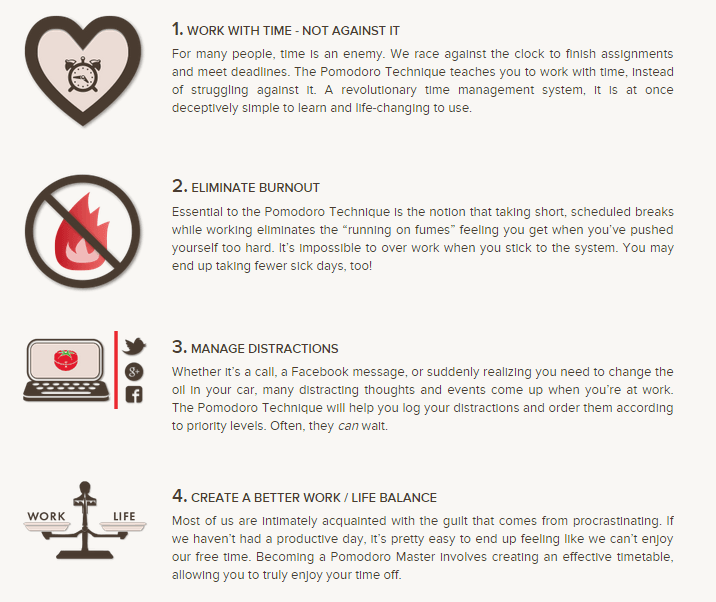
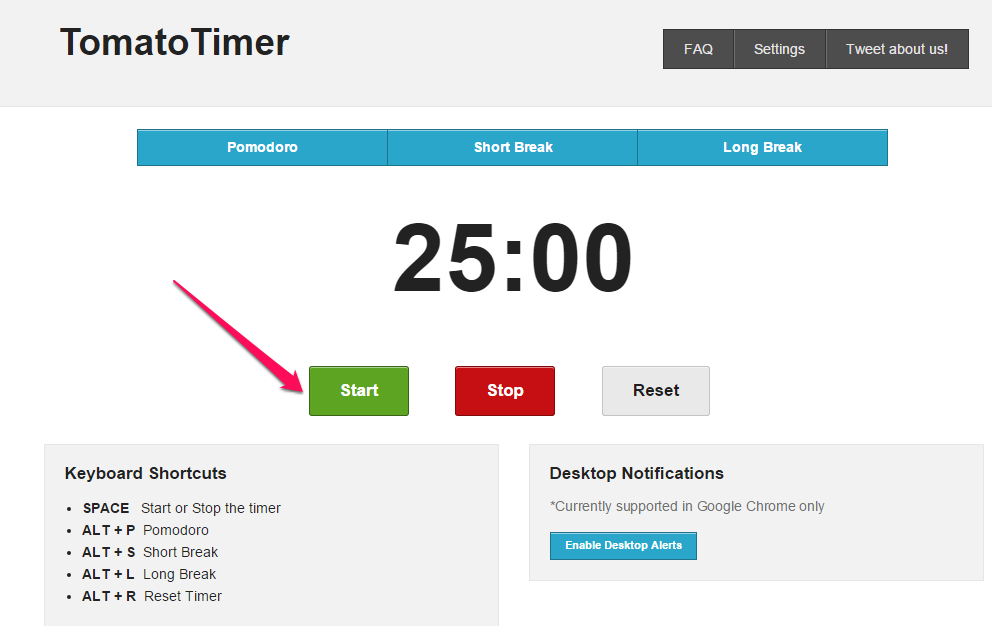
If you don’t have a timer, go to tomato-timer.com. By default, it’ll be set to 25 minutes. Just click the “start” button to get an alert when the 25 minutes are up. You can also set desktop alerts (but this works for Chrome browser only).
Embrace the bullets: “These days, especially in the email and online – bullet points are the most-read copy on the page,” says Anne Holland, Content Director Marketing Sherpa.
Bullet points should be used to highlight specific, important information. They help the reader understand the key points and issues quickly.
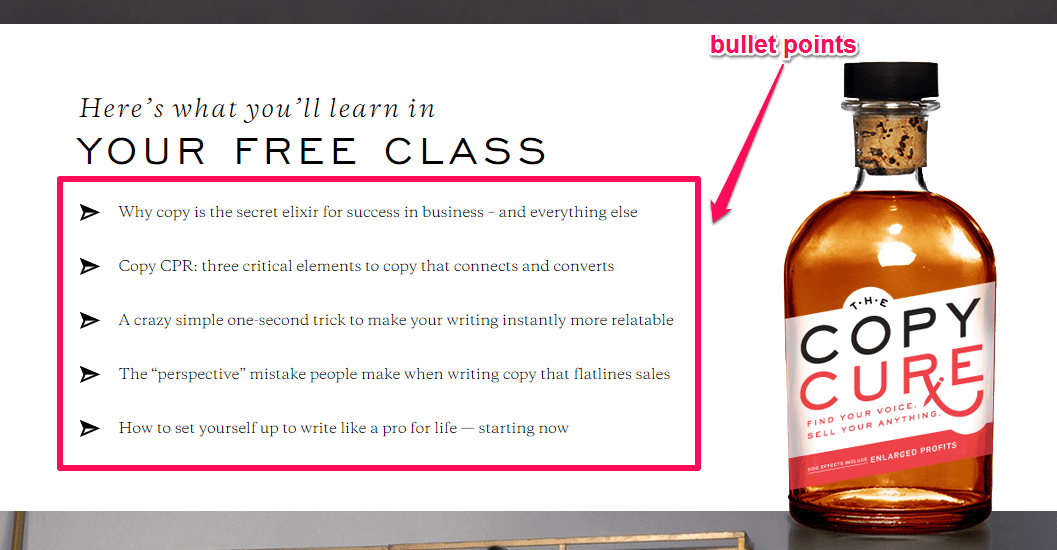
Copyblogger recommends that you craft each bullet point as if it were to serve as your headline. Marie Forleo’s latest course “The Copy Cure” uses copy with strong bullet points to highlight the key lessons in the course:
Whatever you’re writing for your business, you should embrace bullet points. It’ll improve your writing and readers will follow along.
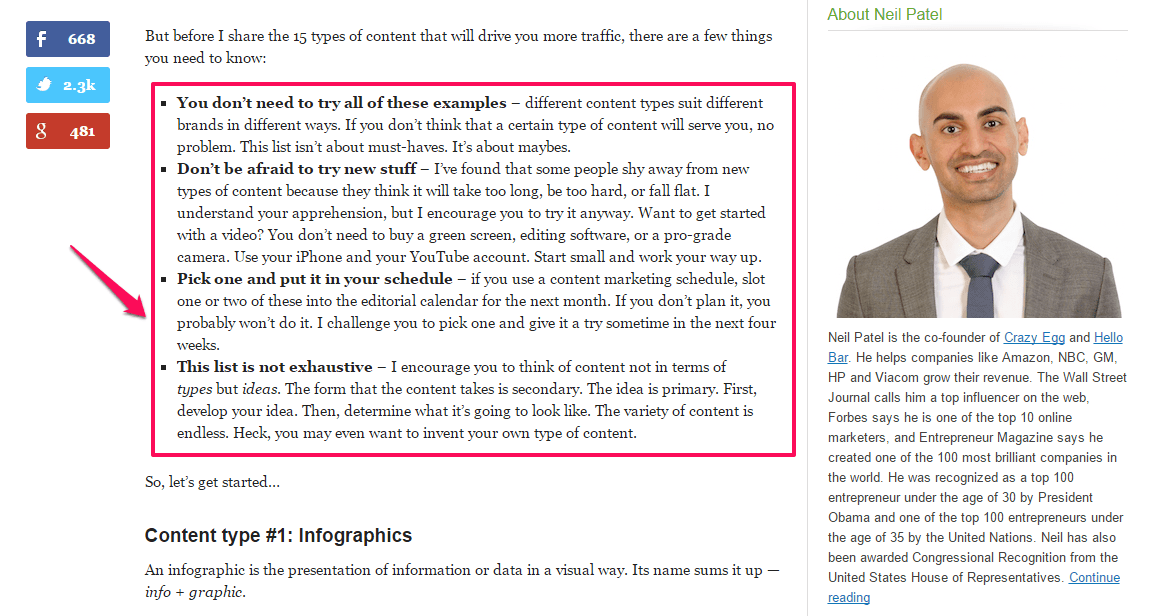
I use bullet points in 96% of my blog posts at Quicksprout.com. Take a look:
Bullet points are a powerful way to express your main points when writing longer articles. But, you’ve got to be smart about it.
The Bracken Business Communications Clinic from Montana State University says that you should “keep bullet-pointed information short, usually no more than two lines in length and use the same font and margin width for each bullet point.”

Trace data to its primary source and use it to back up your points: Data-driven articles, like the one that you’re reading, can build your personal brand faster because people will perceive you as an expert.
However, be mindful when using data from other blogs and research institutes. What you have to understand is that most data online has been compiled from other sources. But, the primary source may not be attributed and this could pose a problem for you. Search engine optimization will penalize you for duplicate content, so don’t copy long sections either.
For example, most of the data on the HubSpot’s Marketing Statistics page didn’t come directly from HubSpot, which only researched and compiled the data.
Your job is to find the original research work from the primary source.
The first step is to copy and paste the primary source and year into Google and search for it.
When writing your article, link to the primary source.
Note: If the primary source of the data that you want to use is unknown, or you’re unable to find or access those results, you could simply quote it and link to the secondary source that compiled it.
Let’s assume that I didn’t find the primary source of data above. I could simply quote Pew Research Center, but link to HubSpot:
As reported in recent marketing statistics compiled by HubSpot, Pew Research Center found that 88% of consumers say that they use the search engines to learn something new.
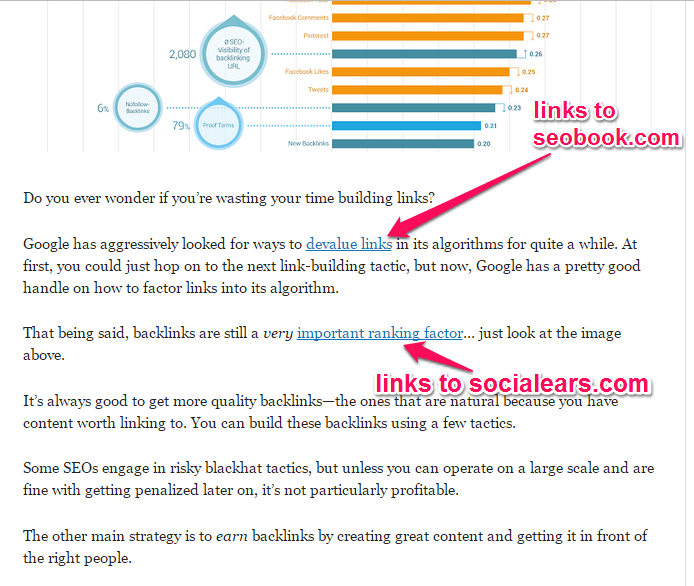
You can also link to the source of the data without quoting the research institute, firm or organization. Remember, part of the perfect blog is the combination of high quality content and link building. I do that a lot in my posts:
Attribute graphics and images correctly: What would it look like if this article with over 5,000 words was all text, with no graphics or images to break up large chunks of words? I bet you’d never read past the first subheading.
It’s important to use images and relevant charts in your article to build trust and authority. Also, the brain processes visual information (graphics, charts, infographics, memes, photos, etc.) faster than plain text.

In the image above, the author combined several pieces of data and created a Slideshare presentation. All I did was credit/link to the exact page on Slideshare.
Attributing graphics and images correctly is one of the skills that you have to develop as a successful blog writer.
When you find any graphics or chart that you’d like to use in your article, you have to know where it came from (primary source) and not (only) where you found it. It’s possible that the site where you saw it didn’t own it. Always read the fine print on the graphics or chart to know the rightful owner.
Always link to the web page where the image was published with the post. Don’t link to the image URL.
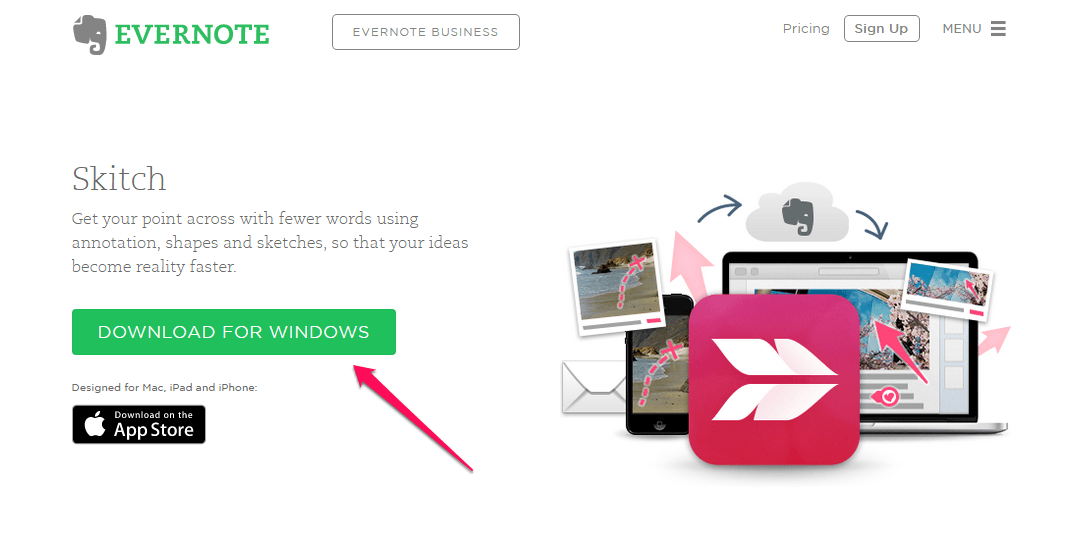
If you want to capture a screenshot or a particular section of someone’s post, you can use Skitch, a simple tool from Evernote. That’s what I use to capture and annotate (add notes to something) all screenshots for my Neil Patel blog.
Proofread and edit after writing: When you’re done writing, the next step is to revise and edit your article. Your draft may have typos and other errors, especially if you’re writing your drafts quickly.
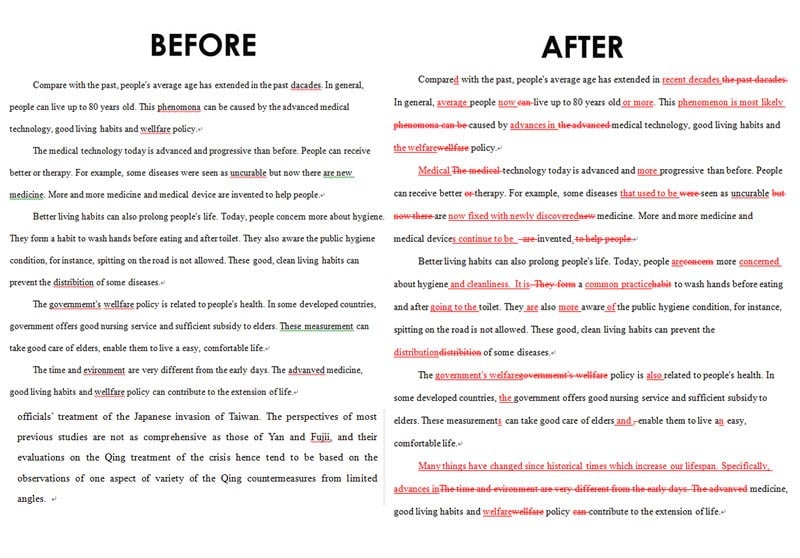
This doesn’t mean that it has to win any prizes. In fact, if you’re a perfectionist, you’ll have a harder time becoming a successful blogger or content marketer. The perfect blog is like that perfect wave, it usually only exists in our minds.
The purpose of revising your work is to eliminate common errors that can make you look uneducated or unprofessional.
But, understand that there is a difference between proofreading and editing. In editing, you adjust the sentence structure and style. You might rewrite an entire paragraph, for example. When proofreading, you focus on correcting spelling and grammar errors and typographical errors (typos).
When you’re editing your article, don’t lose sight of what matters most: your users. The goal is to make your content readable and useful for the target audience. Search engine optimization metrics will reward you.
You can use Hemingway App for basic editing and proofreading. It’s really helpful for beginners with a new post.
See also:
- Get Your Eagle Eye On: 10 Tips For Editing Your Own Work
- How to Edit, Proofread and Revise Your Own Work
Step #4: Create an Editorial Calendar
Do you have a documented content strategy? According to Content Marketing Institute, only 27% of B2C content marketers do. One of the best ways to begin the documentation process is by keeping an editorial calendar.
With your topic list in place, it’s a lot easier to develop a roadmap to follow consistently in creating your articles. After all, sometimes it might just not be possible to create a 2000-word article.
But, as you learn about your audience and develop a passion for writing, you’ll soon start to write 2000 – 5000 words article on a regular basis. That’s why you need an editorial calendar.
There’s nothing fancy about an editorial calendar. So don’t waste time or fret over it.
Depending on your goal or the demand of your target audience, you may want to publish new articles on your blog every 2 days or once per week.
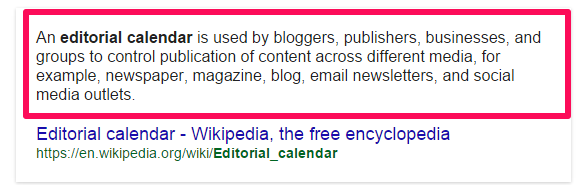
An editorial calendar tells you beforehand what topic you should research and the facts, data and case studies to focus on for that one successful blog you want to create. You could develop a calendar for a week, a month or more. Here’s an example from CoSchedule:
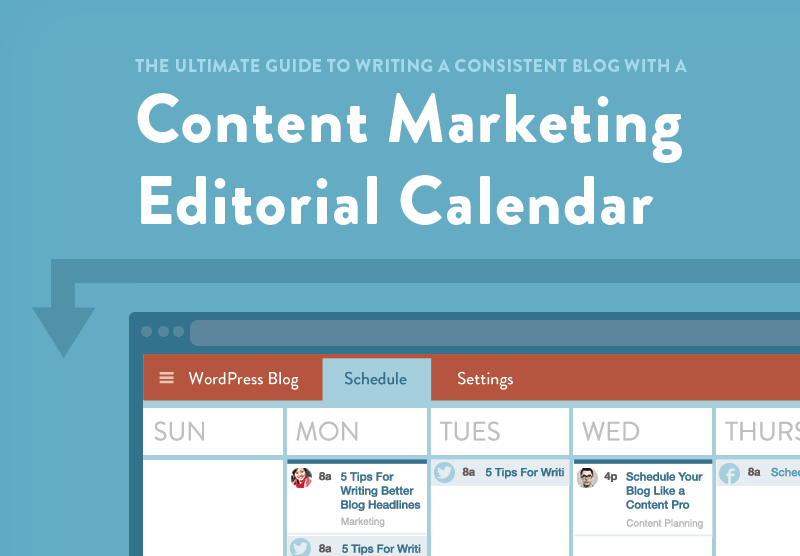
Perhaps your audience wants case studies or research summaries on Mondays and how-to’s or tutorials on Thursdays.
That’s exactly what an editorial calendar does. As a blogger or content marketer, you need to develop one. An editorial calendar helps you stay in control and offers many other benefits as well:

Step #5: When in Doubt, Curate
Content curation is sorting through a large amount of web content to find the best, most meaningful bits and presenting these in an organized, valuable way. – Kevan Lee, Buffer
Content curation has gone mainstream. The demand for content is greater than ever. That means that your prospects and customers are desperately seeking high-quality content.
However, if you want to stand out, you’ve got to add a more human touch, says Content Curation Marketing.

That simply means that, instead of merely compiling other people’s articles, you introduce the content, add your own unique voice and then link to relevant blogs. Better yet, align your voice with the curated content, so as to eliminate objections from your readers.
You can find content to curate from industry blogs, mainstream blogs, and social media networks.
Brian Dean knows how to curate this way. One of his popular posts, entitled “Link Building: The Definitive Guide,” begins with a unique article:
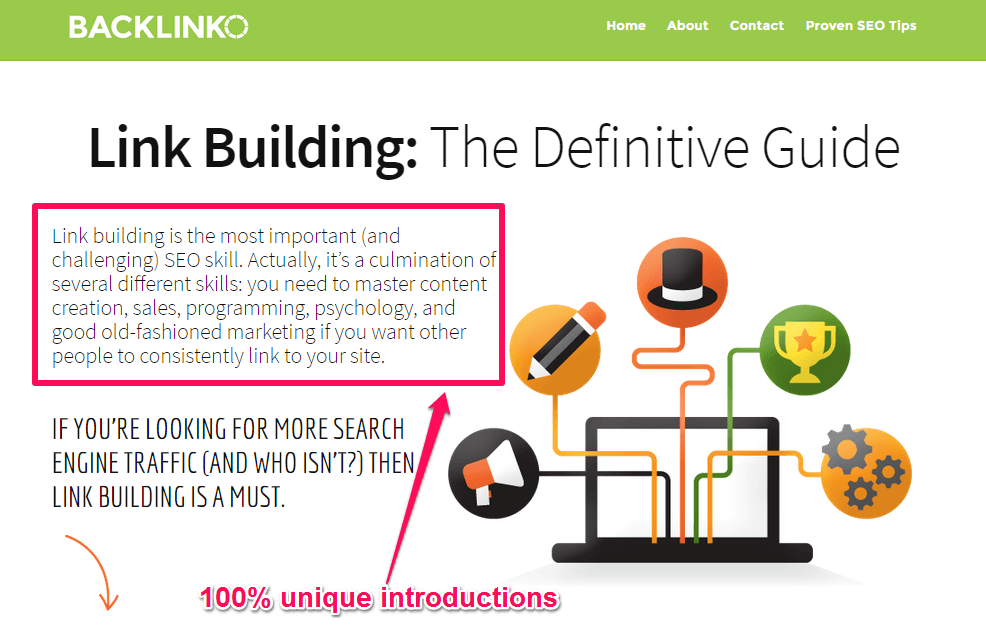
Then, as you scroll down, you get the curated content. Each link points to external web pages on industry blogs:
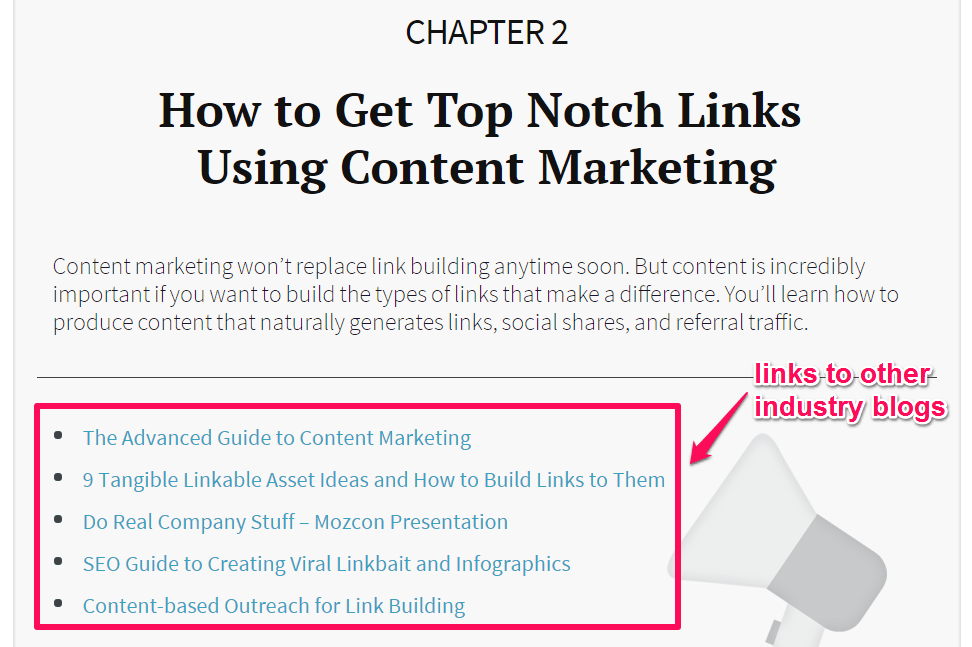
Dean found the best content out there and compiled it into a list. But first, he added his own unique angle and when the post went live he promoted it like a maniac.
So, how do you find relevant and high-quality blog posts and articles to curate instead of writing your own new post? Start by going to Google and searching for the topic or main key phrase that you want to curate (e.g., “blog headline writing”):
Remember to always link to the web page. Don’t copy someone’s work and call it yours. It’s wrong and could get you into trouble. Content curation is supposed to help you build relationships with other bloggers and establish you as an authority while helping your readers improve their knowledge.
Conclusion
Writing is an art and requires creativity. Without it, you’ll be lost in the crowd. But, getting faster at the process helps you harness that creativity and put it to better use.
Recognize that the rate at which content is being produced and published these days has accelerated and marketers are planning to invest more money and time into content creation.
Writing is also a science. You’ve got to study your target audience, your market, and the emerging trends, in order to stay current on what works and what doesn’t.
I’m confident that if you can focus on these five steps, you’ll be able to write a 2000-word article that you can be proud of – in 2 hours or less.
How long do you spend when writing an in-depth article?