 Sign In






 Ubersuggest
  AnswerThePublic
 1000 Followers Vs 1000 Email Subscribers: Revenue Reality
Info
-
Source: NP Digital
-
Date: December 2024
-
Category: Email Marketing
-
Study Methodology: Sample size: 119 businesses generating over $10M in annual revenue; plus 2,501 marketers surveyed on preference; Collection method: Analysis of monthly revenue per 1,000 followers/subscribers and survey of marketer preference.
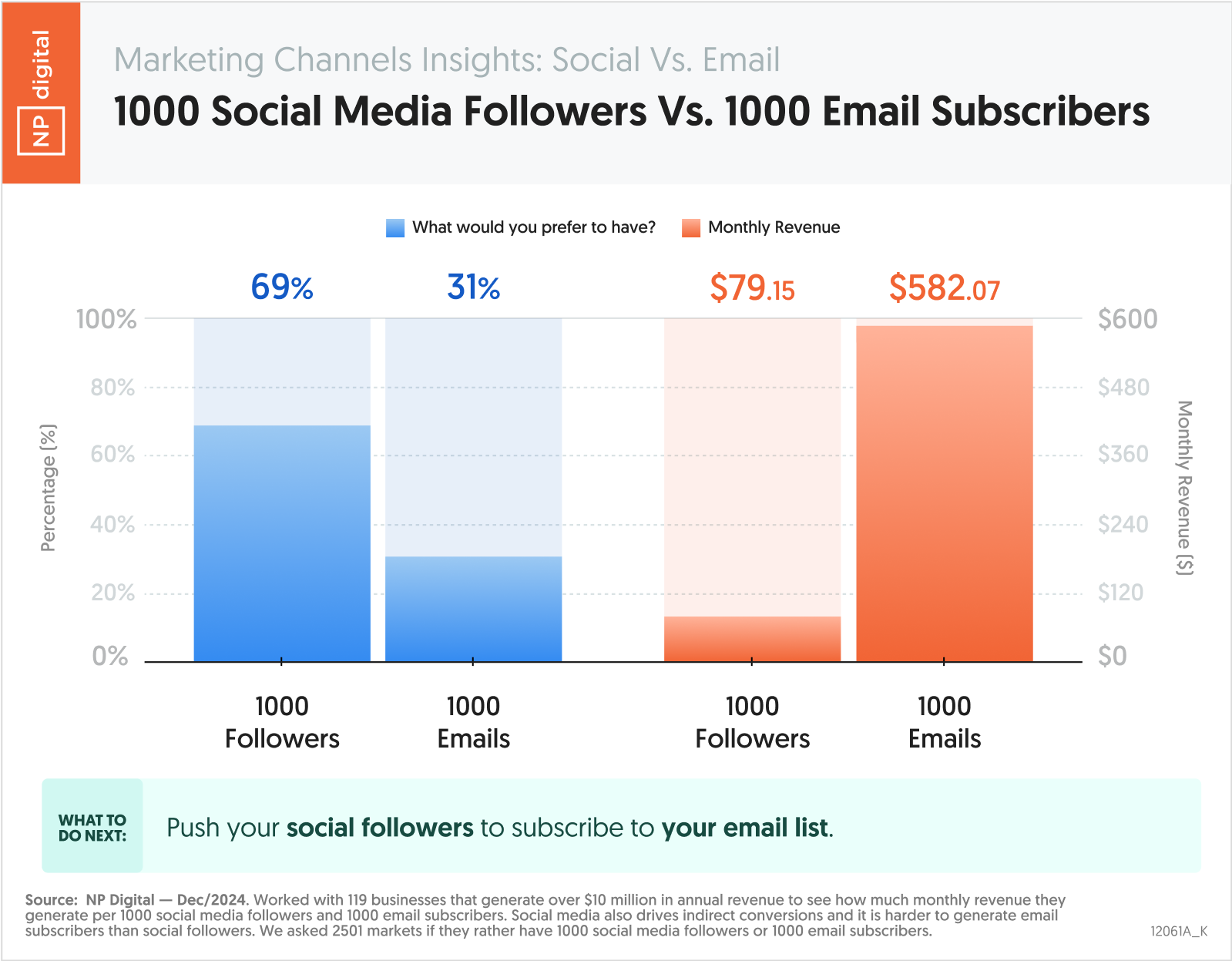
Email audiences feel smaller, but they monetize harder. This chart compares what marketers say they want (followers) versus what actually makes money (email subscribers). It also puts a real dollar value on 1,000 followers versus 1,000 subscribers. Use it to pressure-test whether your social strategy is building a business asset or just vanity growth.
Essential Statistics
- 69% of marketers would prefer to have 1,000 social media followers over 1,000 email subscribers.
- Only 31% would prefer 1,000 email subscribers.
- 1,000 social media followers generate $79.15 in monthly revenue on average.
- 1,000 email subscribers generate $582.07 in monthly revenue on average.
- Email drives about 7.4x more monthly revenue than social followers at the 1,000-unit level.
- The revenue gap exists even though most marketers still prefer follower growth.
Key Takeaways
- Marketers are optimizing for the wrong asset when they prioritize followers over subscribers.
- Email is an owned channel that consistently converts attention into revenue without algorithm dependency.
- Social works best as a feeder channel that captures demand and moves people into owned lists.
- Revenue per audience unit matters more than audience size when forecasting growth.
- The fastest way to improve content ROI is to turn high-performing social content into list growth.
- Follower growth without an email conversion path leaves money on the table.
Actionable Insights
- Build your social calendar around list building, because 1,000 subscribers generate $582.07 per month versus $79.15 for 1,000 followers. Add a single, repeatable opt-in offer that matches your audience’s top problem and promote it weekly.
- Create an opt-in hook for every top-performing social post, because most marketers prefer followers even when subscribers pay more. Turn your best posts into a short CTA that points to a relevant lead magnet, not a generic newsletter signup.
- Use email-first incentives when you run social campaigns, because the revenue gap is roughly 7.4x in favor of email. Test offers like templates, swipe files, benchmarks, or calculators that give immediate utility in exchange for an email.
- Track revenue per 1,000 followers and per 1,000 subscribers in your reporting, because this chart proves the units are not equal. When social looks strong on engagement but weak on revenue, you will have the data to justify shifting effort into list capture.
- Retarget followers with email acquisition ads, because social is easier to grow but email is harder to build. Use warm audience retargeting to push a single opt-in asset until it reaches consistent cost-per-subscriber targets.
- Rebuild your profile and pinned content around a single email conversion path, because most visitors are not scrolling your feed. Make the opt-in the first action someone can take when they land on your profile.
Followers are nice, but subscribers pay the bills. If your social strategy does not consistently turn attention into an email relationship, you are choosing the smaller revenue line on purpose. – Neil Patel