 Sign In












Social Post Half-Life By Platform
Info
-
Source: NP Digital
-
Date: October 2024
-
Category: Social & Organic Reach
-
Study Methodology: Sample size: 4,010,000 social media posts and 145 podcasts. Collection method: analyzed content performance decay over time; chart uses a non-linear scale for readability.
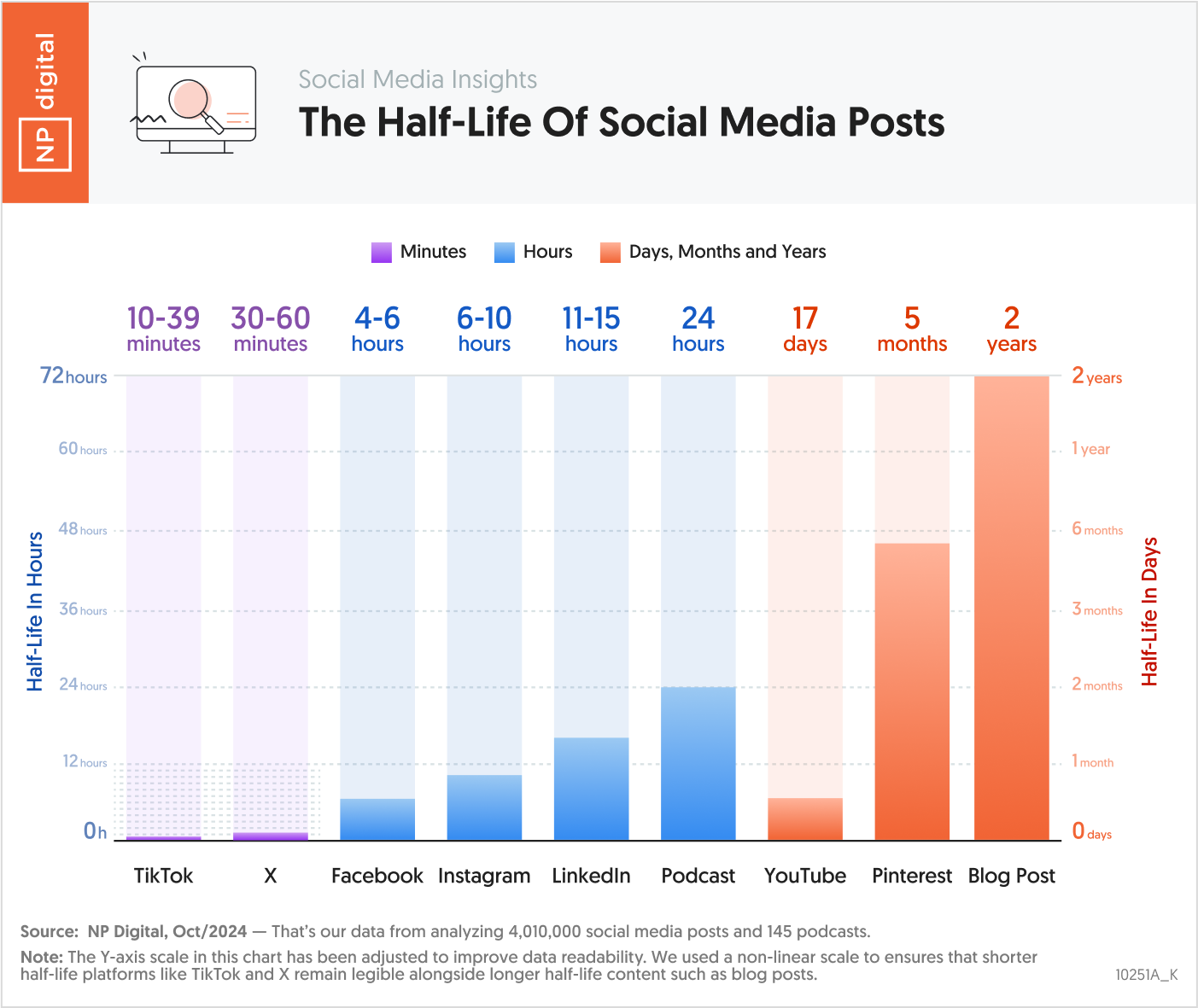
Every platform has a different content decay curve. If you plan distribution the same way everywhere, you will waste effort on channels where posts die fast. This chart shows the realistic lifespan of attention by format and network. Use it to decide where to invest in volume versus durability.
Essential Statistics
- TikTok content has a half-life of roughly 10 to 39 minutes, meaning most momentum fades within the hour.
- X posts last about 30 to 60 minutes before engagement meaningfully drops.
- Facebook and Instagram extend the window into hours, with Facebook around 4 to 6 hours and Instagram around 6 to 10 hours.
- LinkedIn posts hold attention longer at roughly 11 to 15 hours, and podcasts can hold for about 24 hours.
- YouTube content lasts about 17 days, while Pinterest stretches to about 5 months and blog posts can last about 2 years.
Key Takeaways
- Short half-life platforms reward frequency and fast creative iteration.
- Longer half-life platforms reward depth, searchability, and evergreen packaging.
- LinkedIn is a middle ground where a single strong post can carry through a full day of attention.
- YouTube and Pinterest behave more like discovery engines than social feeds, so optimization matters as much as publishing.
- Blog posts remain the durability play, but they require compounding distribution and updates to realize the multi-year upside.
Actionable Insights
- Increase posting frequency on TikTok and X because their half-lives are measured in minutes, not days.
- Batch-produce variations of the same idea and publish in tighter windows so you can win during the brief attention spike.
- Shift your best educational content to LinkedIn when you want a full-day runway to drive comments and clicks.
- Write stronger first lines and add a clear CTA early, because you have roughly 11 to 15 hours to convert attention before the post decays.
- Treat YouTube like a 17-day asset and invest in titles, thumbnails, and retention edits instead of one-off clips.
- Those optimizations stretch the discovery window and make each upload work longer than a typical feed post.
- Use Pinterest and blog posts for evergreen demand capture, since their half-lives are months and years.
- Build a refresh cadence (new images, updated sections, internal links) so older assets keep earning traffic instead of aging out quietly.
- Plan cross-channel handoffs based on lifespan: use TikTok or X for the initial spike, then point viewers to YouTube or a blog post for the durable follow-through.
- This matches short attention channels to long attention assets and prevents your best ideas from dying in the feed.
Most teams lose because they treat every platform like it works the same way. When your half-life is 30 minutes, you need a different playbook than a blog post that can last two years. – Neil Patel