 Sign In






Key Takeaways
- Visibility and accuracy fail independently. An engine can cite you in nearly every answer and still describe you with outdated facts.
- Score three axes, not one verdict. Rate each brand-relevant answer on accuracy, sentiment, and currency. Each axis points to a different fix.
- Answers drift for documented reasons. Engines surface the most repeated claim. Source content that passed through unsupervised AI editing can arrive already degraded.
- No platform offers an edit button. ChatGPT, Google AI Overviews, and Perplexity accept feedback. None commits to changing a specific answer.
- Source correction carries the most weight. Fixing the pages an engine cites changes the answer more reliably than any in-product report.
Every AI visibility report answers one question: are you showing up, and how often? Rank tracking, citation counts, and visibility measured at scale all count appearances. None of them tell you what the answer said about you. That blind spot is where AI sentiment and accuracy live.
Your brand can hold a strong citation rate across ChatGPT, Google AI Overviews, and Perplexity while the answer describes a product you sunset two years ago. The same answer might credit a competitor with your flagship feature, or lead with a complaint from a single review site. Your dashboard still shows green.
Visibility tells you whether you are in the conversation. Sentiment and accuracy tell you whether that helps you or hurts you. This post covers how to score both, why answers go stale, and which correction levers do real work.
Visibility Tells You If You’re in the Room. It Doesn’t Tell You What Was Said.
Citation frequency, inclusion rate, and share of voice all measure presence. An engine can name you in nine of 10 answers and still get your pricing model wrong in all nine. AI brand misrepresentation sits outside what any visibility metric detects.
Four situations call for different work.
High visibility, accurate answers. You are in good shape. Keep monitoring, because engines refresh their sources constantly.
High visibility, inaccurate answers. Your worst case, and the one a dashboard hides. The engine repeats you often and repeats you wrong, so every citation amplifies the error.
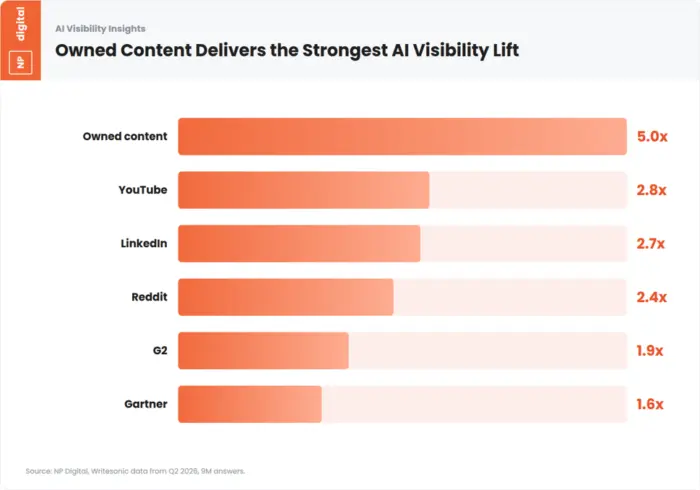
Low visibility, accurate answers. A reach problem. You need more citable, authoritative coverage. NP Digital’s study of 9 million AI answers found that owned citations deliver the single strongest visibility lift in the data.
Low visibility, inaccurate answers. Two jobs at once. Fix the source material first, then push for citations, or you will scale the wrong story.
In the past, this site has covered how AI answers compress a brand’s first impression, and how defending your brand in AI results starts with governance. That piece explains the problem. This one gives you the scoring system, because you cannot govern what you have not measured.
A quarterly report with rising citation counts can cover a quarter in which your reputation got worse. The numbers improve while the answers degrade, and nothing in the report connects the two.
Why AI Answers Drift Out of Date and Out of Alignment
Two documented mechanisms explain most of what an audit turns up. Neither one is a conspiracy against your brand. Both are structural.
Engines Weight Repetition, Not Verification
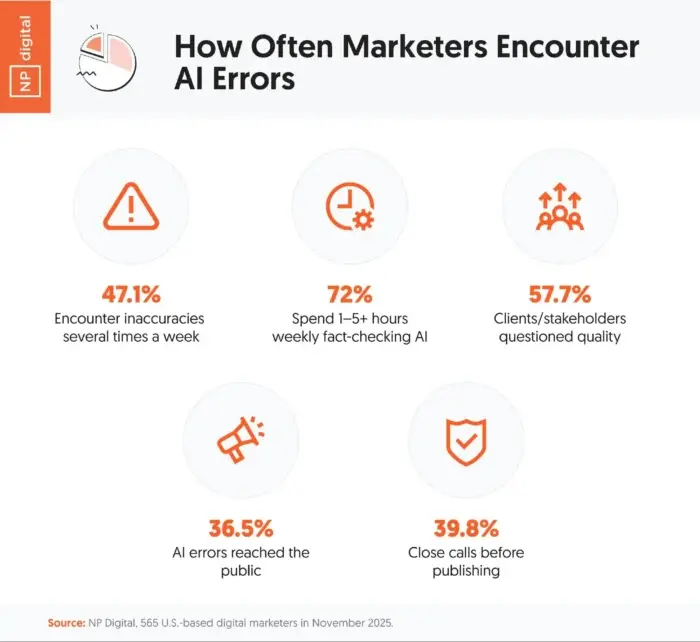
Language models surface the claim that appears most consistently across their sources. A hundred directory pages carrying your 2021 address outweigh one corrected About page, and the engine cannot tell which version is true. Confident phrasing says nothing about input quality. The Tow Center for Digital Journalism tested eight AI search tools and found that they answered more than 60 percent of queries incorrectly. Perplexity performed best, and still got 37 percent wrong. Every wrong answer arrived in the same assured tone as a right one. Our own NP Digital has shown that nearly half of marketers deal with AI errors multiple times a week.
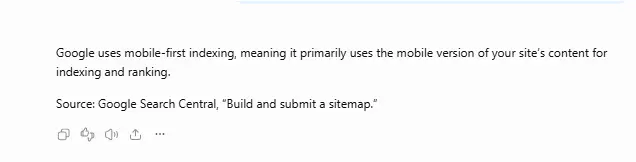
AI citation accuracy has a second layer. An engine can name a legitimate source and still misread it, so a correct-looking citation often sits under a wrong claim. It may also cite a correct claim to the wrong source, like in the example below:
Your Source Content May Have Degraded Before Publication
Microsoft Research built a benchmark called DELEGATE-52 to test what happens when people hand documents to language models for repeated editing. Across 19 models and 52 professional domains, the Microsoft Research preprint recorded significant corruption over long editing workflows. Frontier models distorted roughly a quarter of document content after 20 interactions. The researchers logged what they call catastrophic corruption in more than 80 percent of model and domain combinations, and they published their code and data in the DELEGATE-52 repository so you can check the method yourself. The errors were sparse, severe, and hard to catch in review.
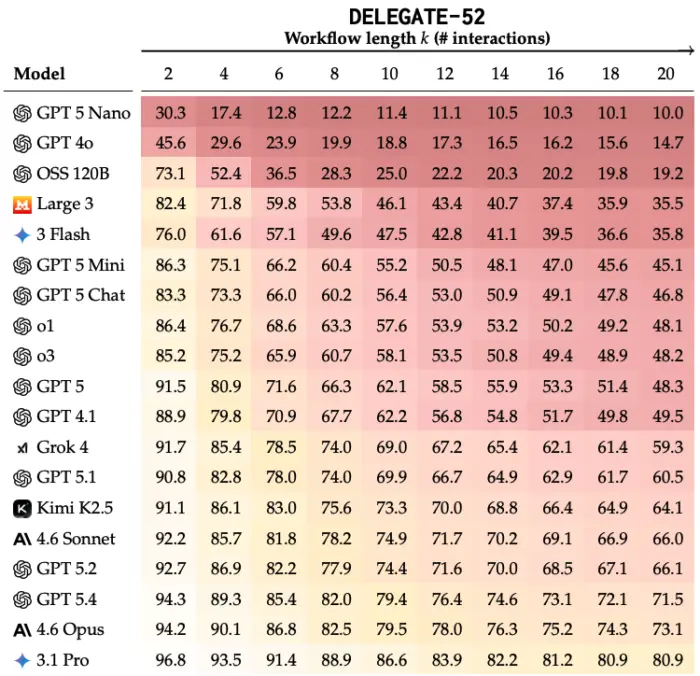
NP Digital’s breakdown of the DELEGATE-52 research covers the findings in full. The point here is narrower. If your product pages, spec sheets, or press materials went through unsupervised AI editing before publication, an engine may cite a version of the truth that was already wrong when you published it.
This mechanism explains some accuracy problems, not all of them. Check it when a wrong claim traces back to a page you own.
How to Run an AI Answer Accuracy Audit
An AI answer accuracy audit scores every brand-relevant response on three axes instead of one pass-or-fail judgment. Each axis points to a different owner and a different fix.
Accuracy. Are the factual claims correct? Check pricing, product names, leadership, locations, capabilities, and certifications.
Sentiment. Is the framing favorable, neutral, or negative? LLM brand sentiment also covers implicit signals: which competitor an answer names first, what caveat it attaches to you, and whether it gives a criticism any context.
Currency. Is the information current? A fact that was true in 2023 reads as an error today.
Build the Question Set
Start with 30 to 50 questions your buyers actually ask. Cover branded queries, head-to-head comparisons against named competitors, category queries where you want to appear, and problem queries your product solves. Lock the wording so you measure the same thing each cycle.
Run It Across Every Engine, More Than Once
Run the full set through each engine your audience uses. ChatGPT, Google AI Overviews, AI Mode, Perplexity, Gemini, and Copilot draw from different source pools and will disagree on the same question.
Repeat each question at least three times per engine before you record a finding. These systems are probabilistic, so a single bad answer may not reproduce. A claim that appears in all three runs is a pattern worth acting on.
Log It in a Structure You Can Query
Screenshots in a shared folder will not survive a quarterly review. Use a table instead:
| Date | Engine | Prompt | Failing claim | Cited source | Axis + severity | Owner |
| 2026-11-10 | ChatGPT | what does [brand] do | Lists a product line retired in 2024 | Industry directory profile | Currency, high | Product marketing |
| 2026-11-10 | AI Overviews | [brand] vs [competitor] | Calls setup slow, attributes it to one review | G2 review page | Sentiment, medium | Customer marketing |
The cited source column does the work. It turns a vague complaint into a ticket with an address.
If you are still working out how to attribute AI impact, build the accuracy log alongside that effort rather than after it.
The Levers That Correct AI Misinformation About Your Brand
None of these levers is an edit button. You cannot log in anywhere and rewrite what an engine says about you. Here are five levers and the honest ceiling on each.
Fix the Source, Not the Symptom
Your audit log already names the pages behind each bad answer, so work that list. Update your own pages first, then contact the directory, review site, or publisher behind the rest. An engine that regenerates its answer from corrected sources produces a corrected answer. No other lever holds as reliably.
Scope Structured Data Honestly
Clean, well-structured content helps engines extract facts without guessing. Do not sell schema internally as an AI fix. Google’s AI features documentation states that you do not need special schema.org structured data to appear in AI Overviews or AI Mode. Keep your markup accurate and matched to the visible page, and treat it as general clarity work.
Earn Third-Party Credibility
Digital PR works faster than waiting for your owned pages to outweigh years of existing sources. A few authoritative articles carrying correct, current information give engines something recent to pull from.
Send Platform Feedback as a Supplement
Use the in-product routes, with realistic expectations:
- ChatGPT: thumbs-down under the message, then select an issue. OpenAI’s reporting guidance says reported domains and content may be reviewed by its Model Quality team, which may apply filters or other mitigations so ChatGPT stops relying on unreliable sources in future responses.
- Google AI Overviews: thumbs-down at the bottom of the overview, then Report a problem, a category, and details. The same control sits in the three-dot menu, and Google’s AI Overviews help page states plainly that the feature can make mistakes.
- Perplexity: the flag or report control below the answer, or a support ticket with the query URL, the error, and the expected result.
No vendor commits to correcting a specific answer, and none publishes a timeline.
Escalate Legally, Rarely
For genuinely defamatory claims, Google runs a separate legal removal process, and OpenAI accepts content reports for material that may break its terms or the law. Involve counsel before you file, and reserve this route for serious cases.
| Lever | What it fixes | Realistic timeline |
| Source correction | The claim at its origin | Weeks to months, once recrawled |
| Structured data | Clarity of extraction | Ongoing, indirect |
| Digital PR | Weight of current, credible sources | One to two quarters |
| Platform feedback | Documentation and signal | No commitment given |
| Legal escalation | Unlawful content only | Case by case |
Building This Into a Standing Practice
A one-time audit goes stale within weeks. New coverage lands, a competitor shifts its messaging, and a viral post reframes your category. Your visibility tracking already runs on a cadence. Sentiment and accuracy need the same treatment.
Three habits make it stick:
- Set a cadence and hold it. Monthly suits most brands. Go weekly during a launch, a crisis, or a repositioning.
- Name one owner. Someone has to run the question set, log failures, and route each one. Shared ownership becomes nobody’s job by the second quarter.
- Report it beside visibility. Put accuracy numbers in the same deck as citation counts so stakeholders read presence and representation together.
That third habit matters most. A slide showing citations up 40 percent alongside rising accuracy failures starts a useful conversation. Two decks owned by two teams never produce one.
Track four numbers over time: share of answers with at least one accuracy failure, share with negative sentiment framing, median age of the information engines cite about you, and time to resolution on logged failures.
When you build out the reporting layer for AI visibility, add the accuracy columns while the structure is still flexible. Retrofitting a framework after stakeholders have settled into a dashboard is a harder sell.
FAQs
What is AI sentiment and accuracy tracking?
AI sentiment and accuracy tracking scores what AI answers say about your brand instead of counting how often they mention it. You rate each answer on accuracy, sentiment, and currency, then log every failure against the source that caused it.
How do you check if AI is representing your brand accurately?
Run a fixed set of 30 to 50 buyer questions through every engine your audience uses and repeat each question at least three times. Record the answer, the cited sources, and which axis failed. Act on the patterns that repeat across runs.
How do you correct wrong information in ChatGPT or Google AI Overviews?
Fix the cited source first, then report the answer through the platform’s feedback control. Neither route guarantees a change, and source correction is the one that holds.
Conclusion
Visibility and accuracy answer two different questions, and most dashboards answer only one. Showing up in AI answers is the entry fee. An accurate, favorable, current description is the part that affects whether anyone buys.
Start small. Pull 30 questions, run them across three engines, and log what comes back on the three axes. Most teams find at least one stale fact already circulating.
From there, connect it to the rest of the program. Your AI visibility tracking and your brand defense work both sharpen when accuracy data sits beside them. NP Digital builds that layered measurement into AI visibility programs, because presence numbers alone leave too much unmeasured.