 Sign In







How People Search For Questions Online
Info
-
Source: NP Digital
-
Date: December 2024
-
Category: Search Trends
-
Study Methodology: Sample size: 5,343 people (2020) and 11,105 people (2024); collection method: survey; comparison shown as 2000 vs 2024 in chart.
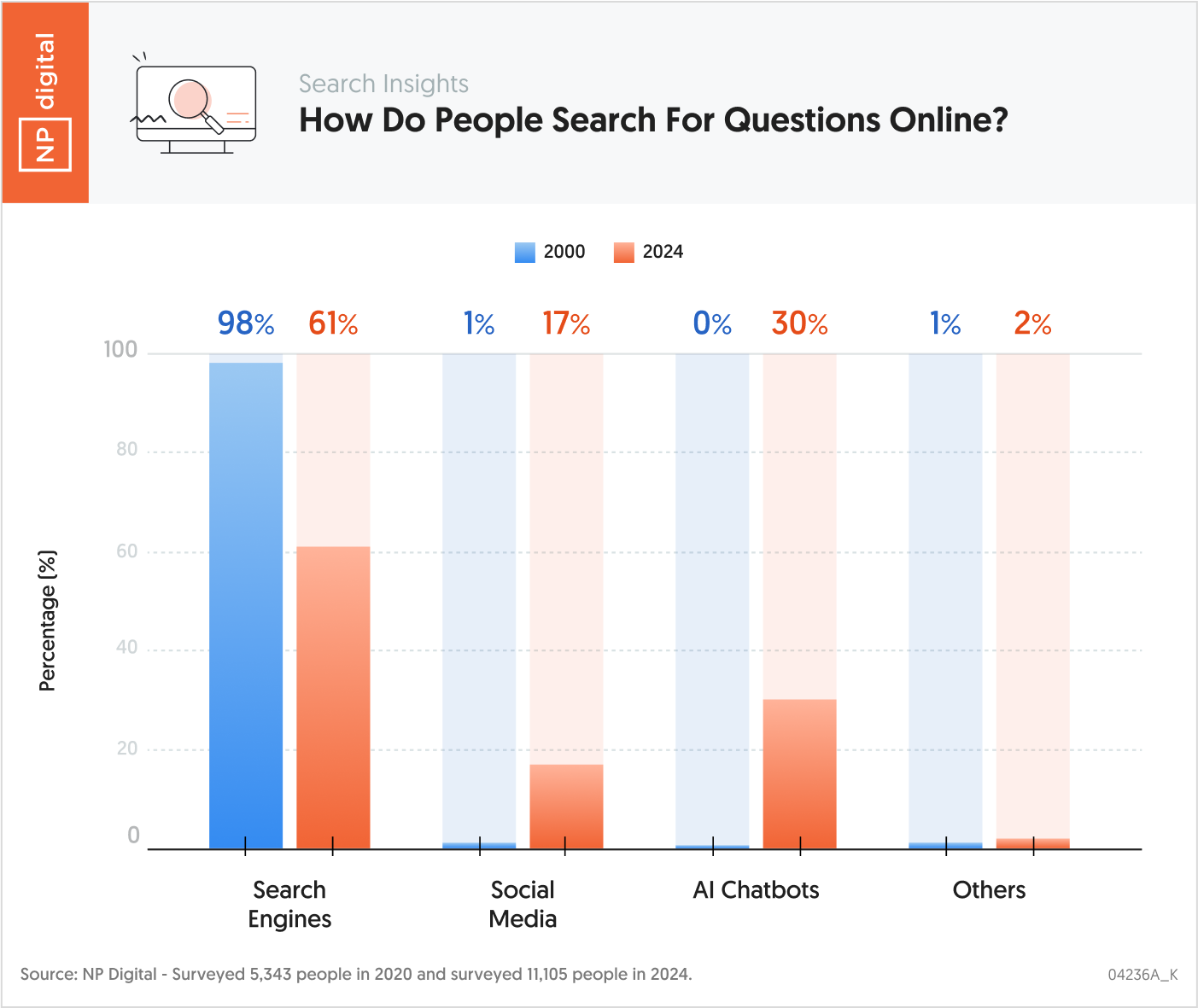
Question-based searching is no longer a single-channel behavior. People still default to search engines, but a meaningful share now asks social platforms and AI chatbots first. That changes how you earn demand, because answers can come from multiple surfaces before a user ever clicks a traditional result. This chart shows the split so you can plan distribution and content formats around real discovery behavior.
Essential Statistics
- Search engines: 98% (baseline) vs 61% (2024).
- Social media: 1% (baseline) vs 17% (2024).
- AI chatbots: 0% (baseline) vs 30% (2024).
- Others: 1% (baseline) vs 2% (2024).
- In 2024, AI chatbots represent nearly one-third of question-search behavior.
- Search engines remain the largest single channel, but no longer dominate question discovery alone.
Key Takeaways
- Your content has to answer questions in multiple ecosystems, not just Google.
- AI chatbots are now a primary discovery path for informational intent, especially early-stage questions.
- Social platforms are functioning as search engines for many users, which rewards native, skimmable answers.
- SEO still matters most, but it cannot be your only distribution strategy for question-led demand.
- Answer quality and clarity are becoming the competitive edge, because users compare answers across channels quickly.
- Brands that package answers in the right formats will capture more first touch attention and lower acquisition costs.
Actionable Insights
- Publish a question library mapped to your highest-intent FAQs. With search engines still at 61% and AI chatbots at 30%, build clear, direct answers that can be reused across web pages, support docs, and social posts.
- Rewrite key pages for extractable answers. If people are asking chatbots first, your content needs concise definitions, step-by-step sections, and strong internal linking so answers are easy to pull and verify.
- Create social-native Q&A content for recurring questions. With 17% using social media for questions, post short answer formats (carousels, short videos, threads) that match how people search inside platforms.
- Track question performance beyond rankings. Measure impressions, assisted conversions, and branded search lift from Q&A content so you can see impact even when the click does not happen immediately.
- Prioritize questions that influence purchase decisions. Use this channel split to focus on comparison, cost, and best queries where early answers shape downstream intent and conversion probability.
- Standardize one source of truth for answers. When users compare answers across channels, inconsistencies hurt trust; keep your core definitions and recommendations aligned across web, social, and chatbot-facing content.
People are not just Googling questions anymore. If you want to win the first touch, you need answers that travel well across search, social, and AI, and still lead back to your brand. – Neil Patel