 Sign In






Organic Social Media Conversion Stats
Info
-
Source: NP Digital
-
Date: May 2025
-
Category: Social & Organic Reach
-
Study Methodology: Data from 33 companies with minimum audience thresholds; surveyed at checkout and compared self-reported vs. tracked analytics conversions.
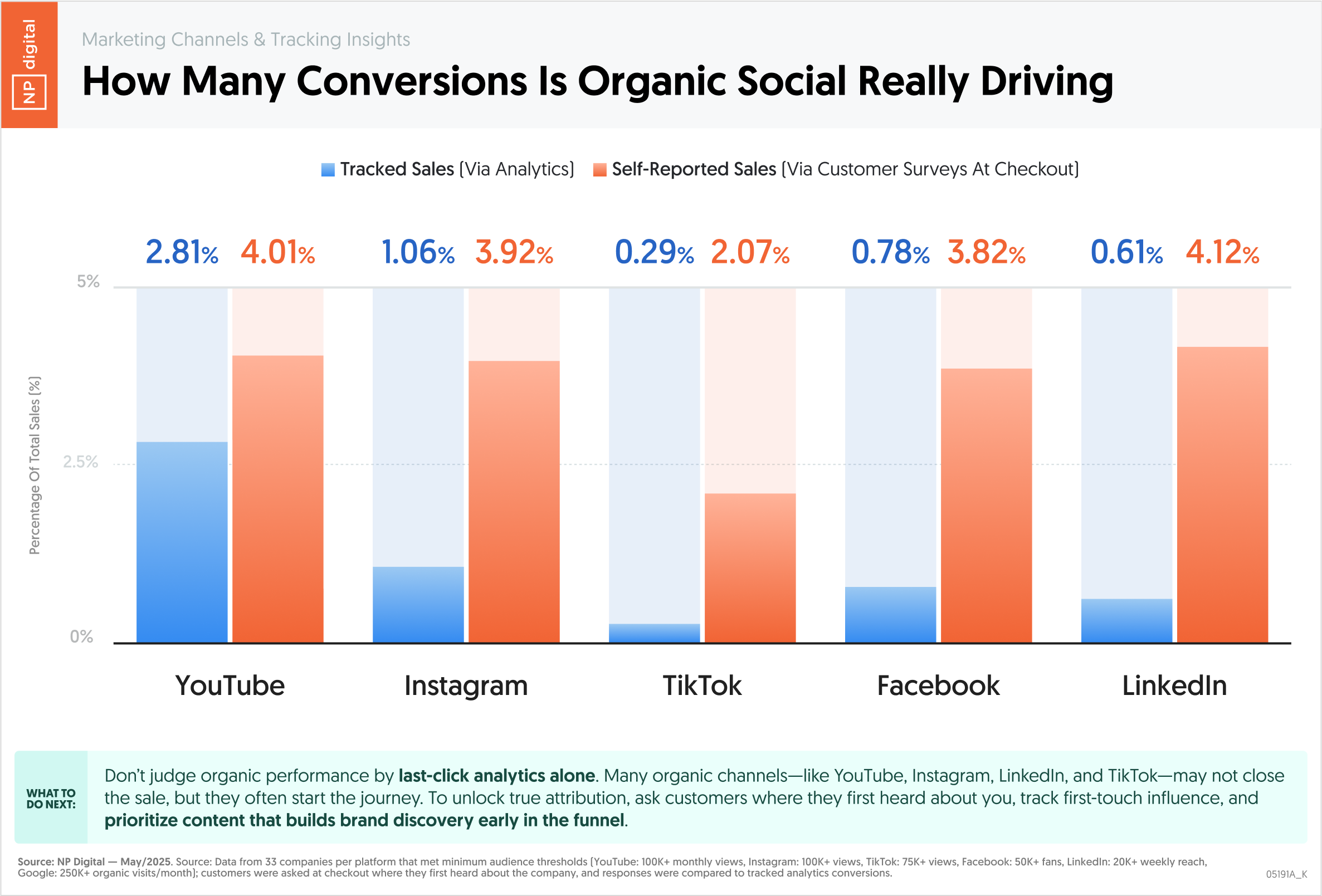
If you’re relying on last-click attribution to measure your organic social ROI, you’re missing the bigger picture. This data compares what analytics platforms track with what customers say actually influenced their decision to buy. The gap is bigger than you’d expect.
Essential Statistics
- YouTube drives 2.81% of tracked sales but 4.01% of self-reported sales.
- Instagram shows 1.06% tracked vs. 3.92% self-reported.
- TikTok’s tracked contribution is only 0.29%, while users self-report 2.07%.
- Facebook sees 0.78% of tracked conversions but 3.82% self-reported.
- LinkedIn shows the largest gap: 0.61% tracked vs. 4.12% self-reported.
- Across the board, self-reported conversions from social are significantly higher than tracked. Tracking underrepresents the influence of social, especially in early-stage awareness.
Key Takeaways
- Traditional analytics tools underreport the true impact of organic social.
- User-reported data consistently shows higher conversion influence across platforms.
- LinkedIn and TikTok have the widest reporting gaps between tracked and actual impact.
- Social media plays a larger role in brand discovery than last-click tools capture.
- Relying solely on analytics may lead to under-investing in top-of-funnel content.
- Organic social is a valuable part of a full-funnel marketing strategy.
- Customer behavior insights add depth to campaign attribution models.
Actionable Insights
- Stop using last-click conversions to judge organic social. The self-reported lift shows social influences purchases even when analytics cannot attribute it cleanly.
- Add a ‘How did you hear about us?’ field at checkout. Compare those answers to your tracked sources to quantify the gap by platform.
- Treat LinkedIn and YouTube as influence engines. They show large differences between tracked and self-reported impact, which is a signal to invest in consistent thought leadership.
- Build platform-specific content that people remember. If social is influencing later, your job is to create repeatable formats (series, recurring hooks) that stick in buyers’ minds.
- Use retargeting to connect the dots. Social often creates awareness, so follow up with search and remarketing campaigns to capture the conversion moment.
- Report assisted impact monthly. Share both tracked conversions and survey-attributed influence so stakeholders do not underfund organic social.
Most marketers are underestimating organic social because they’re measuring it wrong. Start tracking brand discovery, not just conversions. – Neil Patel