 Sign In






Confidence in Measuring AI Visibility
Info
-
Source: NP Digital
-
Date: May 2026
-
Category: AI & GEO Optimization
-
Study Methodology: Sample size: 500 marketers and business owners (Enterprise: n=150 [1,000+ employees]; Mid-Market: n=200 [100-999 employees]; Small Business: n=150 [1-99 employees]). Data source: NP Digital survey. Collection method: Online survey.
Measuring AI visibility is one of the most consequential unsolved problems in modern marketing. The channel is absorbing a growing share of search behavior, driving a meaningful percentage of brand discovery, and influencing purchase consideration, yet only 12 percent of marketers across all company sizes report being very confident in their ability to measure how visible they are within it. This is not a small-team problem. Among enterprise organizations with over 1,000 employees and presumably dedicated analytics infrastructure, only 50 percent report any meaningful level of confidence in their AI visibility measurement. The gap between channel importance and measurement capability is widening, and the teams that close it first will have a compounding analytical advantage over those that wait.
Essential Statistics
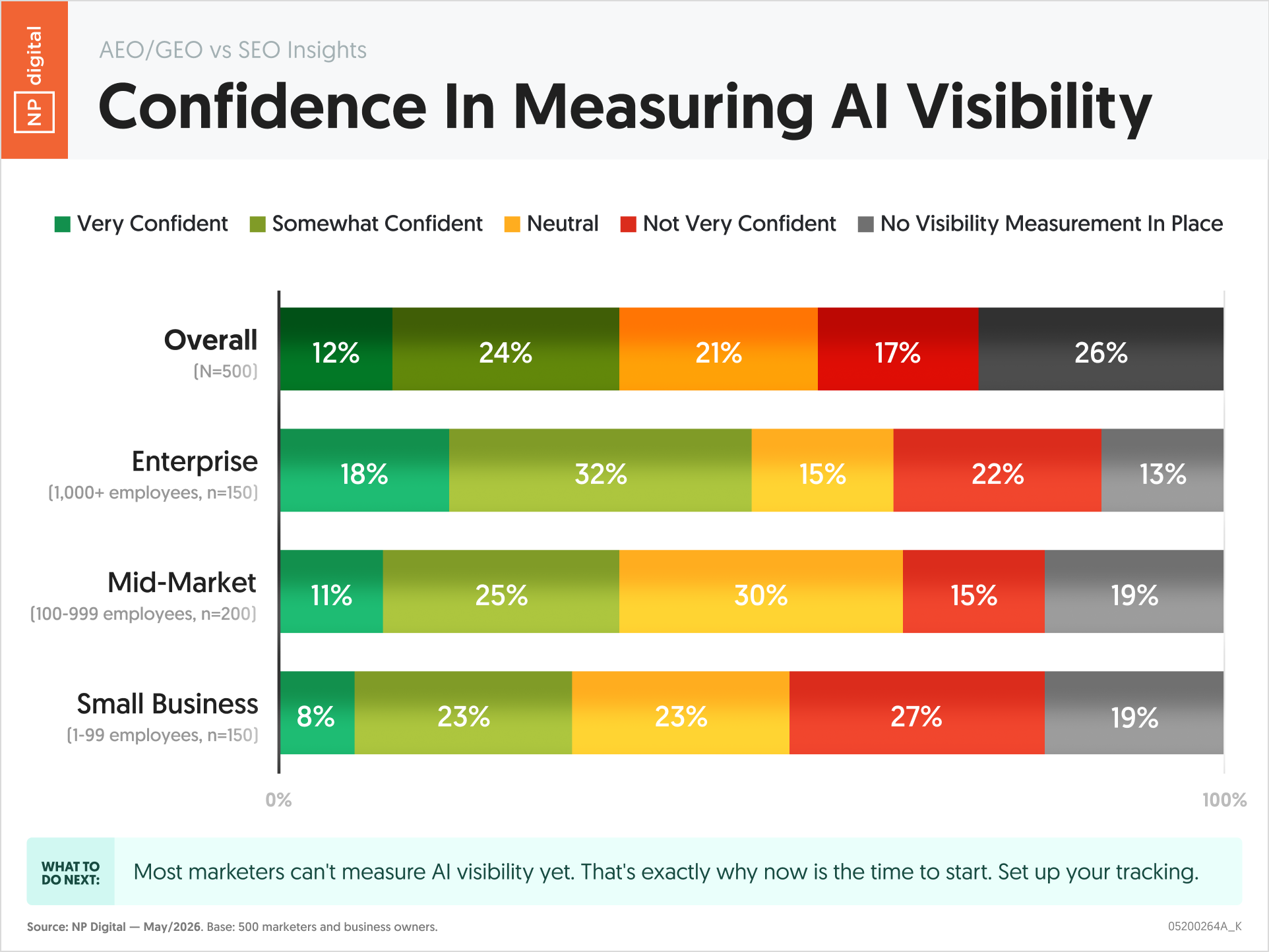
- Only 12 percent of all respondents report being very confident in their ability to measure AI visibility across search surfaces.
- 24 percent are somewhat confident, making the combined confident segment just 36 percent of all respondents.
- 21 percent are neutral, 17 percent are not very confident, and 26 percent have no AI visibility measurement in place at all.
- Enterprise organizations (1,000-plus employees) show the highest confidence: 18 percent very confident and 32 percent somewhat confident, for a 50 percent combined rate.
- Mid-market businesses (100 to 999 employees) show 11 percent very confident and 25 percent somewhat confident, for a 36 percent combined rate.
- Small businesses (1 to 99 employees) show the lowest confidence: 8 percent very confident, with 27 percent not very confident and 19 percent having no measurement in place.
Key Takeaways
- The 26 percent with no AI visibility measurement in place at all are not a separate category from the measurement confidence problem but its most extreme expression. These organizations are making decisions about AEO investment, content format priorities, and search channel budgets without any data from one of the fastest-growing discovery channels.
- The enterprise confidence gap is the most instructive finding in the segmented data. Enterprise organizations have the largest analytics teams, the most sophisticated MarTech stacks, and the greatest access to emerging measurement tools. Yet only 50 percent report meaningful confidence in AI visibility measurement. If the organizations with the most resources have not solved this measurement problem, it is genuinely difficult versus just under-resourced.
- The mid-market confidence rate of 36 percent matching the overall average suggests that company size beyond a certain threshold does not provide meaningful measurement advantage for AI visibility specifically. The tools and methodologies for AI citation measurement are nascent enough that mid-market and enterprise teams are largely working from the same early-stage playbook. A well-resourced mid-market team can match enterprise measurement capability in this specific domain.
- Small businesses at 8 percent very confident face the steepest measurement challenge, but they also operate in a market where most competitors are in the same position. The small businesses that establish basic AI visibility monitoring now will have a meaningful data advantage over the 73 percent of their peer group that are either not confident or not measuring.
- The measurement gap creates a compounding competitive advantage for early movers. Teams that establish AI visibility baselines in 2026 will have 12 to 18 months of trend data by late 2027. This data shows how citations change in response to specific content and PR investments, which AI surfaces are most important for their category, and what the relationship between AI visibility and business outcomes looks like for their specific market.
Actionable Insights
- Set up a manual AI citation monitoring process for your top 20 brand and category keywords this month, regardless of where your current tooling stands. The 26 percent with no measurement in place do not need to wait for purpose-built AI visibility tools to start building baseline data. Run the same 20 queries weekly across ChatGPT, Gemini, Perplexity, and Google AI Overviews and log whether your brand appears, in what context, with what framing, and which competitors appear alongside you. A consistent manual process run over 90 days produces meaningful trend data.
- For enterprise teams in the 50 percent combined confident category, conduct a coverage audit of your current AI visibility monitoring to identify which surfaces you are tracking and which are blind spots. Enterprise confidence often reflects confidence in tracking one or two AI surfaces well rather than comprehensive coverage. Map your current monitoring against ChatGPT, Gemini, Perplexity, Claude, Bing Copilot, Google AI Overviews, and any vertical-specific AI tools relevant to your industry. Gaps in coverage create false confidence in incomplete data.
- Build an AI visibility KPI into your quarterly marketing review with a defined measurement methodology. With only 12 percent very confident overall, most teams do not have AI visibility as a formal reporting metric. Adding it forces the team to confront measurement gaps and creates accountability for improving visibility over time.
- Invest in understanding the AI visibility measurement tools your existing SEO platform vendors are building. Most major SEO platforms have announced or released AI citation and GEO tracking features. Understanding what is available now versus what is coming in the next two quarters helps you plan your measurement expansion without purchasing redundant standalone tools or building manual processes for capabilities your existing stack will soon provide.
- For small businesses in the 73 percent not-very-confident or not-measuring category, focus measurement resources on the AI surfaces most relevant to your customer’s discovery behavior before attempting comprehensive monitoring. A local service business should prioritize Google AI Overviews and Google Maps AI features. A B2B company should prioritize ChatGPT and Perplexity, where professional users conduct research. Starting with the surfaces where your audience actually discovers brands gives you the most actionable early data with the least measurement overhead.