 Sign In









More Channels Published Monthly Means More AI Citations
Info
-
Source: NP Digital
-
Date: June 2026
-
Category: AI & GEO Optimization
-
Study Methodology: Data from 15 brands tracked across AI platforms. AI visibility score measured as citations per month.
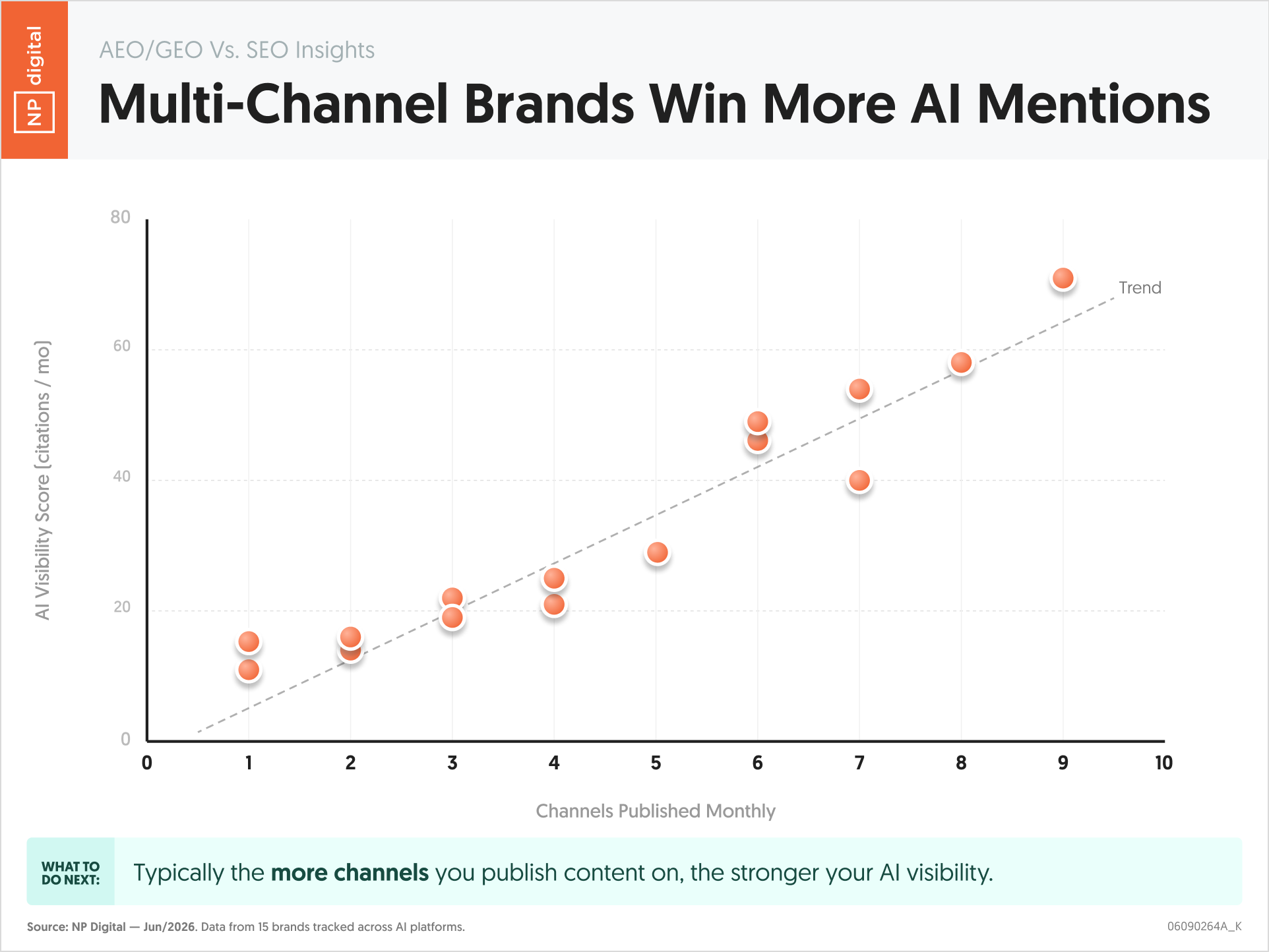
AI citation volume and multi-channel publishing are positively correlated. This scatter plot from 15 brands tracked across AI platforms shows that brands publishing on more channels per month consistently achieve higher AI visibility scores, measured in citations per month. The relationship is not perfectly linear, but the trend is clear and consistent enough to support a direct strategic recommendation: expanding the number of channels where content is published produces measurable AI citation gains.
Essential Statistics
- Brands publishing on one channel per month achieve AI visibility scores in the range of 10 to 15 citations per month.
- Brands publishing on three to four channels per month show AI visibility scores ranging from approximately 18 to 25 citations per month.
- Brands publishing on six channels per month show AI visibility scores in the 45 to 50 citations per month range.
- The highest-performing brand in the dataset, publishing on nine channels per month, achieves approximately 70 citations per month.
- The scatter shows variance at every channel count level, confirming that channel count is a strong predictor of AI visibility but not the only factor. Content quality and topic relevance within each channel also affect citation rates.
Key Takeaways
- The positive correlation between channels published and AI visibility holds consistently across the full range of the dataset, from one channel to nine channels. This is not a relationship that appears only at the high end of channel diversity. Even moving from one to three channels produces a meaningful visibility improvement across the brands tracked.
- The variance at each channel count level indicates that adding a channel is necessary but not sufficient for AI citation gains. Brands at six channels show a range from approximately 40 to 50 citations per month, meaning that two brands with the same channel count can achieve meaningfully different visibility scores based on content quality, topic authority, and audience engagement within those channels.
- The 70-citation monthly score for the nine-channel brand is approximately four to five times the score of one-channel brands. This scale of difference has direct implications for how much AI-referred traffic and revenue potential separates single-channel from multi-channel content strategies.
- The AI model behavior underlying this pattern likely reflects training data weighting: brands mentioned across many different source types, blogs, social media, news, video, forums, are represented more broadly in training corpora, which makes them more likely to be surfaced as citations across a wider range of queries.
- The practical implication for most brands is not to publish everywhere simultaneously but to identify the two or three channels adjacent to their current primary channel where their audience is already present, and begin publishing there before optimizing for long-tail channel additions.
Actionable Insights
- Map your current publishing channels and calculate your actual channel count per month before setting AI visibility goals. Most brands underestimate their channel diversity because they do not count all active publishing surfaces. A brand publishing blog content, LinkedIn posts, YouTube videos, and press releases is already at four channels. Identifying the starting point accurately is the prerequisite to making informed decisions about where to add the next channel.
- Prioritize adding channels where AI platforms demonstrate high citation rates based on the source type data from this batch. UGC and forums rate Very High for AI citations, and blogs and news rate High. Adding a Reddit presence, a guest posting program in trade publications, or a systematic media outreach effort adds to channel count while specifically targeting the source types that AI systems cite most frequently.
- Set a 90-day channel expansion pilot before committing to permanent new channel investment. Choose one channel adjacent to your current primary publishing surface, produce a defined volume of content, and measure AI visibility score change at the end of the period. The 15-brand dataset shows consistent improvement from channel addition, but your specific improvement will depend on content quality and topic match. A 90-day pilot produces enough data to validate the investment before scaling.
- Do not treat channel count as the primary GEO metric. The variance in the scatter plot confirms that two brands at the same channel count can have very different AI visibility scores. Channel count is a leading indicator and a controllable input, but citation frequency is also affected by content quality, structural formatting, recency, and authority within each channel. Track both channel count and citation score as complementary metrics rather than treating one as a proxy for the other.
- Build a channel expansion roadmap that sequences new channel additions based on audience overlap with existing channels. Adding a YouTube channel when your primary audience is on LinkedIn requires building a new audience from scratch. Adding a LinkedIn newsletter when you already publish LinkedIn posts leverages existing audience infrastructure. Sequencing channel additions by proximity to existing audiences produces faster AI visibility gains than pursuing maximum channel diversity in the shortest possible time.
“The more channels you publish on, the more AI citations you earn. That relationship holds consistently across 15 brands from one channel to nine. The brands generating 70 citations per month are not doing one thing better than the brands generating 15. They are doing it in more places, across more source types, reaching more of the surfaces that AI systems train on and cite from.” – Neil Patel