 Sign In









 Ubersuggest
  AnswerThePublic
 Claude Code Adoption Among Marketers: 16% to 33% in 3 Months
Info
-
Source: NP Digital
-
Date: May 2026
-
Category: AI In Marketing
-
Study Methodology: Data from surveying the same 100 marketers each month for 3 months. Longitudinal panel survey tracking the same 100 marketers across February, March, and April 2026.
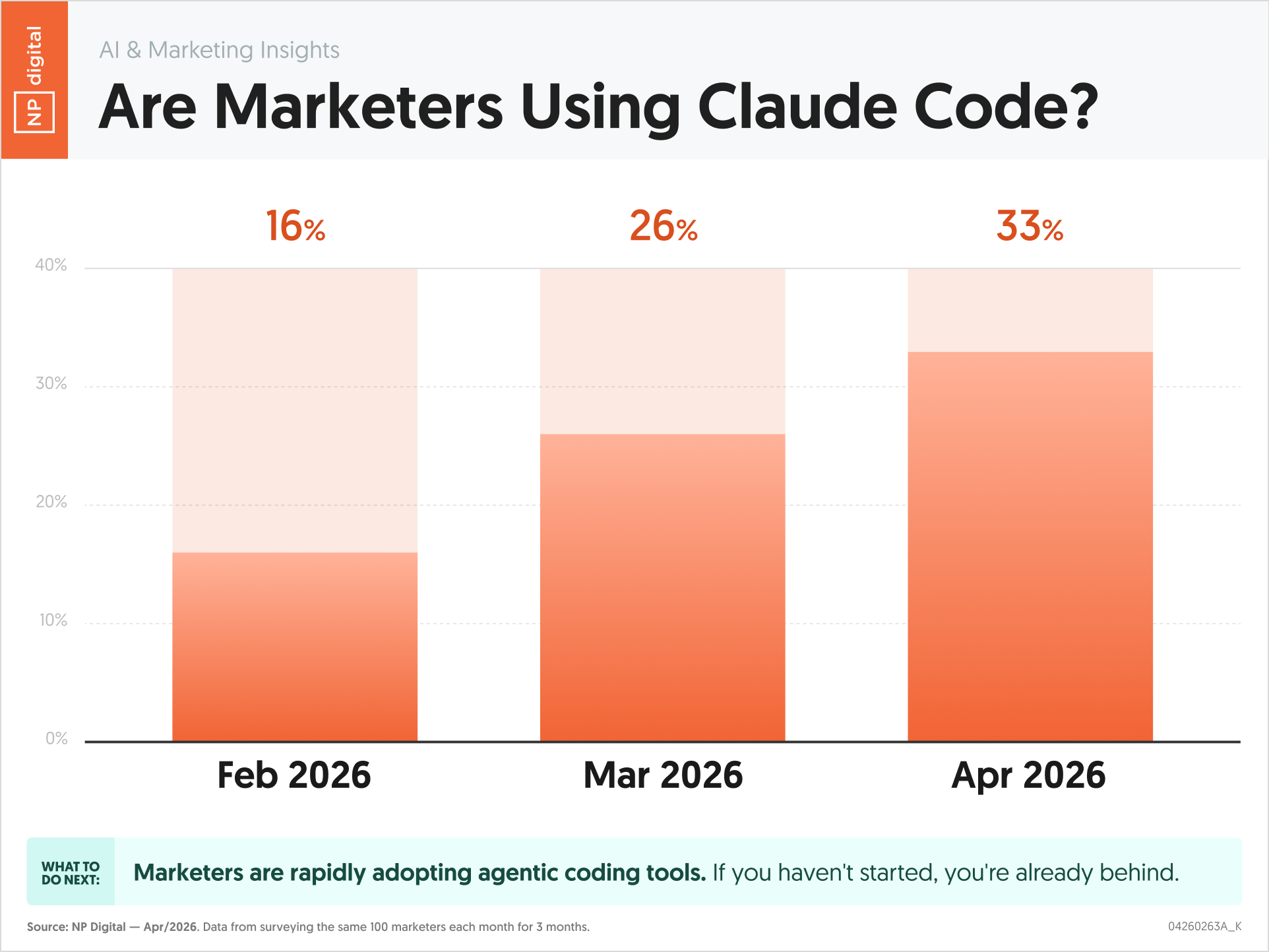
Claude Code adoption among marketers is not trickling in. It is accelerating. This longitudinal panel of the same 100 marketers tracked monthly shows adoption more than doubling from 16 percent in February to 33 percent in April, with consistent month-over-month growth. The speed of this adoption curve within a marketing audience rather than a developer audience signals that agentic coding tools are crossing into mainstream marketing workflows faster than most observers anticipated.
Essential Statistics
- Claude Code adoption among the 100-marketer panel stood at 16 percent in February 2026.
- Adoption grew to 26 percent in March 2026, a 10 percentage point increase from the prior month.
- By April 2026, adoption reached 33 percent, adding another 7 percentage points and bringing total growth to 17 percentage points over three months.
- The month-over-month growth rate was 62.5 percent from February to March and 26.9 percent from March to April, suggesting the steepest growth occurred in the first month of the observation period.
- At the February-to-April growth rate, Claude Code adoption in this marketer cohort could approach 50 percent within the following two to three months if the trajectory continues.
Key Takeaways
- A 17 percentage point adoption increase in three months within a marketing-specific panel is a rapid adoption signal. Developer adoption of new coding tools typically leads marketer adoption by months or years. The speed of this curve in a non-developer audience reflects how Claude Code and similar tools are being positioned and used for marketing-adjacent tasks rather than pure software development.
- The consistent month-over-month growth without a plateau through the three-month window suggests adoption has not yet hit its ceiling within this cohort. If the growth rate continues even at a declining pace, the majority of marketers in this panel will be using Claude Code within six months of the observation start.
- The What To Do Next callout is unusually direct: marketers are rapidly adopting agentic coding tools and if you have not started, you are already behind. That framing reflects the speed at which the competitive landscape is shifting rather than a speculative prediction.
- Claude Code’s marketing use cases likely include automating data pulls, building tracking scripts, generating marketing performance dashboards, and managing integrations between tools without requiring dedicated engineering resources. These are tasks that previously required a developer hand-off and now can be executed by marketing team members directly.
- The longitudinal panel methodology, tracking the same 100 marketers each month, makes this adoption curve more reliable than cross-sectional surveys that might capture different populations at each measurement point.
Actionable Insights
- Identify one marketing workflow in your current operation that requires developer assistance and test whether Claude Code can handle it without the hand-off. The most common starting points are data export automation, custom tracking script generation, and API connection between marketing tools. A successful test on one workflow builds the internal case for broader adoption faster than any survey data can.
- Share the adoption trajectory data with your marketing leadership team as a competitive context signal. One in three marketers in this panel is already using Claude Code. If your team is in the two-thirds not yet using it, the framing is not about whether to adopt but about how quickly the gap will affect competitive capability in areas like data automation, reporting speed, and workflow efficiency.
- Evaluate which team members have the highest tolerance for learning new technical tools and start Claude Code adoption with them rather than rolling out broadly. Adoption within a marketing team rarely happens uniformly. Finding the two or three people most likely to use Claude Code effectively and building internal case studies from their workflows accelerates broader team adoption more efficiently than organization-wide training.
- Connect Claude Code adoption to a specific marketing performance metric rather than treating it as a general capability investment. Teams that can point to a concrete output, such as a custom attribution report that previously took two days to build now taking two hours, generate the internal momentum that sustains adoption beyond initial experimentation.
- Monitor the adoption curve in your team over the following three months using the same monthly tracking methodology this survey used. Setting a baseline adoption rate in your team now and measuring it monthly gives you the same longitudinal view this data provides at an industry level, applied to your specific organization.
“One in three marketers is now using Claude Code. Three months ago it was one in six. That growth rate in a marketing audience tells you that the definition of what a marketer can do technically is changing faster than most teams have adjusted for. The marketers who figure out how to use agentic coding tools effectively will have a capability advantage that compounds over time.” – Neil Patel