 Sign In









How People Spend Their Day
Info
-
Source: OurWorldInData.org - OECD Time Use Database, Gender Data Portal
-
Date: December 2025
-
Category: Search Trends
-
Study Methodology: OECD Time Use Database; surveys across multiple countries.
Essential Statistics
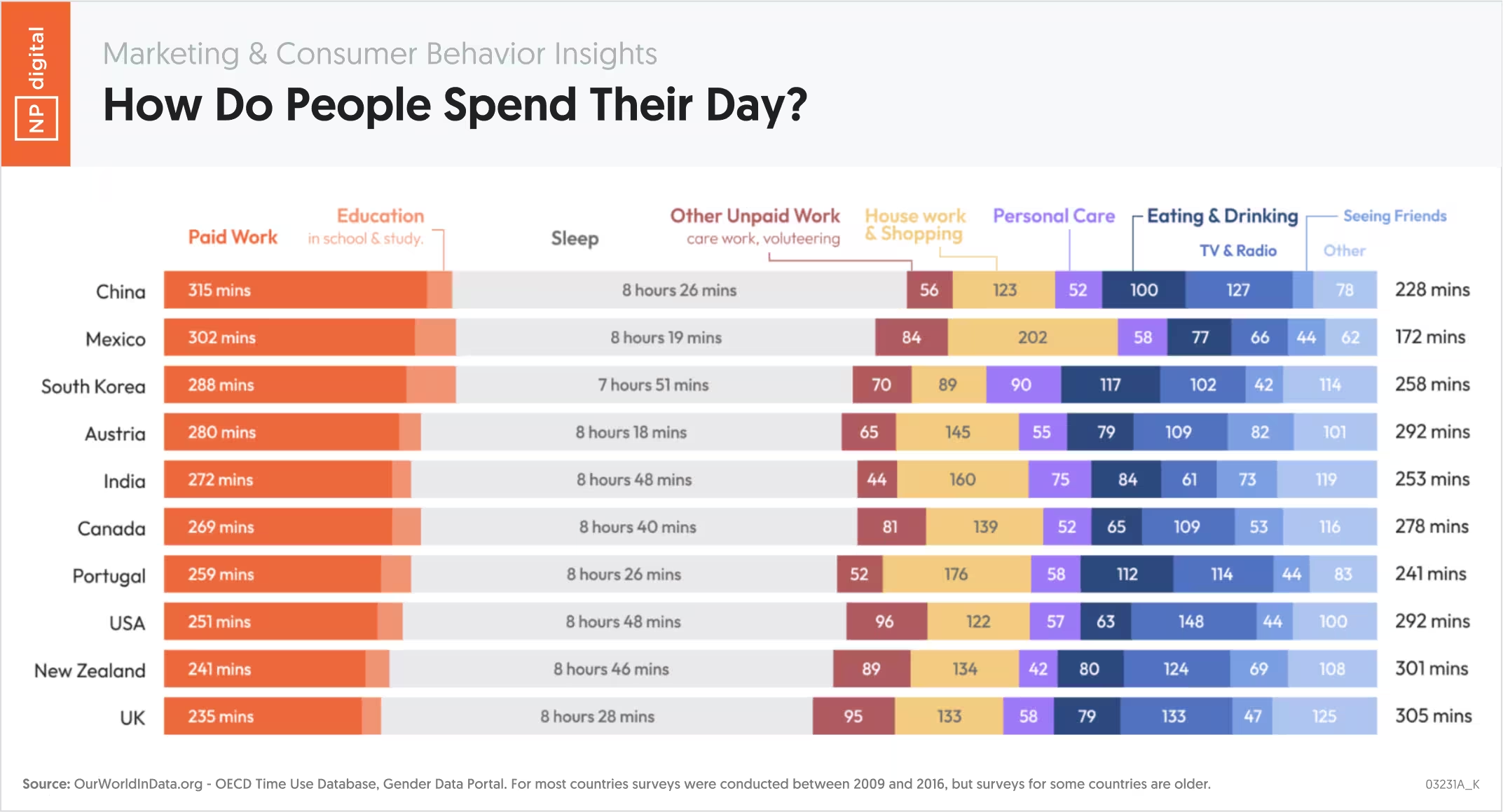
- China leads daily paid work time at 315 minutes, compared to the UK at 235 minutes.
- India and the USA record the highest sleep durations at 8 hours 48 minutes.
- Austria allocates 145 minutes to housework and shopping, the highest in the dataset.
- Personal care time peaks in South Korea at 90 minutes.
- Eating and drinking varies widely, with the USA reaching 148 minutes.
- The UK records the highest leisure/social time at 125 minutes.
Key Takeaways
- High paid-work countries show reduced discretionary time for digital consumption.
- Markets with longer sleep cycles may experience shorter peak engagement windows.
- Large housework blocks reduce the number of continuous attention segments in a day.
- Wellness, food, and entertainment opportunities differ substantially by culture.
- Time-use structure strongly shapes purchasing behaviors and marketing channel effectiveness.
- Daily routines help predict when audiences are most receptive to brand messaging.
Actionable Insights
Optimize Campaign Timing by Culture
Adapt messaging windows to each region’s daily rhythm to improve engagement.
Target Wellness in Low-Sleep Markets
Areas with shorter sleep cycles may respond strongly to wellness and stress-reduction content.
Serve Bite-Sized Content in High-Work Regions
Short-format assets perform better where discretionary time is limited.
Build Leisure-Time Funnels
Capture attention during long entertainment windows with relatable storytelling.
Use Time-Use Data in Persona Modeling
Replacing generic personas with behavioral-time personas boosts accuracy.
Adjust Channel Mix to Lifestyle
Channels like email or social may outperform search in markets with fragmented time blocks.