 Sign In







The GEO Opportunities Smaller Teams Would Prioritize
Info
-
Source: NP Digital
-
Date: October 2026
-
Category: AI & GEO Optimization
-
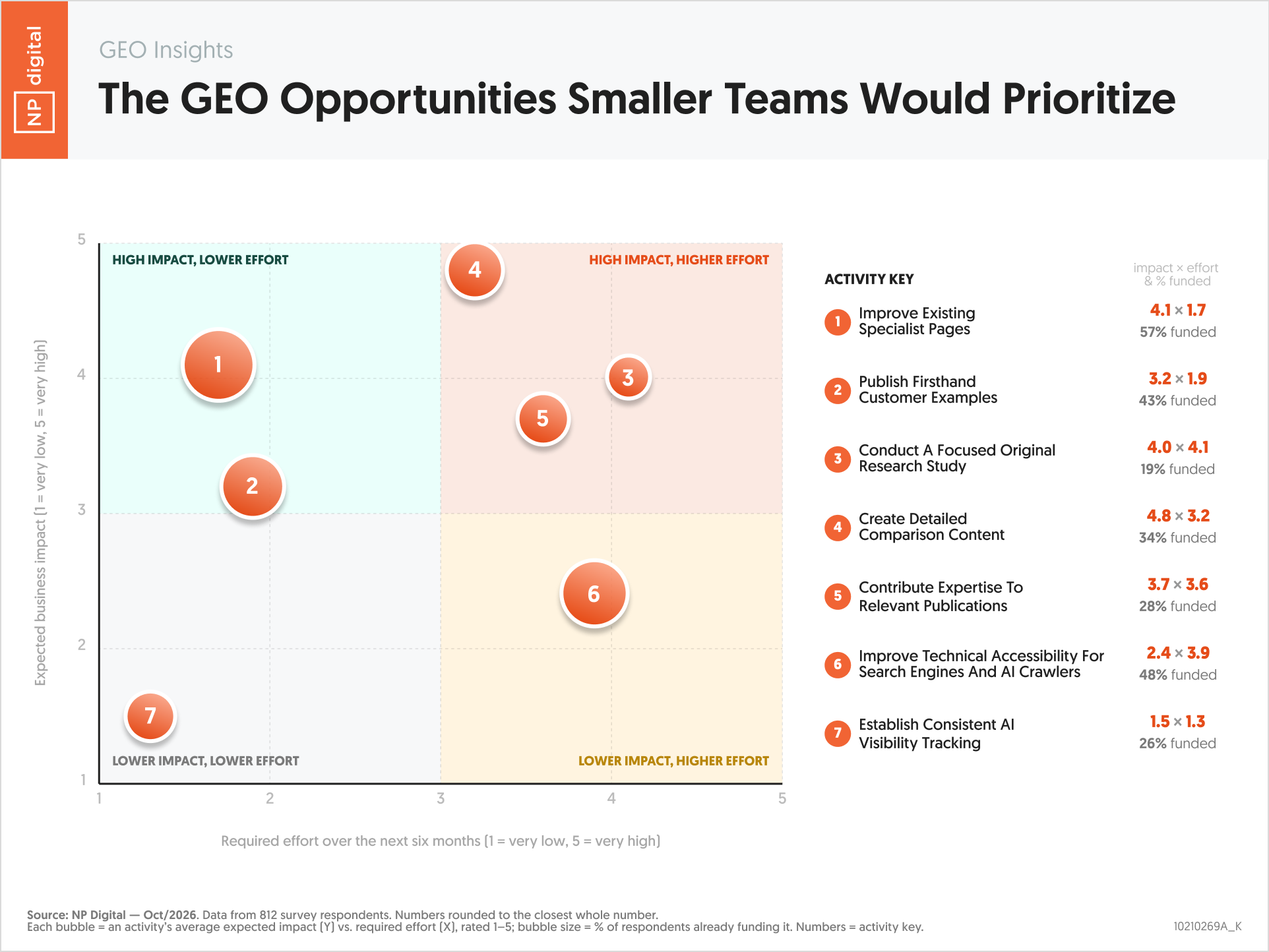
Study Methodology: Data from 812 survey respondents. Each activity's average expected impact versus required effort, both rated 1 to 5; bubble size represents share already funding it.
Smaller marketing teams have to be selective about where they invest limited GEO resources, and a survey of 812 marketers shows a clear best option. Improving existing specialist pages scores high on expected impact while requiring relatively low effort, making it the standout opportunity in the high-impact, lower-effort zone. Creating detailed comparison content scores even higher on impact, but at a cost of being the most effort-intensive activity measured.
Essential Statistics
- Improving existing specialist pages scores 4.1 in expected impact against only 1.7 in required effort, with 57% of teams already funding it.
- Creating detailed comparison content scores highest in expected impact at 4.8, but also requires the highest effort at 3.2.
- Conducting a focused original research study scores 4.0 in impact but requires 4.1 in effort, the highest effort-to-impact ratio measured, and only 19% of teams currently fund it.
- Publishing firsthand customer examples scores 3.2 in impact against 1.9 in effort, with 43% of teams already funding it.
- Establishing consistent AI visibility tracking scores lowest in both impact and effort, at 1.5 and 1.3 respectively, with only 26% of teams funding it.
Key Takeaways
- Improving existing specialist pages combining high impact with low effort suggests this is the single most efficient opportunity available to smaller teams right now.
- Creating detailed comparison content scoring highest in impact but also high in effort suggests it’s a strong investment but one that requires real resourcing commitment to execute well.
- Original research scoring high in impact but requiring the most effort, combined with low current funding, suggests this remains an underpursued opportunity primarily due to resource constraints rather than lack of perceived value.
- AI visibility tracking scoring lowest on both dimensions suggests smaller teams don’t yet see this as either a high priority or a resource-intensive one, which may be worth revisiting as AI search continues to grow.
- This impact-versus-effort mapping suggests smaller teams should sequence their GEO investments starting with the highest-efficiency opportunities before tackling higher-effort initiatives.
Actionable Insights
- Start by improving your existing specialist pages before launching any new content initiatives, since this delivers the strongest impact-to-effort ratio in this data and over half of teams are already funding it.
- Treat creating detailed comparison content as a planned, resourced project rather than a quick win, given its high effort requirement, but prioritize it once lower-effort opportunities are addressed.
- Consider a focused, narrow original research study rather than a broad one if resources are limited, since this activity scores well on impact but currently sees low funding, likely due to its effort demands.
- Continue publishing firsthand customer examples as a steady, moderate-effort activity, since it offers a solid impact score without requiring the heaviest resourcing.
- Revisit AI visibility tracking periodically even though it scores lowest here, since its low current priority may shift as AI-driven discovery continues to grow in importance.
‘Improving the pages you already have beats almost everything else on this list for the effort it takes. Start there before you build anything new.’ – Neil Patel