 Sign In














Content. Traffic. Revenue.
These are the 3 things that truly matter. Every other metric is secondary in your content marketing strategy..
The good news is that they’re all intertwined: the more useful the content you have on your site, the more likely you are to increase your traffic and revenue.
For this reason, both B2B and B2C companies are creating more content. According to State of Inbound, 41% of content marketers say that their content creation is generating a return on that investment.
I’m always surprised by what I learn while writing.
I write to help my readers improve their SEO and content marketingknowledge. I write to help them generate organic traffic, acquire leads and increase revenue.
But many times, I walk away with insights I can put to work to make my content more interesting, more helpful and more engaging. I fine-tune my own SEO content and improve my own search engine results.
I’ve found that the right content will drive traffic, engagement, and conversion. When I apply each insight into my content creation and see a significant result, I quickly turn it into a replicable strategy.
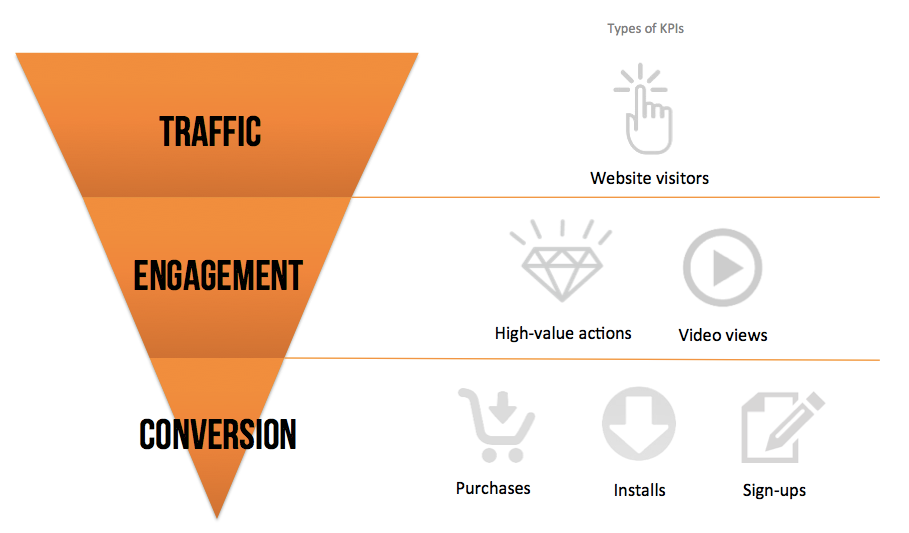
Today, you’ll learn 6 strategies that’ll help you create highly engaging content that will draw your target audience in.
1. Align your tone to your target audience.
I like to describe “tone” as a quality of writing that adds strength to your content. Your tone can be formal, informal, intimate, solemn, ironic, playful, etc.
An understanding of voice and tone in writing will give you an edge over the competition. Too many content strategists ignore these elements because they are focused on SEO content, but they’re the ingredients that add flavor to your writing.
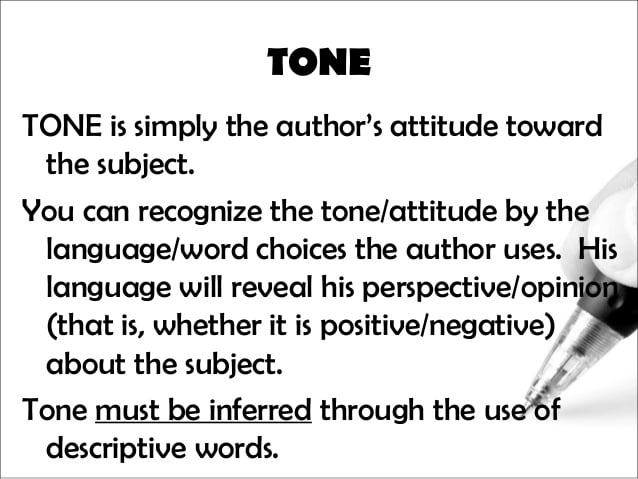
One of the reasons why people struggle to captivate readers is because they’re not paying attention to their tone. So, people click on their titles and leave.
According to Wheaton College, “the overall tone or attitude of a piece of writing should be appropriate to the audience and purpose. One way to achieve proper tone is to imagine a situation in which to say the words being written.”
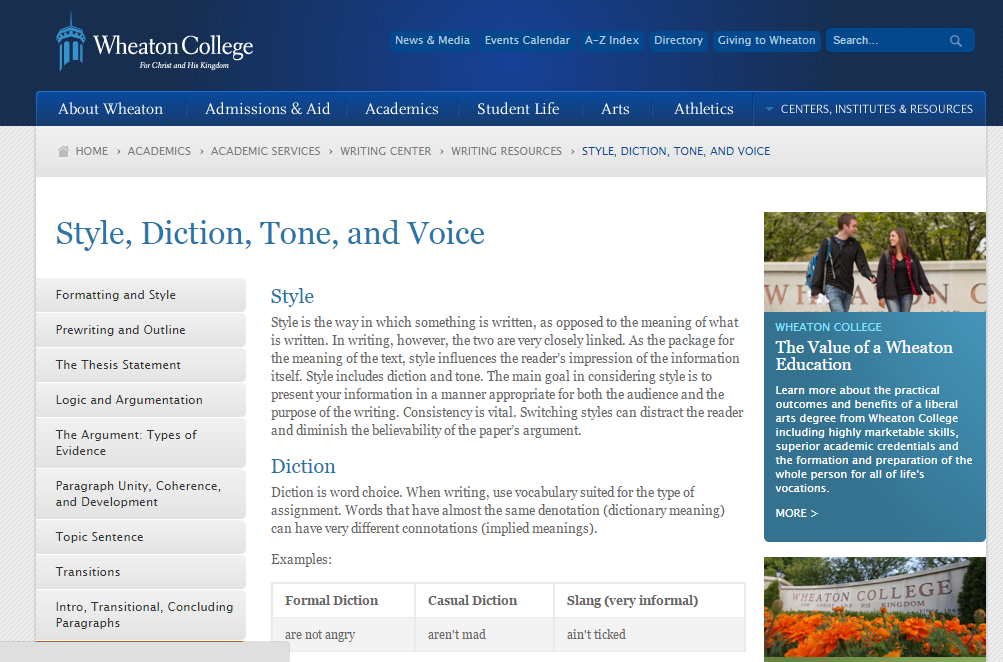
Even if your overall writing isn’t bad, the way that you deliver or present your value matters. The purpose of writing is to give your audience a wake-up call — to inspire them by your content creation.
Don’t try to show how clever or knowledgeable you are. Do you know why there aren’t that many university professors who are bestselling authors? One reason is that academic writing can be dry and complex. They have content, but they need a better content strategy.
Bestselling novels and nonfiction books don’t sound like academic works – and neither should your content. Use common English words. Instead of writing the word “famished,” use “hungry.” Forget “ubiquitous” – just use “everywhere.”
A good content writer will write the way you speak. Write blog posts as if you’re conversing with a single reader. Let your tone and vision draw the target audience closer to you.
Pay attention to how you answer your users’ questions and engage with them, on your site and on social sites like Twitter, Facebook, Pinterest, etc.
As a general rule, don’t use a professional or formal tone in your blog posts. You may get a few people to follow you, especially those who value professionalism over relevance, but sooner or later, you’ll struggle to attract new readers with this content marketing strategy.
People don’t read blogs or web content in order to appear clever. They want real answers and solutions to their problems. Welcome them with fresh and entertaining content.
Stick to relevant topics, find and use the right tone, and you’ll build an audience that trusts you.
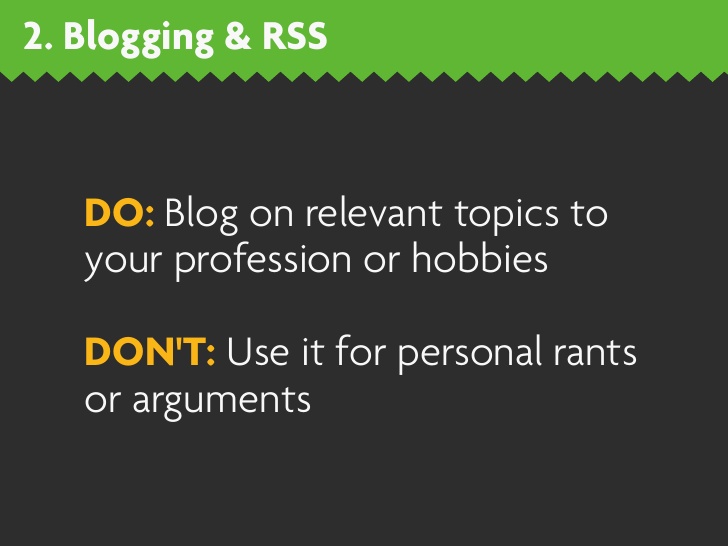
Help people by being interesting and useful. Even if you’re writing about rocket science, you can break the complicated aspects into a step-by-step guide.
2. Leverage third-party data and expand on it.
Third-party data is the kind of data that you find on industry blogs, online publications, videos, online courses, ebooks, etc. The data doesn’t primarily come from you, so you’ve got to be careful how you use it. But it can be a strong component of your content strategy, especially if you are not a prolific content writer.
For years, content writers and bloggers have looked for a simple solution that lets them create content that converts.
But instead of just curating content, I’d suggest a better way.
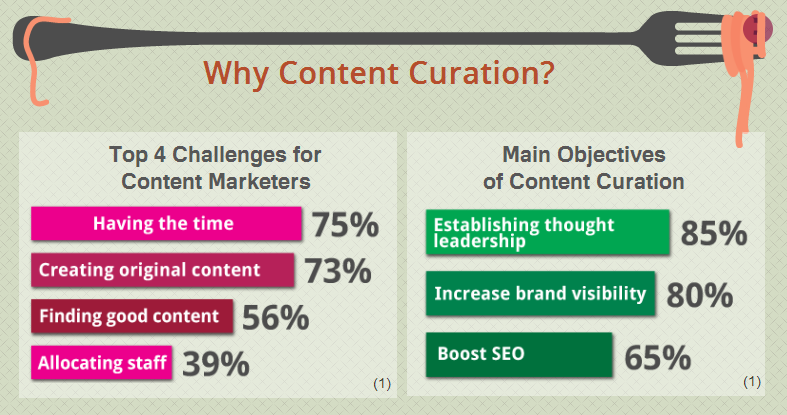
Why do you think writers read a lot of books, even ones unrelated to their niches or interests? They want to increase their knowledge because they know it helps their writing. They read in order to collect ideas from other authors.
It’s not just writers who do this. In response to a question about how to get smarter, Warren Buffett said, “I just sit in my office and read all day.” He estimated that he spends 80% of his working day reading and thinking.
That said, reading alone can’t help you in content creation that your target audience craves. You have to go further and showcase results from experiments, research studies, projects, etc. There needs to be more to your content strategy.
In “Stephen King’s 20 tips for becoming a frighteningly good writer,” Jon Morrow gives a formula for writing popular blog posts.
The part that piqued my interest is that you should “jot down a list of blog posts that you could write about, and circle the ones at least 80% of your readers would find irresistible.”
There are thousands of pages full of data out there. How do you pick the right data to leverage and expand on?
Take Jon’s advice and make sure that 80% of your readers would find it irresistible. This is crucial because if the data or research study doesn’t resonate with them, you won’t get people to act.
If you write about internet marketing topics, then HubSpot’s marketing statistics post is the first place you should look for third-party data to expand on. Remember, your content marketing strategy should look for data and statistics that’ll interest your audience.
Say, for example, you want to create a social media marketing article. In that case, you need some social media statistics. Follow these simple steps:
First step: Go to HubSpot’s Marketing Statistics page. Click the “social media” link, and you’ll be taken to the appropriate section.

Second step: Find some compelling statistics that are relevant to your topic.
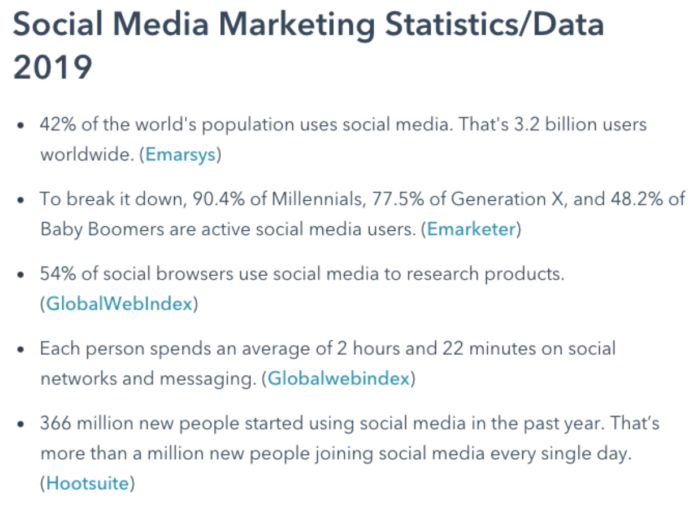
From the screenshot above, several social media statistics will catch your attention, as they relate to your business.
Third step: Create powerful titles. The title is where 73% of a buying decision is made, according to Ted Nicholas, a well-known copywriting expert. If 8 out of 10 people read the title, you need to give it top priority.
Therefore, with the statistics above, let’s create some powerful and compelling headlines:
How to Spend 4 Hours on Social Media Networks and Drive More Blog Visitors
Case Study: How 59% of Marketers Spend Their 6 Hours Engaging on Social Media
Referral Traffic: The Ultimate Guide to Increasing Referral Traffic Through Pinterest
13 Pinterest Referral Traffic Strategies That Work
How to Increase Pinterest Referral Traffic to Your Site By 3.6%
How to Write a Call-to-Action That Increases Pinterest Engagement by 80%
The Simple Call-to-Action Pin Description That Increases Traffic
Once you get past the title, the rest of the article will flow easily. That’s why I recommend that you write the title first, before the introduction and outline.
My personal experience is that each time I leverage third-party data, I tend to produce better blog content. Here’s an example:

In the post above, I leveraged the research results and insights from Buzzsumo’s experiment. Did I copy the data word for word? Of course not. That’s plagiarism.
Moreover, Google hates duplicate content. If Google sees the same content on my blog duplicated elsewhere, it’ll use the freshness factor to determine which site owns the content. Consequently, I’m at risk of penalty, because I stole the content.
Not a content marketing strategy worth the risk when I am capable of my own content creation.
But I was smarter. I simply learned from Buzzsumo’s experiment and used the insights to create a 4500+ word article that has since generated thousands of visitors to my blog.
Other smart marketers leverage third-party statistics in their content.
Always reference the exact web page where you got the data from. Promote the site as much as you can. I always link back to the site where I got my data from.
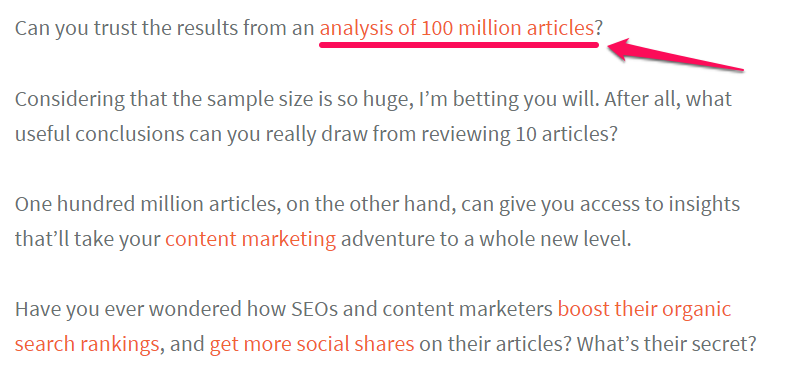
If you’re new to content creation, or you haven’t been able to grow your blog’s traffic yet, I think you should leverage third-party data more.
This content marketing strategy simply utilizes the work of the content writer before you who got results.
Because as it stands now, people have no reason to trust you and it’s hard to convince them to trust you. But if they find a reputable name or brand with striking statistics as the focal point of your content, they’ll listen.
3. Visualize and write for a single person.
How do you read content online? Do you read a blog post when you’re by yourself, or do you call your friends to join you? Chances are, like the rest of us, you read alone.
By the same token, you need to visualize one person as the “targeted reader” for your content. That one person then stands in for the rest of your readers.
Writing to one person at a time is one quick way to find your voice. It’ll make your content more powerful, too.
Content written this way engages the audience better since each person will read it and feel a personal connection.
You can impact lives with words and get paid to change the world when you write to one person at a time.
Writing for the web requires creativity. You just can’t throw 500 words together and expect people to read it.
When it comes to blog writing, you need to integrate certain words that personalize the experience for readers. The words “you” and “because” are stronger than you think.
According to Jonathan Goodman, founder of ViralNomics, the word “because” is the most powerful word in the English language, while “you” is the most important word in blogging.
To successfully write to one person and engage that person with your content, include “you” in the content.
This word is powerful because people are ultimately interested in fulfilling their own needs.
You may not believe this, but it’s true: your readers don’t care about you. They don’t really care how successful or how much of a failure you’ve been. What matters to them is the value you provide.

Of course, when you start to deliver immense value, readers will start to care about you. From personal experience, I can tell you that it takes time before people begin to trust you.
At the time that it’s clear your readers trust you, great things will automatically begin to happen. They’ll link to your content, share it on social media networks, recommend your products and even refer their fans/family/friends to your site.
Shift your focus from yourself to your readers. I always tell people that if you start a blog, that blog is by you – but not for you. It belongs to the audience you’re serving. They make the rules. They set the pace. You just follow.
In your blog posts, videos, ebooks, etc., use the word “you” more. Reduce “me” and “I” — that way, readers will perceive that all you care about is them, not your own pocket.
You’ll be amazed at the results.
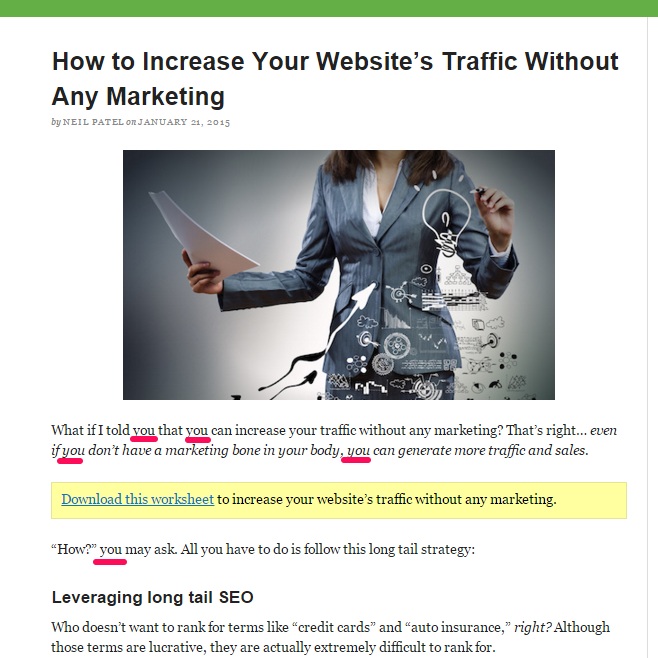
Experienced copywriters use “you” to captivate the buyer with their copy and get the readers excited. Joanna Wiebe, founder of Copyhackers.com, does this really well:
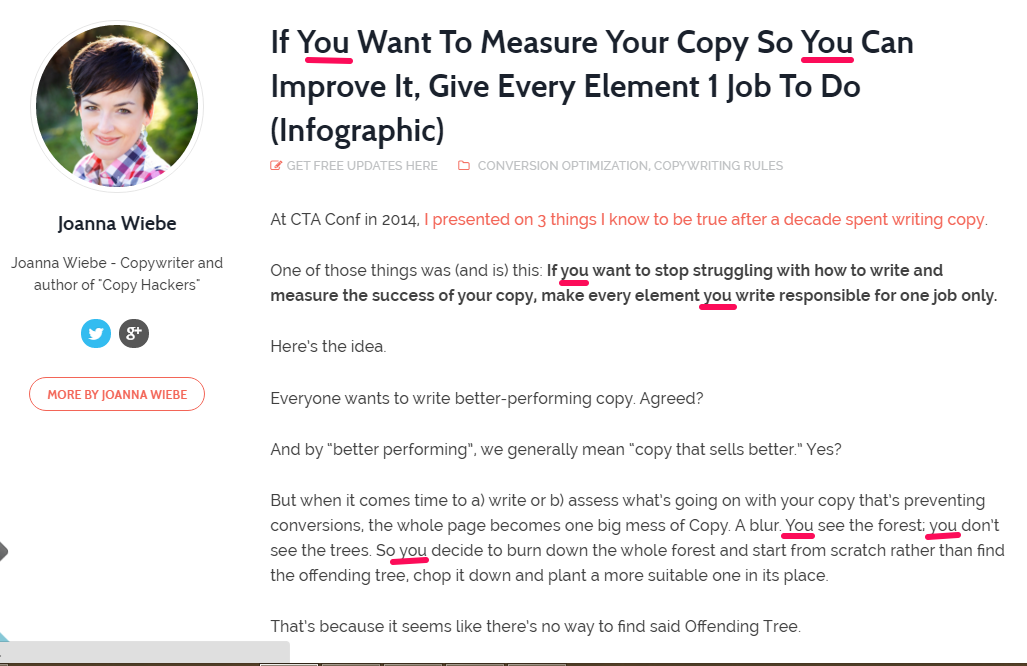
Chris Ducker also understands the power behind the word “you.” He named his podcast “Youpreneur,” to tell you the purpose of the podcast. It’s all about others.
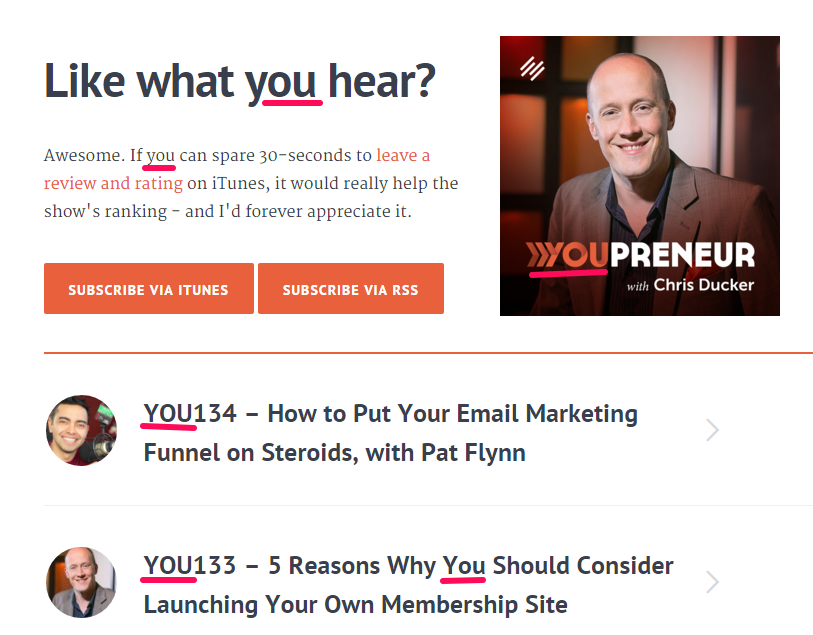
Though writing rules are not set in stone, that doesn’t mean that every blog post or article will be read and shared. In this age, the audience decides what content gets the most attention and publicity. Even SEO content doesn’t always win here.
So write for them. Forget about yourself. Your audience will seek you out when you’ve impacted their lives positively.
4. Integrate user feedback into your content.
Data and analytics enable us to gain deep insights into what our customers want from us.
But sometimes, don’t you wish that you could get an answer straight from your site users or customers?
That’s what user feedback is all about.
One of the most important characteristics of compelling and persuasive content is relevance. Is your content relevant to the right group of people?
Bestselling authors don’t write to impress anyone. They understand that writing to impress only leads to failure. Instead, they write to express their emotions and thoughts, based on the deep knowledge that they have about their audience.
User feedback shows your audience’s reactions, suggestions and worldviews. This is vital, because everyone has a worldview — you just have to give them your attention.

There are lots of methods you can use to collect user feedback. But regardless of which method you use, one thing is certain: you want to collect relevant opinions and questions from your audience.
In turn, you’ll use these insights to create better content.
The various ways to collect user feedback are:
- Surveys
- Feedback boxes/forms
- Email outreach
- User activity
- Usability tests
Surveys: When it comes to surveys, keep it simple. It’s not always a good practice to throw your readers a full-blown survey that takes 10 minutes or more to complete.

Limit it to 2 or 3 questions. After all, what you need is their insight, which you can then develop further into useful content for them.
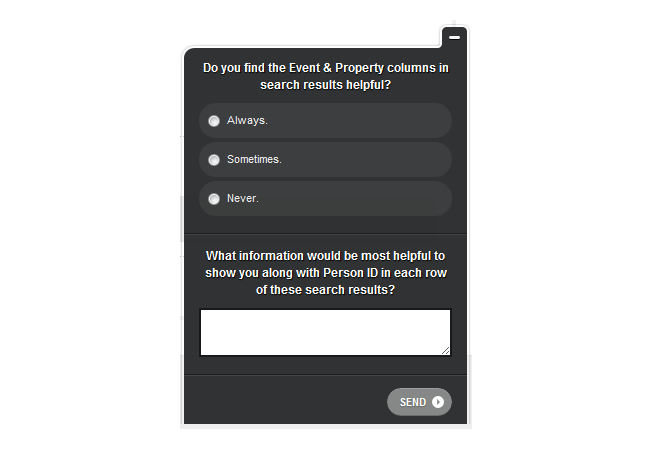
Consider asking open-ended questions, such as “how do you currently drive visitors to your blog posts?”
Avoid asking direct questions, which will only get you a “yes” or “no” answer. For example, “do you run Facebook ads?”
A better question in that same vein is, “what’s keeping you from running a Facebook ad?” Learning how to create surveys and asking the right questions will help you collect valuable user feedback for your content.
To create a simple survey, you can use Survey Monkey, Qualtrics, or Google forms. You could also consider giving incentives to users when they complete a survey. That way, they’ll be motivated to provide unbiased answers.
Surveys provide one of the most accurate and quick methods to access user feedback. Armed with the feedback, you can create a better content strategy and improve your conversion rate.
Feedback boxes: This feature provides a way for you to receive feedback from your site users. Just keep it simple.

Reach out directly: This is the easiest method of collecting user feedback. You don’t have to create any surveys, polls, or quizzes. You can write a simple email to your friends, Facebook fans, Twitter followers or Google+ connections.
If you’ve built a loyal audience, reaching out directly can be a source of quick and insightful feedback. As a content strategist who wants to know what their target audience needs to know, what better way is there?
Dig deeper into your email list and maybe invite a few of them to lunch. Ask simple open-ended questions as you converse with them.

User activity: How do people engage with your content? What percentage of people will buy your product or subscribe to your list, based on the level of experience you provide?
This is where you dig into your Google Analytics dashboard. First, you want to find out which landing pages are generating most of your visitors.
To a large extent, those landing pages are ones perceived as engaging, valuable and easy to navigate. That’s why users entered there and then decided to explore your site.
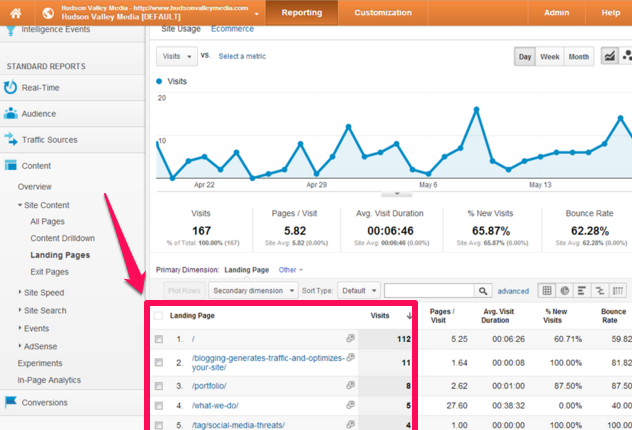
You’ll need to create more SEO content related to the topics you covered on those landing pages. In other words, produce more content on popular topics.
Aside from Google Analytics data, you should endeavor to find out which sections of your site people are using and how often. Google Analytics shows you what happened, and how often, but not why it happened, what led to it and how to optimize for user behavior.
There are many user behavior analytics tools out there. For instance, CrazyEgg shows you a heat map of active sections that users click on your site. This knowledge puts you ahead of your competitors and helps you to convert more visitors into customers.
User testing: If you conduct an effective user test, the feedback you’ll collect will powerful and accurate.
User testing reveals exactly what users think about your content, product or brand. This information is invaluable.
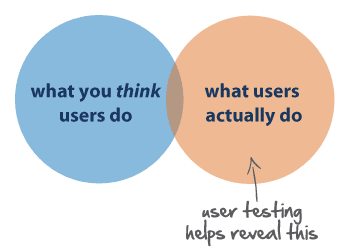
It’s like watching someone use your product, software or online course. You’ll see exactly which sections, pages or actions that they chose – and sometimes, why they made each choice.
So, now that you have all the feedback, data and insights from your users, what do you do with them? No matter what you do, you won’t be able to act on every piece of information.
Instead, pick the most relevant ones and include them in your post. For example, if you got feedback when you sent out surveys that your target audience wants more instructional content, what do you do?
Simple: create more “step-by-step…” content. If you’re writing a blog post, make it a tutorial and show people how to do a particular thing or achieve a specific result.
Better yet, make videos or other visually appealing content.
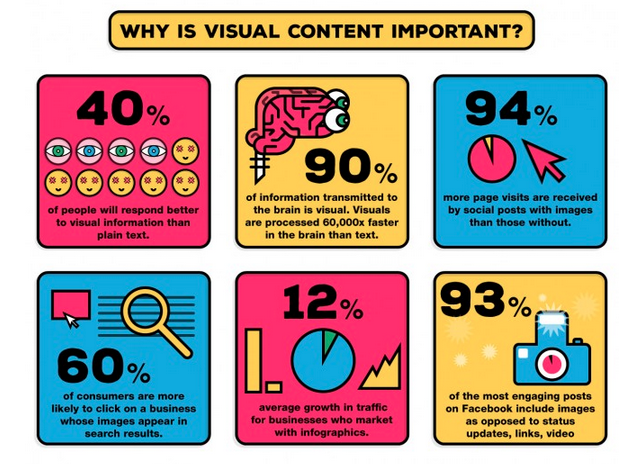
You can’t fail with visual marketing, because 94% of the information transmitted to the human brain is visual and the brain processes visual information 60,000x faster than plain text.
5. Keep it controversial but back up your opinions.
Sometimes it’s good to shake things up by tackling a tough topic. I’ve seen several bloggers who created controversial posts that went viral.
This type of content creation is not for the faint of heart; you will be made angel and devil equally.
For example, you’ve undoubtedly heard the old saw that “content is king.” While people were busy singing the praises of content, Derek Halpern challenged the saying.
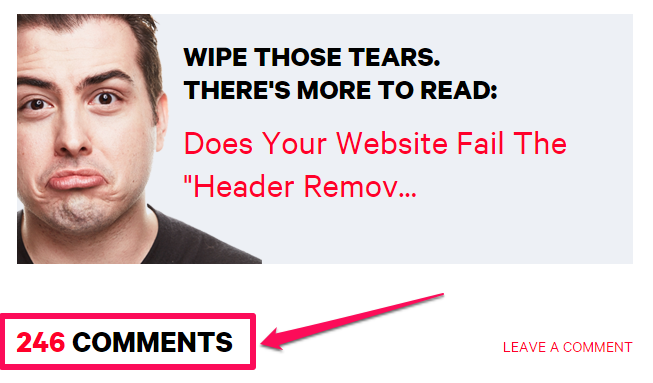
He created a controversial article entitled, “The “Content is King” Myth Debunked.”
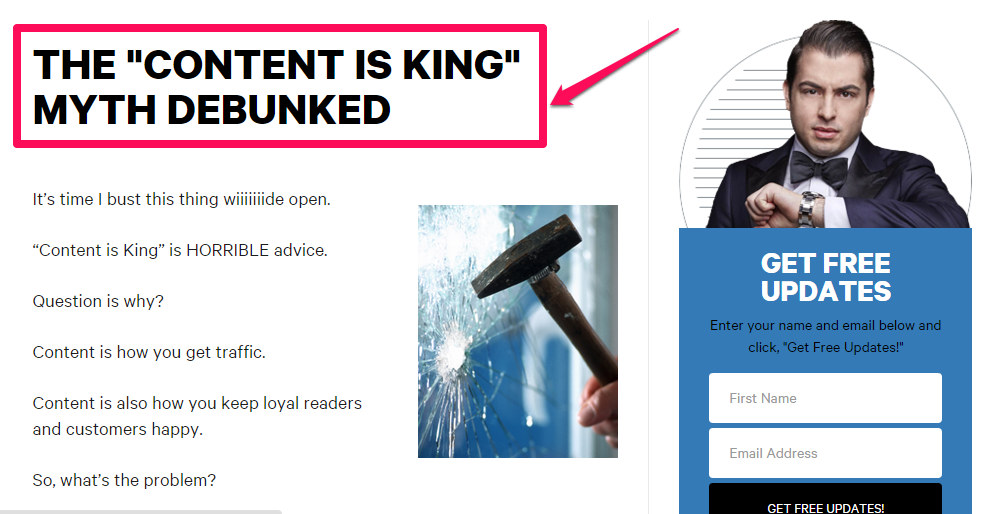
The blog article generated more than 240 comments and got thousands of social shares.
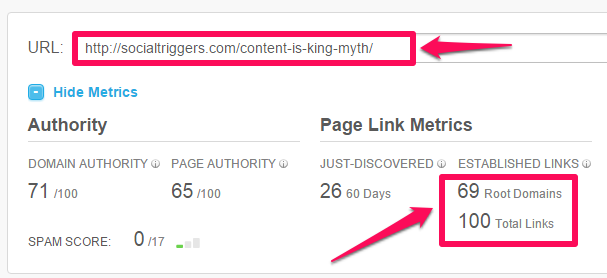
The content page also generated 69 inbound links from authority sites. Getting 69 links means a lot, and can push your organic rankings to the #1 spot.
Your target audience wants to participate in your idea. Don’t just throw words at them and expect them to give you their full attention. It doesn’t work that way.
Yet, when you’re controversial, people listen to you and they respond to you, whether they agree with you or not.
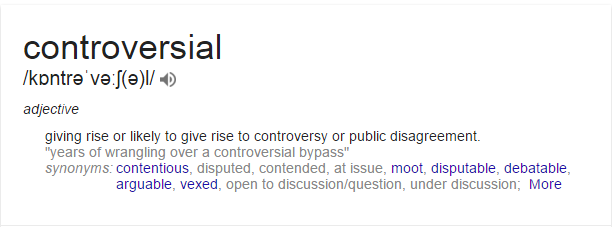
You want people to stop whatever they’re doing to read your content. If you can raise a little disagreement, you’ll see tremendous results with your content.
However, I encourage you to back up your arguments with accurate data and sources. In the example above, Derek debunked the “content is king” myth – but provided backup for that opinion.
He gave strong reasons why design trumps content. After all, you have to draw people into your site before they will read your content.
And it’s true, your design is responsible for welcoming people. According to Stanford Persuasive Technology Lab, “46.1% of people say a website’s design is the number one criterion for discerning the credibility of the company.”
Caution: When you handle controversial topics poorly, it can backfire — it can drive traffic away from your site and bring the wrong kind of attention to you. You don’t want that to happen.
Of course, people are going to read the content to read your reasons and what alternatives you’d recommend instead.
If you do a great job, you’ll gain fans for life. If you fail at delivering value, you’ll likely lose your online credibility.
On several occasions, I’ve created content on controversial topics. For example, a lot of SEO experts and bloggers believe that social signals are not a ranking factor.
But I went the extra mile, debunked the idea and showed how social signals impact search rankings. I provided proof, and that post generated thousands of organic visitors. Sure, I’m excited about that, but my biggest satisfaction comes from the fact that the content helped a lot of people.
Being controversial is sometimes what you need to improve your personal brand online and stand out in a crowded marketplace.
Whether you’re playing devil’s advocate, or creating a controversial piece of content from scratch, you must be 100% sure of your facts.
Ideally, don’t approach the topic from only one perspective. Instead, tackle both sides. Highlight the good as well as the bad and spell out why you believe one “side” is better.
6. Use visual assets to increase your content’s perceived value.
Michel Wedel, Professor of Consumer Science at the University of Maryland, has conducted research into eye-tracking and visual marketing and has found that the human mind responds to visuals more than text. In fact, almost 50% of your brain is involved in visual processing.

Top social media networks such as Pinterest and Instagram thrive because the primary form of content that can be uploaded, shared, and distributed is visual.
Images are the delight of marketers and is a wise content strategy. Interestingly, your target audience prefers visuals more than plain text.
Whether you’re a seasoned pro at visual marketing or you’re just getting started, you can increase your content’s perceived value in a dramatic way.
When creating content of any form, use visual assets such as infographics, videos, Slideshare presentations or interactive content (e.g., quizzes, surveys, polls).
In my experience, infographics are among the most effective visual assets for generating authority links, growing your organic traffic and creating more brand awareness. The demand for infographics continues to increase.
I’ve generated over 40,000 visitors through infographics marketing.
As visual information, infographics can help you acquire more organic traffic and clients.
If you want to create & distribute infographics, you’ll need the services of a professional graphic designer, which you can find at Dribbble.
Or, you can simply outsource to Visual.ly. But it’ll cost you a premium (up to $1000) for a professionally looking infographic.
Create and share infographics regularly. Publishers who use infographics grow their traffic an average of 12% more than those who don’t.
What about Slideshare presentations? Can they increase the perceived value of your content? Absolutely!
Conclusion
Writing isn’t for everyone. However, if you decide to make a difference in the world, writing is probably one of the best ways to do that.
Authors, bloggers and content marketers know the importance of well-crafted content. Content that converts isn’t easy to create. But you can do it, by following the strategies here.
Great content can cement relationships with your best prospects and leads. Yes, you can create awareness about your product through content marketing, but it doesn’t stop there. That audience needs to be nurtured, too.
How many times have you read on blogs that you have to “stand out from the crowd?” This phrase has become a cliche, but it’s true.
After all, if you’re not unique, you’ll struggle to drive organic traffic, let alone convince clients that you’re the right solution for them.
Imagine how much impact you can make on your audience if you use these strategies consistently going forward. Struggling to acquire leads, make sales, and build a successful organic traffic pipeline will be a thing of the past.
Which of these content writing strategies do you use when producing your blog content?