 Sign In





Which AI Visibility Factors Matter Most? [2026 Data]
Info
-
Source: NP Digital
-
Date: May 2026
-
Category: AI & GEO Optimization
-
Study Methodology: Sample size: 500 marketers and business owners. Data source: NP Digital survey. Collection method: Online survey.
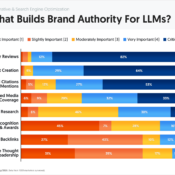
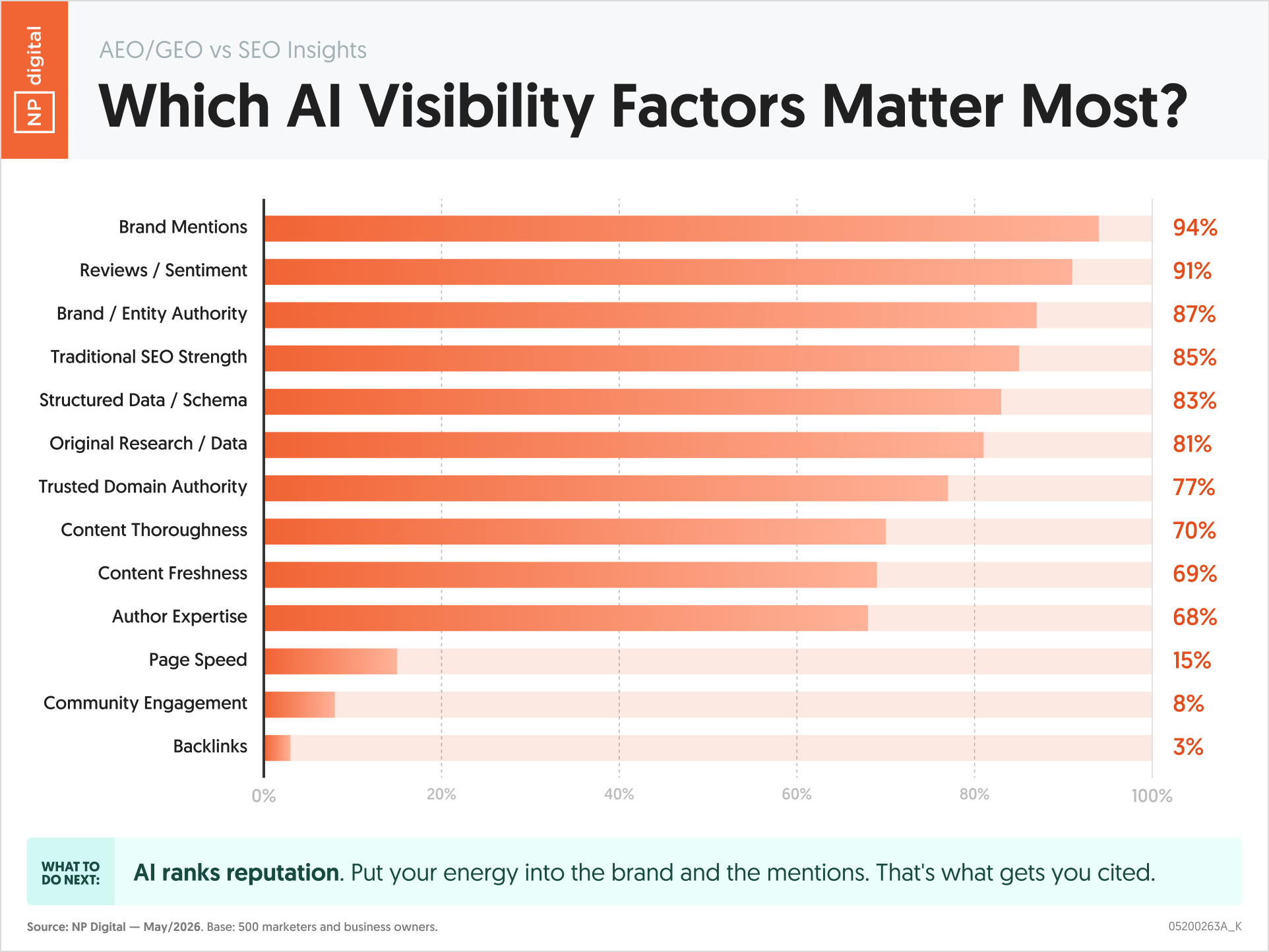
The signals that drive AI visibility are not a reordering of traditional SEO factors , but a different set of signals altogether. This survey of 500 marketers and business owners identifies 13 factors by their perceived importance to AI visibility, and the ranking reveals a hierarchy that should fundamentally change how content and SEO teams allocate their optimization work.
Essential Statistics
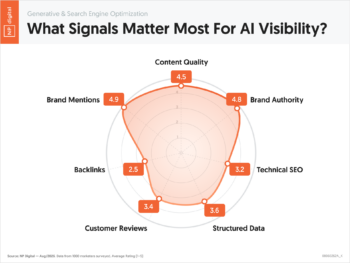
- Brand mentions are the top AI visibility factor at 94 percent importance, the highest-rated signal in the dataset.
- Reviews and sentiment rank second at 91 percent, within 3 points of brand mentions.
- Brand and entity authority ranks third at 87 percent, and traditional SEO strength ranks fourth at 85 percent.
- Structured data and schema markup ranks fifth at 83 percent, and original research and data ranks sixth at 81 percent.
- Trusted domain authority ranks seventh at 77 percent, content thoroughness at 70 percent, and content freshness at 69 percent.
- Author expertise ranks tenth at 68 percent.
- Page speed, community engagement, and backlinks rank eleventh through thirteenth at 15 percent, 8 percent, and 3 percent respectively.
Key Takeaways
- The dominance of brand mentions at 94 percent reflects how AI engines are trained. They learn what brands are known for, trusted for, and associated with by reading what other sources say about those brands. A brand with extensive third-party mentions in authoritative publications has a rich signal pool for AI engines to draw from. A brand that produces substantial owned content but generates little external mention has a sparse signal pool regardless of content quality.
- Reviews and sentiment at 91 percent is the highest-scoring signal that local businesses and e-commerce brands have the most direct ability to influence. Review volume, average rating, recency, and the specific language used in reviews all feed into the AI visibility signal. This include reviews across Google, Yelp, Trustpilot, G2, Capterra, and category-specific review platforms.
- Backlinks at 3 percent is the most dramatic repositioning of a traditional SEO signal in this dataset. Link building has been a cornerstone of SEO strategy for two decades because Google’s PageRank algorithm weighs link authority heavily. AI engines do not operate on the same principle. Teams allocating significant resources to link building as their primary AI visibility strategy are optimizing for a signal at 3 percent when signals at 87, 81, and 77 percent are underfunded.
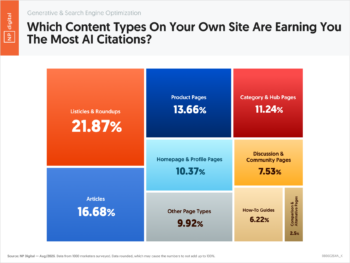
- Original research and data at 81 percent connect directly to the content type findings in companion charts. AI engines cite content that contains information they cannot generate themselves. Original research is the content format most likely to generate citations because it is, by definition, content that only one source can provide.
- The tight clustering of brand mentions (94%), reviews (91%), and brand entity authority (87%) in the top three positions signals that AI visibility is fundamentally a reputation problem, not a content problem. Brands with strong reputations and extensive third-party mention profiles will earn AI citations even with average content. Brands with outstanding content but weak external reputation signals will be underrepresented in AI-generated answers regardless of content quality.
Actionable Insights
- Build a systematic brand mention acquisition program as a first-priority AEO investment. At 94 percent importance, most content and SEO teams treat brand mentions as a PR byproduct rather than a deliberate optimization target. Identify the 15 to 20 authoritative publications, industry blogs, and community spaces most relevant to your category. Build a relationship and contribution strategy with each with the goal of generating consistent mentions in sources that AI engines draw from. Track mention volume and source authority monthly as a primary AEO KPI.
- Build a multi-platform review generation program targeting the review sources most relevant to your category. Reviews and sentiment at 91 percent is a signal that most businesses have the operational capacity to influence through systematic outreach. At minimum, implement a post-purchase review request sequence for Google, and add the category-specific review platforms where AI engines are most likely to draw review sentiment data for your industry. Review recency matters — a consistent flow of new reviews outperforms a historical volume of aging ones.
- Invest in two to three original research studies per year as a core content strategy commitment. Original research at 81 percent is the content format most directly aligned with how AI engines select citation sources. Survey your customer base, analyze your proprietary platform data, or partner with a research organization to produce findings that only your brand can publish. Structure the research with a clear methodology section, a findable data visualization, and a citable headline statistic.
- Redirect link-building budget toward brand mention campaigns, structured data implementation, and review generation programs. Backlinks at 3 percent are nearly irrelevant to AI visibility. If your current AEO strategy includes significant link building investment, the opportunity cost is substantial.
- Implement Article, FAQ, Organization, and Product schema markup across your key pages as a one-time technical investment with ongoing AI visibility returns. Structured data and schema at 83 percent is one of the most actionable items because it is a bounded technical project with a clear implementation endpoint. Schema markup tells AI engines what type of content a page contains, who authored it, and how its claims relate to the broader knowledge graph.
“Brand mentions at 94 percent and reviews at 91 percent dominate AI visibility because AI engines are trained on what people say about you, not what you say about yourself. The brands getting cited are the ones with the strongest external reputation signals. Build those first.” – Neil Patel