 Sign In





 Ubersuggest
  AnswerThePublic
 How Effective Is Prompt Tracking on ChatGPT?
Info
-
Source: NP Digital
-
Date: April 2026
-
Category: AI & GEO Optimization
-
Study Methodology: Data from 12 companies surveying customers upon conversion. Methodology reflects post-conversion survey responses categorized into three prompt tracking outcomes.
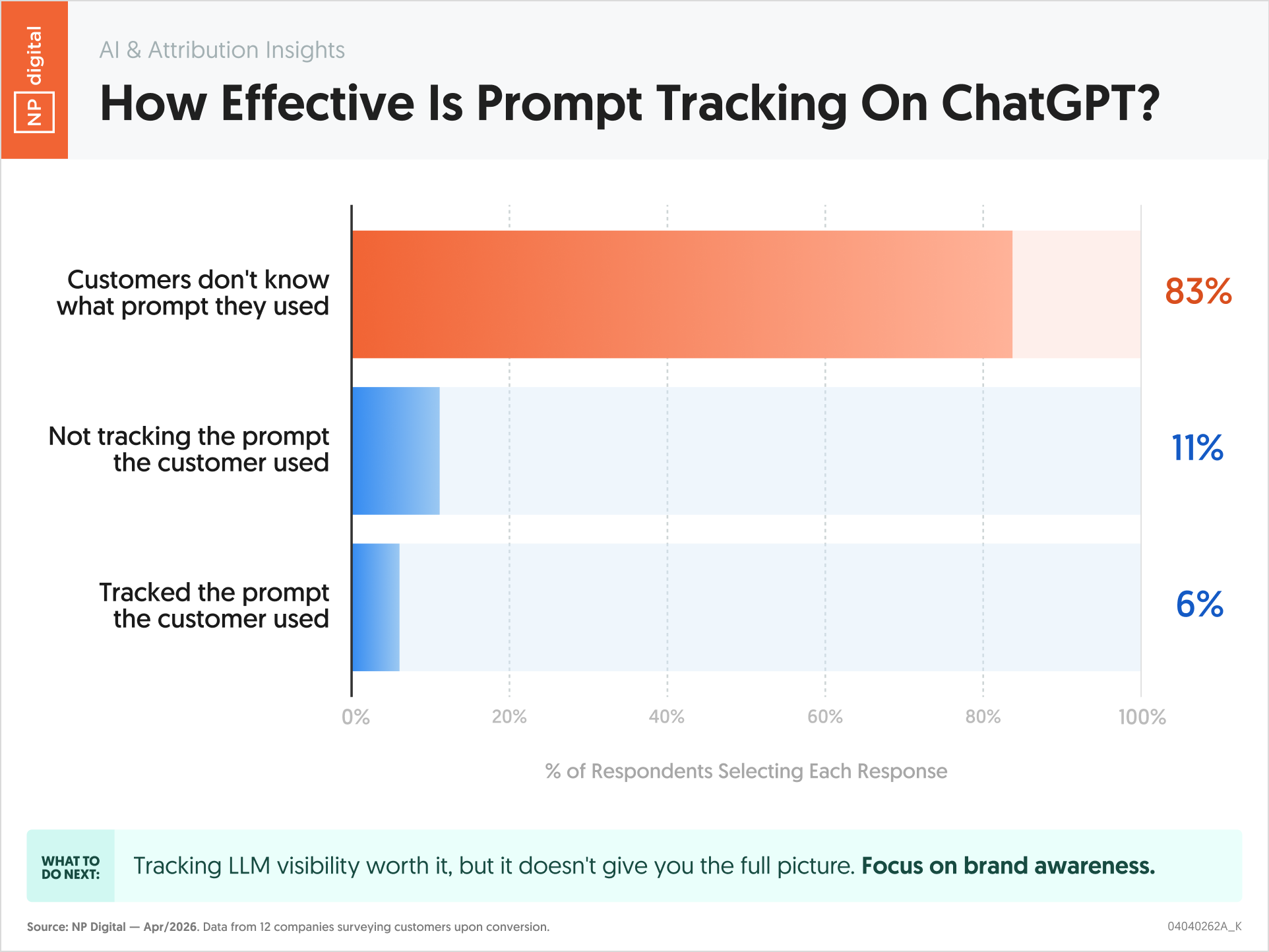
Prompt tracking on ChatGPT sounds like a logical attribution solution. Ask customers what prompt they used, match it to a citation, attribute the conversion. The problem is that 83 percent of customers do not remember what they typed. This data from 12 companies surveying customers upon conversion reveals why prompt-level attribution remains a fundamentally limited approach, and what brands should focus on instead.
Essential Statistics
- 83 percent of respondents said customers did not know what prompt they used before converting, the dominant outcome across all three categories.
- 11 percent of companies reported they were not tracking the prompt the customer used, indicating a significant portion have not yet implemented even basic prompt inquiry systems.
- Only 6 percent of respondents successfully tracked the prompt a customer used prior to conversion.
- Combined, 94 percent of post-conversion prompt tracking attempts either fail due to customer recall limitations or are not being attempted at all.
- The 6 percent success rate for prompt tracking means that for every 100 AI-influenced conversions, prompt-level attribution data is available for only six.
Key Takeaways
- Prompt tracking as a primary ChatGPT attribution method is not viable at scale. An 83 percent failure rate due to customer recall alone, before accounting for the 11 percent not tracking at all, means the method produces useful data for fewer than one in ten conversions.
- The 11 percent not tracking at all represents an addressable gap. Adding a post-conversion prompt question costs little to implement and would at least surface the 6 percent of trackable cases that some companies are currently capturing.
- The more important implication is strategic: because prompt-level attribution will always be incomplete, AI marketing measurement needs to be built around brand visibility and citation share monitoring rather than conversion-level prompt tracking.
- The “What To Do Next” callout on this chart points directly toward brand awareness as the strategic response to attribution limitations. If you cannot reliably track which prompts drive conversions, the priority becomes making your brand the citation that appears across the widest range of relevant prompts.
- The data also suggests that customers using ChatGPT for research are completing a multi-session, multi-prompt discovery process before converting. Attribution for that journey requires multi-touch frameworks, not single-prompt capture.
Actionable Insights
- Add a post-conversion prompt survey question even though the data shows it will only work for 6 percent of customers. That 6 percent still produces qualitative insight into which prompt types and topics drive your highest-intent customers to discover you through ChatGPT. Even a small sample of that data is more valuable than none.
- Shift your ChatGPT measurement strategy from prompt attribution to citation share monitoring. Track how often your brand appears in ChatGPT responses across your core topic clusters by testing queries manually or using AI citation monitoring tools. Citation share is a leading indicator of future conversion influence even when prompt-level attribution is not recoverable.
- Build brand awareness investment into your AI strategy budget as a direct response to attribution limitations. The “What To Do Next” guidance on this chart is specific: focus on brand awareness because prompt tracking does not give you the full picture. Brands that appear frequently across many ChatGPT prompts convert users who cannot recall the specific prompt, making broad citation presence the only reliable attribution proxy.
- Use UTM parameters and referral tracking as your primary ChatGPT attribution layer rather than prompt surveys. When ChatGPT sends a click with trackable parameters, your analytics captures it without relying on customer recall. GPT-5.4 now sends nearly half of its citation clicks with trackable parameters, making this a more scalable approach than prompt surveys at 83 percent failure rates.
- Invest in share-of-voice tracking across AI platforms as a proxy for attribution you cannot capture directly. Monitoring how your brand’s mention frequency changes quarter over quarter in ChatGPT responses to your core queries gives you a directional signal for AI-influenced demand even when individual conversion-level attribution is not available.
“Eighty-three percent of customers cannot tell you what prompt they used before finding your brand on ChatGPT. That is not a tracking problem you can engineer your way out of. It is a reminder that the right measurement strategy for AI-influenced traffic is brand visibility and citation share, not conversion-level prompt attribution.” – Neil Patel