 Sign In













Having the right SEO tools in your arsenal can set you on track for online success. However, with so many tools on the market, knowing which one (or ones) to choose can be overwhelming.
Enter Mangools and Ahrefs.
Mangools is scrappy, lean, and long-tail keyword-focused.
Ahrefs is a backlink analysis powerhouse that also packs a punch in other areas of SEO.
Which is right for you? I will help you find the answer by comparing Mangools vs. Ahrefs.
I’ll delve into the features that set them apart, testimonials, and pricing so you can make an informed decision.
After reading, you’ll know which best suits your digital marketing needs.
Ready? Then here we go.
Main Points
- Mangools and Ahrefs are renowned SEO platforms marketing pros use to create strategies and measure campaign performance.
- Mangools’ five main features focus on keyword research, search engine results page (SERP) analysis, SERP rank tracking, backlink analysis, and SEO metrics.
- Ahrefs’ vast set of features includes tools for backlink analysis, keyword research, performance tracking, content gap analysis, and more.
- Mangools’ pricing starts at $19.90 per month (when billed annually), while Ahrefs plans begin at $83 (when billed annually).
- Ahrefs pulls data from more than 20 billion keywords, 3.1 trillion backlinks, and 14 billion pages in its context.
- Mangools has a database of over 2.5 billion related keywords, 100 million competitor keywords, and more than 30 million SERPs.
How to Use Mangools for SEO
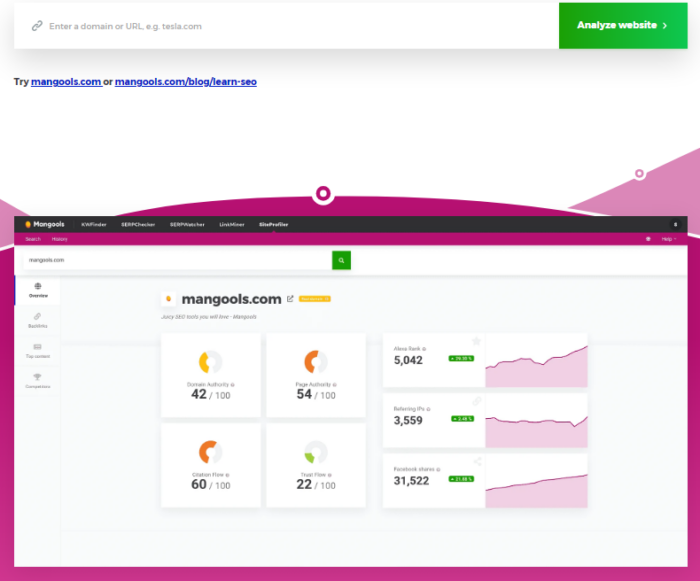
Our Mangools’ SEO journey begins with an overview of your current SEO status. Use the SiteProfiler tool for a high-level look at backlinks, SEO data, and your domain authority. This helps assess your site’s strengths and weaknesses and gives you a good starting point.
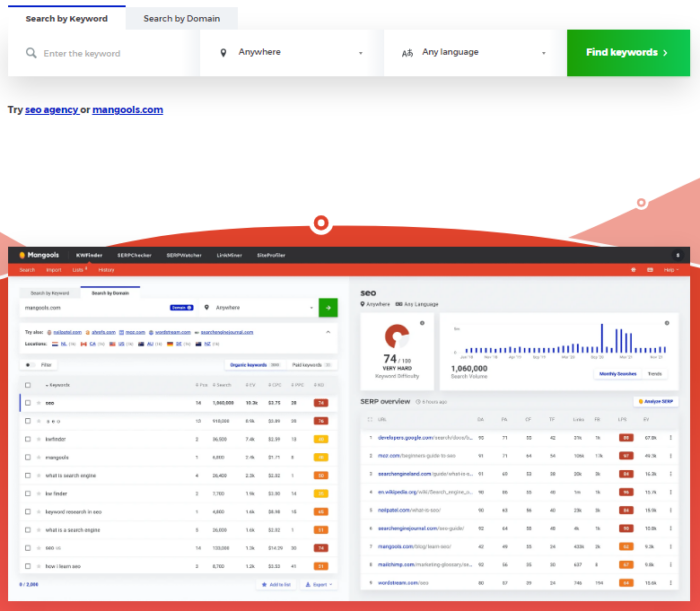
Next, find relevant keywords with the KWFinder tool. Enter your niche seed keyword and get data on search volumes and difficulty scores. You can select the keywords that best fit your SEO and content strategies.
That’s just scratching the surface of Mangools’ functionality. Let’s explore its other features and how they can turbocharge your SEO efforts.
Features
Mangools has five main features. We already covered SiteProfiler and KWFinder (and we’ll dig deeper into those next). The others are SERPWatcher, SERPChecker, and LinkMiner.
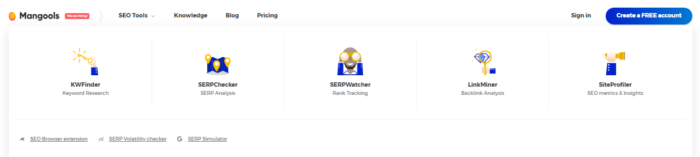
You can access all the tools for free from Mangools’ website or by installing the Mangools extension for Chrome or Firefox, but you’ll get a prompt asking you to create a free account when you enter a keyword. Note that free accounts limit your number of daily searches to five.
Now let’s dive deeper into each tool.
KWFinder: Mangools’ keyword finder enables you to find long-tail keywords with low SEO difficulty. You can also use it to perform keyword analysis, research competitor keyword strategies, track long-term search trends, and identify high-impact local keywords. You can also use it to import keywords in bulk and organize keywords in lists.
SERPWatcher: Mangools says, “SERPWatcher is a rank tracking tool that makes other complicated tools look like they’re from the [’80s].” With SERPWatcher, simplicity really is the name of the game. Just enter a domain name and click “Start tracking” for insights into how your site ranks in the SERPs.
SERPWatcher metrics include the Performance Index, which tells you your site’s organic traffic potential based on current keyword positions and those keywords’ search volumes. You can even get daily ranking updates, easily share interactive reports, and track your rank position by geographic location.
SERPChecker: Find local SERPs for over 50,000 geographic locations and exploit your competitors’ weak spots with Mangools’ SERPChecker. All you have to do is enter your keyword, country, and device type and click “Analyze SERP.” It checks 45 SEO metrics and “spies” on competitors to see if you can outperform them.
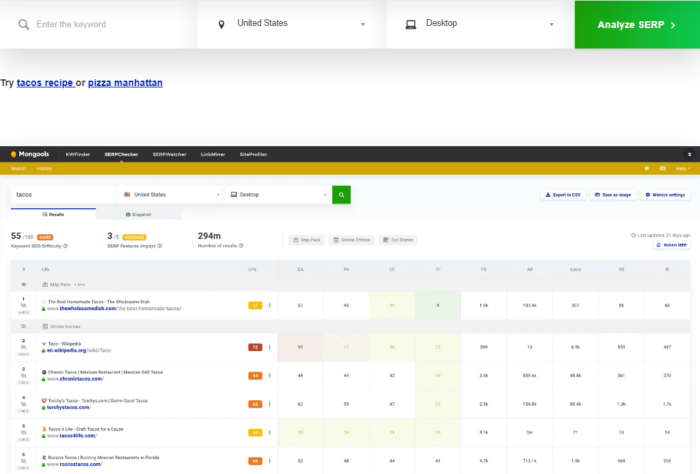
SERPChecker can also measure the effect of rich snippets on your click-through rates (CTR) and show you how Google SERP features impact your site’s organic search results. Its database has over 30 million SERPs, with about 100,000 added monthly.
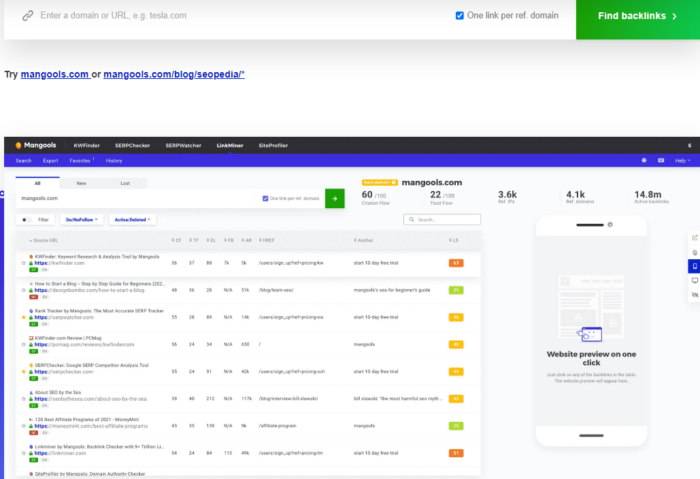
LinkMiner: This tool is great for finding backlinks and tracking new and lost links. Enter your domain or URL, click “Find backlinks,” and you’ll get results. You can also check the quality of your and competitors’ backlinks through Mangools’ Link Strength metric. This is also handy for checking whether your links are valuable or if you need to disavow any spammy links.
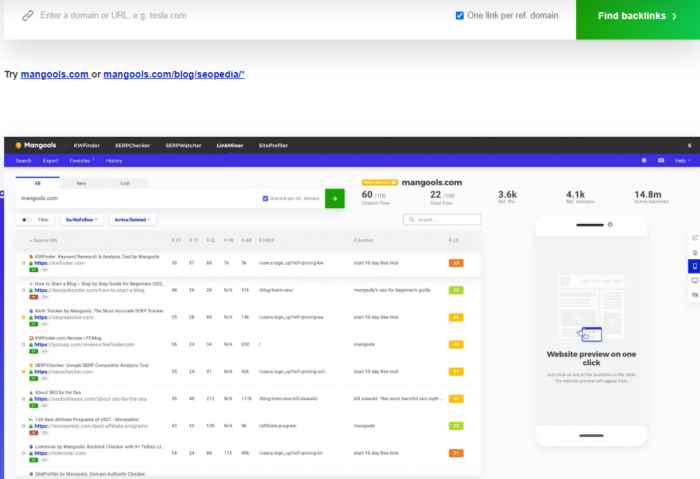
In addition, you can add favorite links to a list, conduct advanced backlink analysis, and get live link placement previews.
SiteProfiler: As I mentioned before, SiteProfiler is a great place to start assessing your site’s SEO health. This tool lets you check the authority of domains or URLs. Just enter your details and click “Analyze website.” Mangools uses Moz and Majestic metrics and Alexa Rank and Facebook shares to give a clear picture of the trustworthiness and authoritativeness of your site.
Pricing
Mangools pricing structure includes four subscription tiers: Entry, Basic, Premium, and Agency. Prices range from $19.90 to $89.90 monthly if you opt for an annual billing. Month-to-month subscriptions range from $29 to $129.
A free deal is available, too. It gives you five lookups every 24 hours, with 15 related and five competitor keywords per lookup.
Mangools also offers additional free tools beyond the main suite, including their SERP simulator and SERP volatility tracker.
Customer Thoughts
Mangools shares many customer success stories and positive reviews on its website and across the web. Many cite its intuitive user interface, simple keyword research functionality, and ability to uncover long-tail keyword opportunities.
According to one Mangools review, PCMag Assistant Editor Rob Marvin says, “KWFinder earns its reputation as one of the best SEO tools out there for doing long-tail keyword research.”
Orainti International SEO Consultant Aleyda Solis calls it a go-to tool “to easily identify keyword opportunities to target.”
On the flip side, some reviewers mention that Mangools lacks the resources for an extensive database like Ahrefs or Semrush. Others question the accuracy of the platform’s data.
How to Use Ahrefs for SEO
While Mangools is all about simplicity, Ahrefs is a much more robust SEO platform with a longer list of features. It’s best known for its link-building features but excels in many areas of SEO.
So, where should you begin?
To get more visibility, start with the platform’s keyword research tool, Keywords Explorer. This will detail search volume, keyword difficulty, and other metrics to help you select the right keywords for your content.
Next, visit Ahrefs’ Backlink Checker tool to see referring domains and find low-competition topics and high-quality links for authority building.
The Content Gap tool is a logical next stop. It’s a great place to find subjects your competitors are featuring and you’re not.
You can use Site Explorer to restore lost backlinks and competitive analysis to see how you stack up against others in your niche.
For more details on how to use these tools, Ahrefs has a tutorial on YouTube.
Official Ahrefs Tutorial: How to use Ahrefs to Improve SEO
While these are fantastic first steps in using Ahrefs for SEO, that’s just a peek at the platform’s capabilities. Let’s look at its features, pricing, and customer sentiment in more depth.
Features
As we said, Ahrefs has a lot of features, so many it’d be tough to touch on them all. So, let’s focus on some of the main ones.
SEO Dashboard: The SEO Dashboard provides a view of essential metrics like referring domains and backlinks, organic traffic and keywords, and your site’s Health Score (the percentage of your site’s internal URLs that don’t have errors). You can also view your Domain Rating, Ahrefs’ proprietary website authority metric.
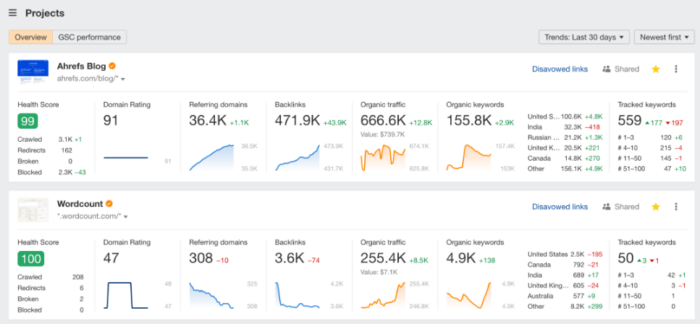
You can also track an unlimited number of verified projects, view your Google Search Console performance, and monitor the performance of multiple URLs. Additionally, you can set up email notifications for individual projects, create keyword lists, and organize projects with folders.
Site Explorer: This feature shows the organic search traffic and backlink profile for any website or URL. You can also view paid traffic performance and website structure and perform keyword research.
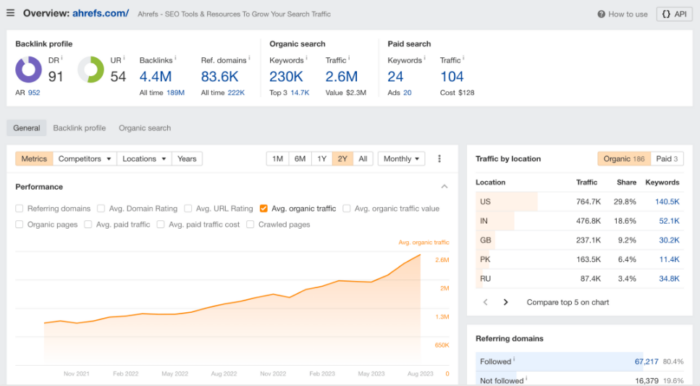
It also shows you which keywords competitors are bidding on, displays historical data for various keywords, and allows you to browse competitors’ external links.
Keywords Explorer: Ahrefs calls Keywords Explorer “the most complete keyword research tool on the market.” It provides thousands of keyword suggestions from 10 search engines and supports 171 countries.
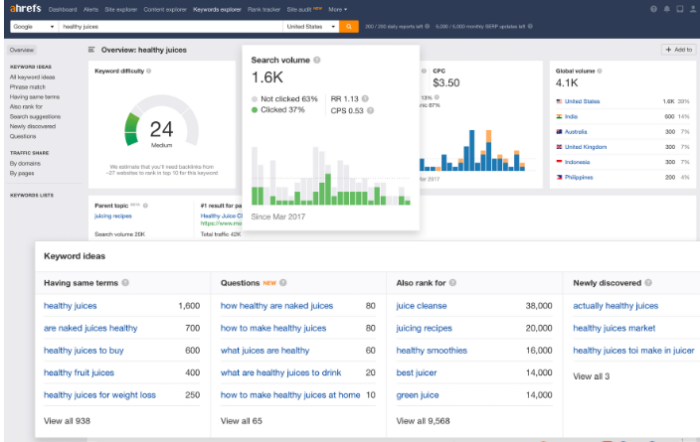
Among the metrics Keywords Explorer displays include a keyword difficulty score, advanced search volume, and cost per click (CPC). You can also find the “parent” topic for your target keyword. Also, be sure to take advantage of the keyword filters and keyword ideas listing tools.
Site Audit: Conduct an audit to find any technical or on-page SEO issues that may keep your site from ranking in the SERPs. Site Audit provides a detailed site and SEO health analysis that checks for over 160 potential SEO problems.
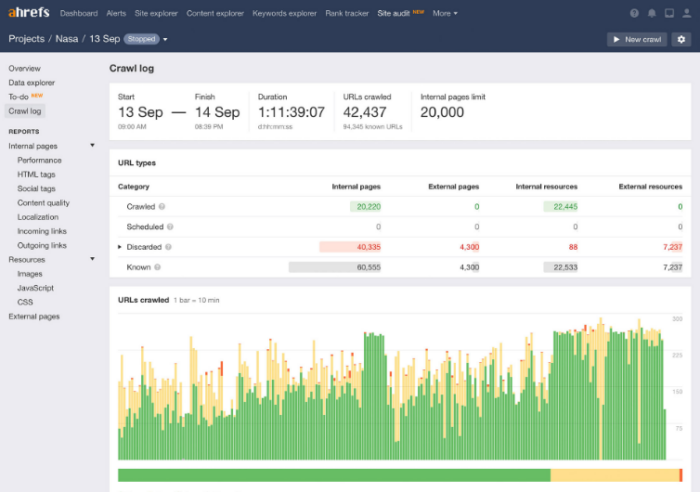
Choose from the filter options to focus on different data points and schedule audits.
Rank Tracker: Ahrefs’ Rank Tracker lets you keep tabs on your Google rankings on mobile and desktop across 190 countries. You can add or import a list of keywords, choose multiple countries per keyword, and track your competitors’ URLs. Ahrefs tracks the data and sends you regular email updates.
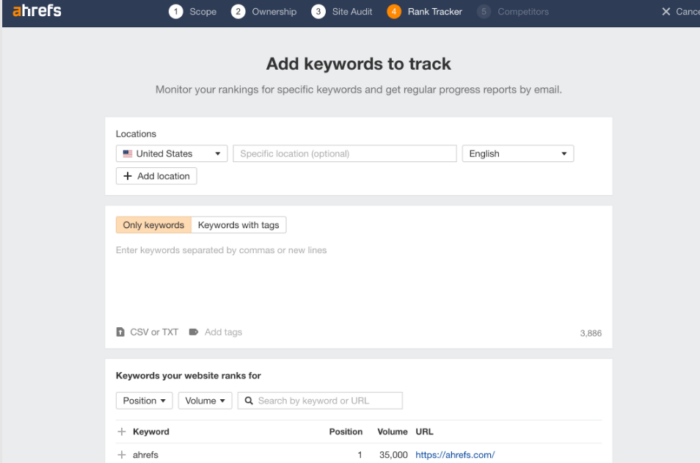
Additionally, you can use Rank Tracker to measure share of voice, average position and traffic, and position distribution. You can even check whether your website appears in SERP features like featured snippets or Local Pack. Use it to segment your keyword list data, compare your stats against competitors, and view your Google Search Console data.
Content Explorer: Find top-performing niche content and thousands of linking opportunities with Content Explorer. Ahrefs has a database of 14.5 billion web pages to pull content ideas and link prospects from. You can refine your search by SEO and social media metrics like social shares, word count, website traffic, and traffic value.
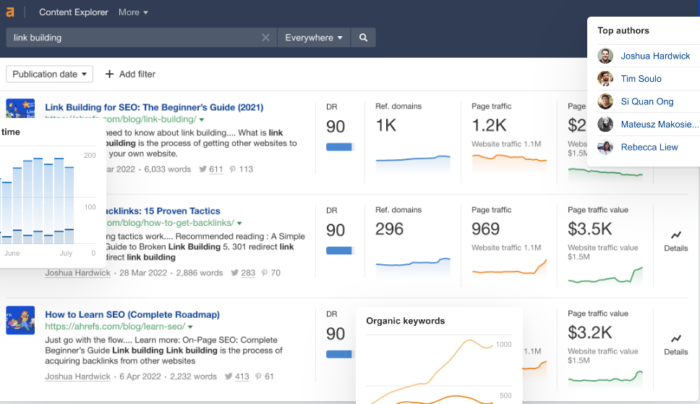
In addition, you can get a history of any URL’s organic traffic, social shares, keyword rankings, and backlinks. You can then use this data for link building, finding guest blogging opportunities, discovering broken links and unlinked brand opportunities, and discovering content that attracts links.
Pricing
Ahrefs pricing starts at $99 monthly for the Lite subscription, providing essential small business or hobby data.
It also offers Standard, Advanced, and Enterprise packages ranging from $179 to $999.
Discounts are available if you pay annually.
Alternatively, you can access usage-based pricing based on how much you use the tools. However, this does not apply to the Site Audit and Rank Tracker tools.
Customer Thoughts
Ahrefs scores highly across Capterra, G2, TrustRadius, and Crosdesk, with scores of 4.7/5, 4.6/5, 8.8/10, and 4.6/5, respectively.
Users describe Ahrefs as the “best audit SEO tool” and “fantastic software to work with SEO projects.” They also say it’s invaluable for SEO data and research.
It gets positive reviews for its backlink tool, competitor analysis capabilities, and Content Explorer feature. Others like its Keywords Explorer tools for finding long-tail keywords and general keyword discovery.
The free audit tools, content gap analysis, and free educational content are also popular among users. However, remember there are plenty of other excellent (and free) SEO tools out there to try, like mine—Ubersuggest.
Negatives cited by Ahrefs users include pricing and issues with integrating with other tools. Plus, some users feel it could have a better user experience (UX) or find the number of features overwhelming.
Ahrefs vs. Mangools: Choosing the Best SEO Tool
Like any other SEO tool, choosing the right one depends on what you’re looking for and want to achieve.
If you want an affordable tool with fewer features to keep from overwhelming you or you have a highly specific goal, then Mangools may be perfect for you. Its focus on long-tail keywords allows you to create more relevant content that matches user intent. Mangools may also be better for small businesses with a limited budget.
Ahrefs has a laundry list of features, which some users may find too much if they’re new to digital marketing or SEO. However, it’s tried and tested and hugely popular among the SEO community and marketers.
Really, it’s a matter of reviewing both tools and what they offer. Keep in mind that you can use Ahrefs and Mangools together as well. (You can also check out my comparison of Ubersuggest vs. Ahrefs if you’re looking for an Ahref or Mangools alternative.)
Does It Make Sense To Use Ahrefs and Mangools Together?
It sure does.
While Ahrefs has the most extensive tools, Mangools’ limited features make it a good add-on at an affordable price.
Mangools’ focus on long-tail keywords can complement Ahrefs for an even more complete SEO strategy.
Other features that can work well together are Ahrefs’ Rank Tracker and Mangools SERPWatcher. Rank Tracker doesn’t provide daily updates of keyword positions, but Mangools’ SERPWatcher does.
Additionally, you can use Ahrefs’ Backlink Checker alongside Mangools’ LinkMiner for limited site audits.
As a final added note, if you don’t feel like fully investing in both tools, Mangools offers some free tools like their SERP simulator, which you can use alongside Ahrefs.
FAQs
How do Mangools and Ahrefs compare in terms of SEO tools and features?
Mangools has fewer features than Ahrefs, but it’s still an excellent add-on for concentrating on specific tasks like uncovering long-tail keywords and understanding search intent.
How do Mangools and Ahrefs assist businesses in improving their search engine rankings?
These tools help boost your visibility by allowing you to discover keywords and trending content, find backlink and guest post opportunities, and conduct site audits to find potential errors and optimize your site.
What are the key differences between Mangools and Ahrefs in terms of pricing and affordability?
At prices starting from $29 monthly or $19 monthly for an annual subscription, Mangools is more affordable. However, it’s got limited, more focused features compared with Ahrefs, where paid subscriptions start at $99 monthly or $83 monthly for an annual subscription.
How do Mangools and Ahrefs handle keyword research and analysis?
Both platforms provide keyword research tools. Ahrefs has Keywords Explorer, while Mangools has KWFinder.
Keywords Explorer offers keyword difficulty scores, advanced SEO metrics, click metrics, and thousands of keyword suggestions from 10 different sources. It also offers filters and keyword ideas listing tools.
Mangools’ keyword finder focuses on long-tail keywords and works best for discovering user intent.
Conclusion
Ahrefs and Mangools are both valuable resources to help your digital marketing efforts.
If you’re looking for affordability and a less comprehensive mix of features, then Mangools may be a good starting point.
In contrast, Ahrefs is undoubtedly robust. Its comprehensive data and suite of SEO tools make it ideal for larger organizations and marketing professionals who already have experience with SEO.
The choice between Mangools vs. Ahrefs depends on what you want to achieve, your expertise, and budget constraints.
It might even make sense to use both tools to maximize your results.
Do you use Mangools or Ahrefs? Let me know what you think of them in the comments below.