 Sign In



Most Common AI Search Mistakes Marketers Make
Info
-
Source: NP Digital
-
Date: May 2026
-
Category: AI & GEO Optimization
-
Study Methodology: Sample size: 500 marketers and business owners. Data source: NP Digital survey. Collection method: Multi-select responses. Online survey.
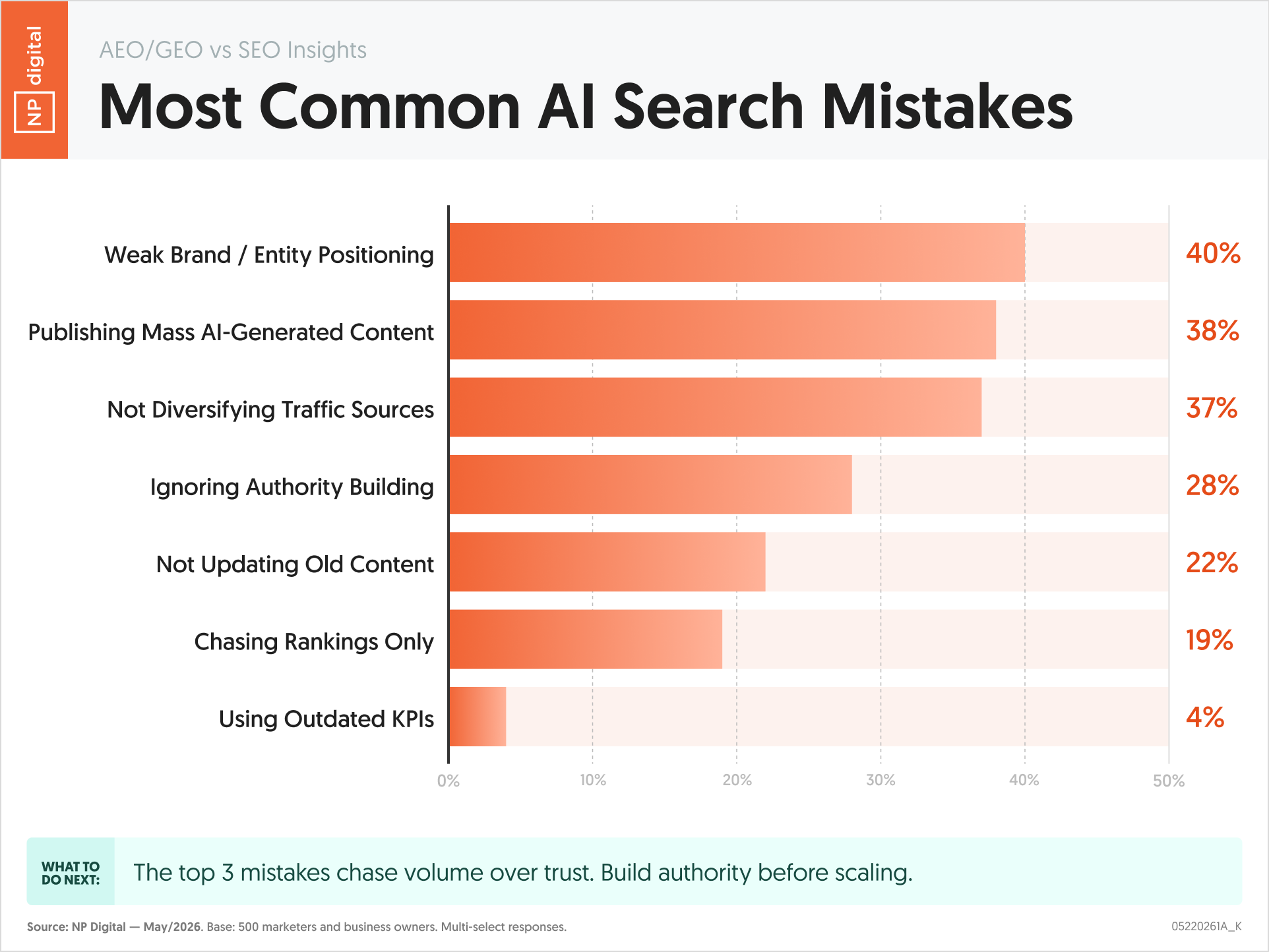
The most common AI search mistakes are not technical errors but strategic misalignments between what AI engines reward and what most content teams are currently producing. This survey of 500 marketers using multi-select responses identifies the seven most prevalent mistakes, and the top three cluster closely enough to represent a single underlying pattern: optimizing for volume at the expense of trust. AI engines are trained to surface sources with strong external reputation signals, genuine expertise, and diverse distribution. The most common mistakes are the direct opposites of each of those criteria.
Essential Statistics
- 40 percent of respondents identify weak brand and entity positioning as the most common AI search mistake.
- 38 percent cite publishing mass AI-generated content as a primary mistake.
- 37 percent flag not diversifying traffic sources as a significant error in AI search strategy.
- 28 percent point to ignoring authority building as a common mistake.
- 22 percent identify not updating old content as an ongoing issue in AI visibility.
- 19 percent cite chasing rankings only as a strategic mistake that does not serve AI visibility goals.
- Only 4 percent flag using outdated KPIs as a problem, the lowest recognition rate in the dataset despite its strategic importance.
Key Takeaways
- Weak brand and entity positioning at 40 percent is the top mistake because it is foundational. AI engines build their understanding of a brand from cross-source signals like how the brand is described in third-party publications, how it is categorized in structured data or what it is mentioned in connection with across the web. A brand with weak entity positioning gives AI engines an incomplete or ambiguous picture, which makes citation selection uncertain even when content quality is high.
- Mass AI-generated content at 38 percent is particularly damaging because it actively contradicts what AI engines reward. AI engines have an inherent disinterest in citing content they could have generated themselves — they are designed to surface authoritative, original sources that add information to a conversation rather than recapitulate what is already known. Publishing large volumes of AI-generated content floods the web with undifferentiated text while doing nothing to build the external reputation signals that actually drive citation selection.
- Not diversifying traffic sources at 37 percent is a risk management failure as much as an AI search strategy failure. The companion Rankings Up, Traffic Down chart shows that AI Overviews are absorbing an increasing share of organic search clicks for informational queries. Teams that have concentrated their traffic in organic search are more exposed to that absorption than teams with diversified source portfolios.
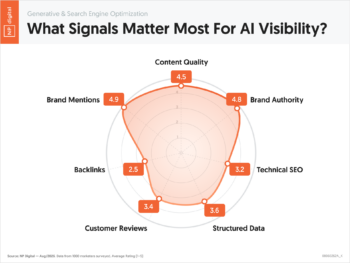
- Ignoring authority building at 28 percent is directly connected to the AI visibility factor data showing brand mentions and entity authority as the top two AI ranking signals. Teams skipping authority-building investment are bypassing the primary driver of AI citation selection in favor of on-page optimization that ranks lower in the signal hierarchy.
- Using outdated KPIs at only 4 percent recognition is the most strategically consequential finding in the dataset despite its low ranking. The fact that 96 percent of marketers do not identify outdated KPIs as a mistake suggests most teams have not examined whether their success metrics align with how AI search actually evaluates and surfaces content. Teams measuring AI search success through rankings and traffic alone are using the wrong instruments for the channel.
Actionable Insights
- Conduct an entity audit of your brand across the AI surfaces most relevant to your audience before investing further in content production. Start by understanding how AI engines currently describe and categorize your brand. Search for your brand name and your top three category keywords in ChatGPT, Gemini, and Perplexity. Document how your brand is described when it appears, what attributes are associated with it, what competitors are mentioned alongside it, and whether the description aligns with how you want the brand to be understood.
- Establish a content production policy that caps the percentage of published content originating primarily from AI generation without substantive expert input. The 38 percent identifying mass AI content as a top mistake are pointing to a production practice that undermines AI visibility. A policy requiring expert review, original data, or proprietary analysis before any AI-assisted content is published maintains the content differentiation that AI citation selection rewards.
- Map your current traffic sources against a diversification target and identify the two or three non-search channels most feasible to build meaningful volume in over the next 90 days. The 37 percent citing traffic source concentration recognize the dual risk: concentrated traffic is fragile in the face of AI Overview expansion, and single-channel presence limits the cross-surface mention patterns that build AI visibility. Email lists, community platform presence, YouTube channels, and podcast appearances all create traffic diversification while simultaneously building the external mention patterns that improve AI citability.
- Build a 12-month authority-building calendar that schedules PR outreach, expert contribution opportunities, conference speaking, research publication, and partnership content as recurring activities rather than opportunistic ones. The 28 percent citing ignored authority building recognize that authority cannot be accumulated in bursts. A calendar that commits specific team capacity to authority-building activities each month treats it as the primary AEO investment it is.
- Audit your current AEO KPI framework against the signal hierarchy revealed in the AI visibility factors chart and identify the metrics that are missing. Only 4 percent recognize outdated KPIs as a problem, which means 96 percent of teams may be using the wrong success metrics without realizing it. An AEO KPI framework should include citation frequency across tracked AI surfaces, brand mention volume from authoritative sources, review volume and sentiment trend, share of voice in AI-generated answers for category keywords, and direct brand search volume.
“The top AI search mistakes all trace back to the same error: optimizing for what worked in traditional SEO without accounting for what AI engines actually reward. Mass content, weak brand positioning, and ignored authority building are 2012 SEO tactics applied to a 2026 channel.” – Neil Patel