 Sign In









The Accuracy Gap in Lead-to-Close Reporting
Info
-
Source: NP Digital
-
Date: May 2026
-
Category: Measurement & Strategy
-
Study Methodology: Sample size: 100 companies that collect at least 241 leads per month. Collection method: Online survey.
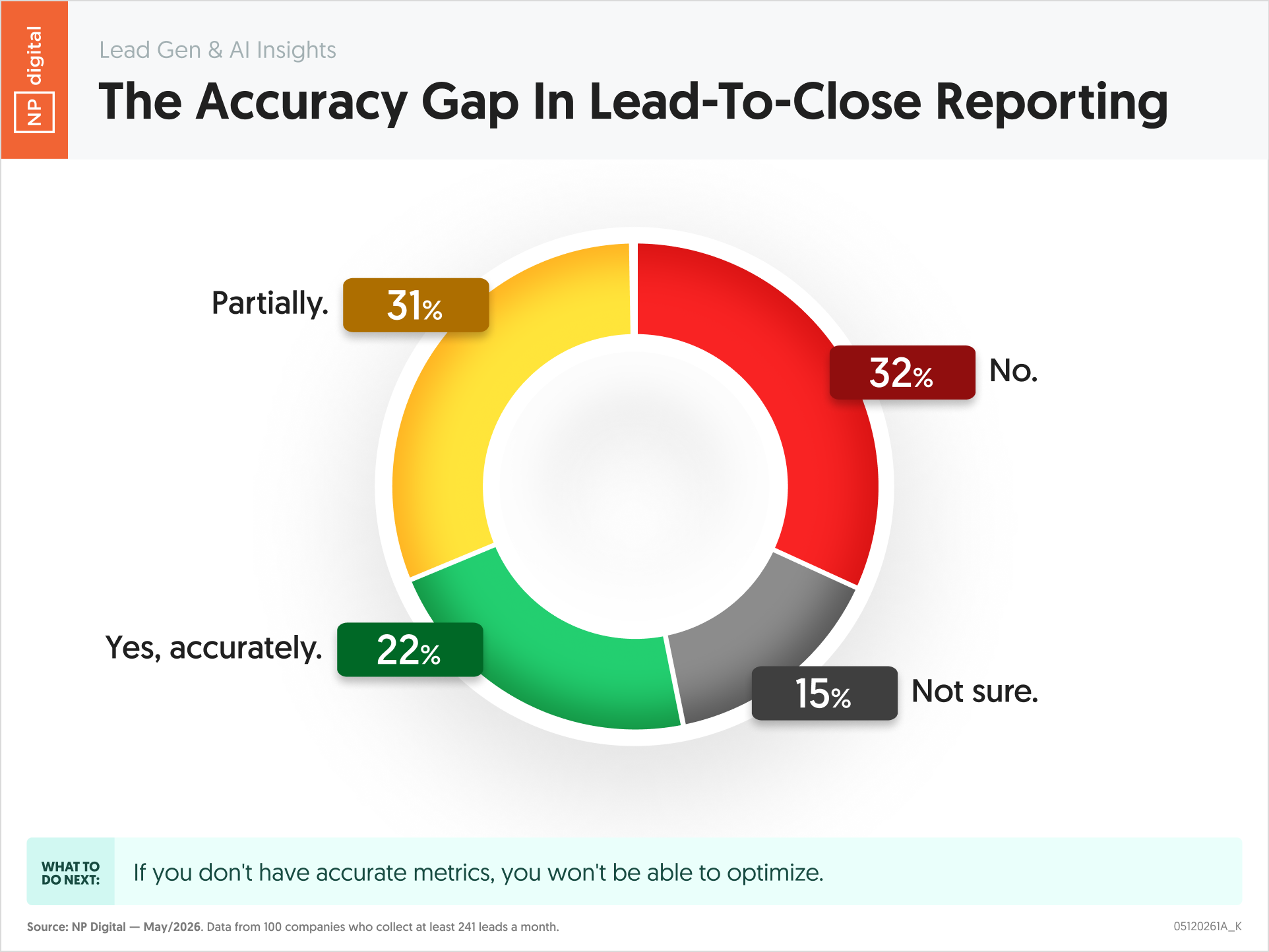
Only 22 percent of companies in this survey can accurately track what happens between lead capture and deal close. The remaining 78 percent are making channel investment decisions, setting cost-per-acquisition targets, and evaluating campaign performance using data that is incomplete, uncertain, or entirely absent. That is not a small-team problem. It is a systemic attribution failure at scale.
Essential Statistics
- Only 22 percent of companies generating at least 241 leads per month say they track lead-to-close data accurately.
- 32 percent say they do not track lead-to-close data at all, making this the single largest segment in the distribution.
- 31 percent report partial tracking only, meaning they have some visibility into the funnel but significant portions remain unmeasured.
- 15 percent are unsure whether their current lead-to-close tracking is accurate, indicating data flows through systems without confidence in their integrity.
- A combined 78 percent of high-volume lead generation companies cannot fully and accurately account for the path from lead capture to closed revenue.
Key Takeaways
- The 32 percent with no tracking at all represents the most acute version of this problem, but the more insidious situation belongs to the 31 percent with partial tracking. These teams believe they have data, and that belief drives real budget decisions. Partial data treated as complete data produces worse outcomes than acknowledged ignorance, because it generates false confidence in channel performance conclusions.
- The 15 percent who are unsure about their tracking accuracy are revealing a specific infrastructure problem: data is flowing through multiple disconnected systems, and no one has mapped the full handoff chain to verify where it breaks down. This is typically a symptom of marketing automation tools that are not fully integrated with the CRM, or CRM fields that are not being populated consistently by the sales team.
- Without accurate lead-to-close data, cost-per-acquisition numbers are directionally wrong. A channel that generates high lead volume but low close rates will appear to outperform a channel that generates fewer but higher-quality leads, because cost-per-lead does not capture what happens downstream. Teams optimizing to cost-per-lead without close rate data are systematically defunding their best channels.
- The problem compounds across time. Attribution gaps identified in Q1 affect Q2 budget decisions, which affect Q3 performance, which feeds back into Q4 planning.
- The 22 percent with accurate tracking have a structural competitive advantage that compounds in the same direction. They are incrementally improving channel allocation decisions each cycle while competitors iterate on incomplete signals.
Actionable Insights
- Map every point where lead data moves between systems before touching your tech stack or reporting configuration. Draw out the full sequence from form submission to CRM entry to sales assignment to opportunity creation to closed-won, and identify at each step whether the lead source field persists, whether the record is created automatically or manually, and whether sales disposition data is being logged. This map will surface the specific breakpoints your reporting is missing.
- Implement a closed-loop reporting integration between your marketing platform and CRM that carries lead source data through to the closed-won stage. Lead source is captured at acquisition but does not survive the handoff to sales in some scenarios. This requires both a technical integration and a process change: sales must log opportunity outcomes against source-tagged records for the data to close the loop.
- Run a manual lead source audit on your last 90 days of closed deals as an immediate diagnostic step. Pull every closed-won deal from your CRM and trace it back to its original source. For the 32 percent with no tracking infrastructure, this exercise produces a first approximation of channel-to-revenue relationships that can inform budget decisions while the infrastructure is being built.
- Build a sales-to-marketing feedback loop that requires disposition tagging on every lead. Implement a simple qualification tagging system that sales applies at each stage and make it a required field rather than optional.
- Set a monthly reporting cadence that explicitly shows lead-to-close conversion rates by channel alongside volume and cost metrics. The 15 percent unsure about their tracking accuracy often lack a structured review process. A monthly report that forces the team to reconcile lead volume, opportunity creation, and close rate by source will expose data integrity problems that never surface in volume-only reports.
“”If you do not know which leads actually close, you do not know which channels actually work. You are just optimizing for activity. The 78 percent without accurate lead-to-close tracking are making budget decisions that look rational but are built on incomplete evidence.” – Neil Patel