 Sign In





 Ubersuggest
  AnswerThePublic
 Who’s Actually Building AI Agents for Businesses?
Info
-
Source: NP Digital
-
Date: April 2026
-
Category: AI In Marketing
-
Study Methodology: Data from surveying 300 companies, of which 23 are building agents. Self-reported responses on who is responsible for AI agent development.
Most companies know they need AI agents. Far fewer know how to build them. This survey of 300 companies, with 23 actively building agents, reveals a clear pattern: the majority are turning to outside help rather than developing the capability in-house. The breakdown of who is doing the building has direct implications for agencies, consultancies, and any business deciding whether to build or buy its way into AI agent adoption.
Essential Statistics
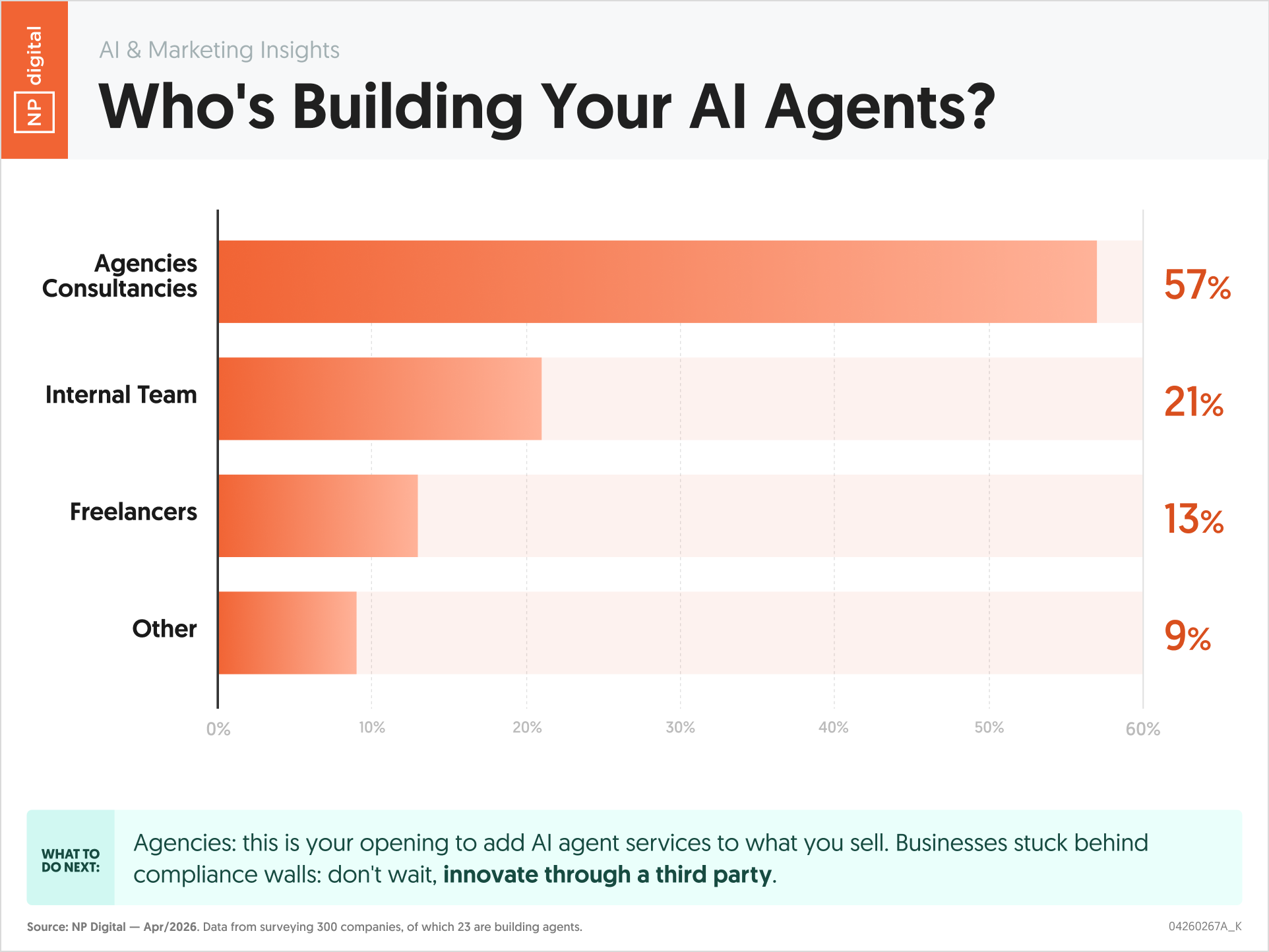
- 57 percent of companies building AI agents use agencies or consultancies, making external partners the dominant delivery model.
- Internal teams account for 21 percent of AI agent development, meaning fewer than one in four companies with active agent programs are building entirely in-house.
- Freelancers handle 13 percent of AI agent development, representing a meaningful slice of the market outside traditional agency relationships.
- Other sources account for the remaining 9 percent of AI agent builds.
- Only 23 of the 300 companies surveyed are currently building AI agents at all, indicating adoption is still highly concentrated among early movers.
Key Takeaways
- The agency and consultancy model dominates AI agent development at 57 percent, signaling a significant service opportunity for firms that can credibly offer AI agent strategy and execution.
- The low in-house rate at 21 percent reflects the skills gap most companies face. Building AI agents requires technical capability, prompt engineering, and workflow design that most marketing teams do not yet have internally.
- The freelancer segment at 13 percent suggests demand is broad enough that individual practitioners are capturing meaningful work, though the agency model still leads by a wide margin.
- With only 23 of 300 surveyed companies currently building agents, the market is still in its earliest stages. The competitive advantage for early movers is real and measurable because most competitors have not started.
- Companies behind compliance walls or with strict procurement processes face the highest adoption barriers. The chart points toward third-party partners as the path forward.
Actionable Insights
- If you run an agency or consultancy, add AI agent development to your service offering now. With 57 percent of active agent builders using external partners, the demand is already there. The constraint is the supply of credible providers, not client interest. Positioning your firm as an AI agent implementation partner before the market matures is the highest-leverage move in the current window.
- If you are a brand that has not started AI agent development, begin with a scoped external engagement rather than waiting for internal capability to develop. The 21 percent building in-house are almost certainly companies with engineering resources that most marketing teams do not have. Working with an agency on a contained pilot lets you build institutional knowledge without a full internal hire cycle.
- If compliance or procurement barriers are slowing adoption, structure your first AI agent engagement as a consulting assessment rather than a technology implementation. This framing often bypasses procurement thresholds while still producing the internal case for a full build.
- Use the 23-out-of-300 adoption figure when making the internal case for moving faster. At roughly 8 percent adoption among surveyed companies, the first-mover window is still open. Building the internal argument around competitive timing rather than technology merit often moves faster through approval processes.
- For freelancers and independent consultants, the 13 percent market share in AI agent development is a signal to build this capability specifically. Agencies will capture larger enterprise clients, but the mid-market and small business segments will increasingly look to trusted individual operators for accessible agent development work.
“Most companies building AI agents are using agencies to do it. That tells me two things. First, internal teams are not ready to build this on their own yet. Second, there is a significant service gap that agencies filling it right now will own for years. If you run an agency and you are not offering AI agent services, you are leaving a growing market to someone else.” – Neil Patel