 Sign In





The One Social Platform B2B Marketers Rely On Most
Info
-
Source: NP Digital
-
Date: November 2025
-
Category: Social & Organic Reach
-
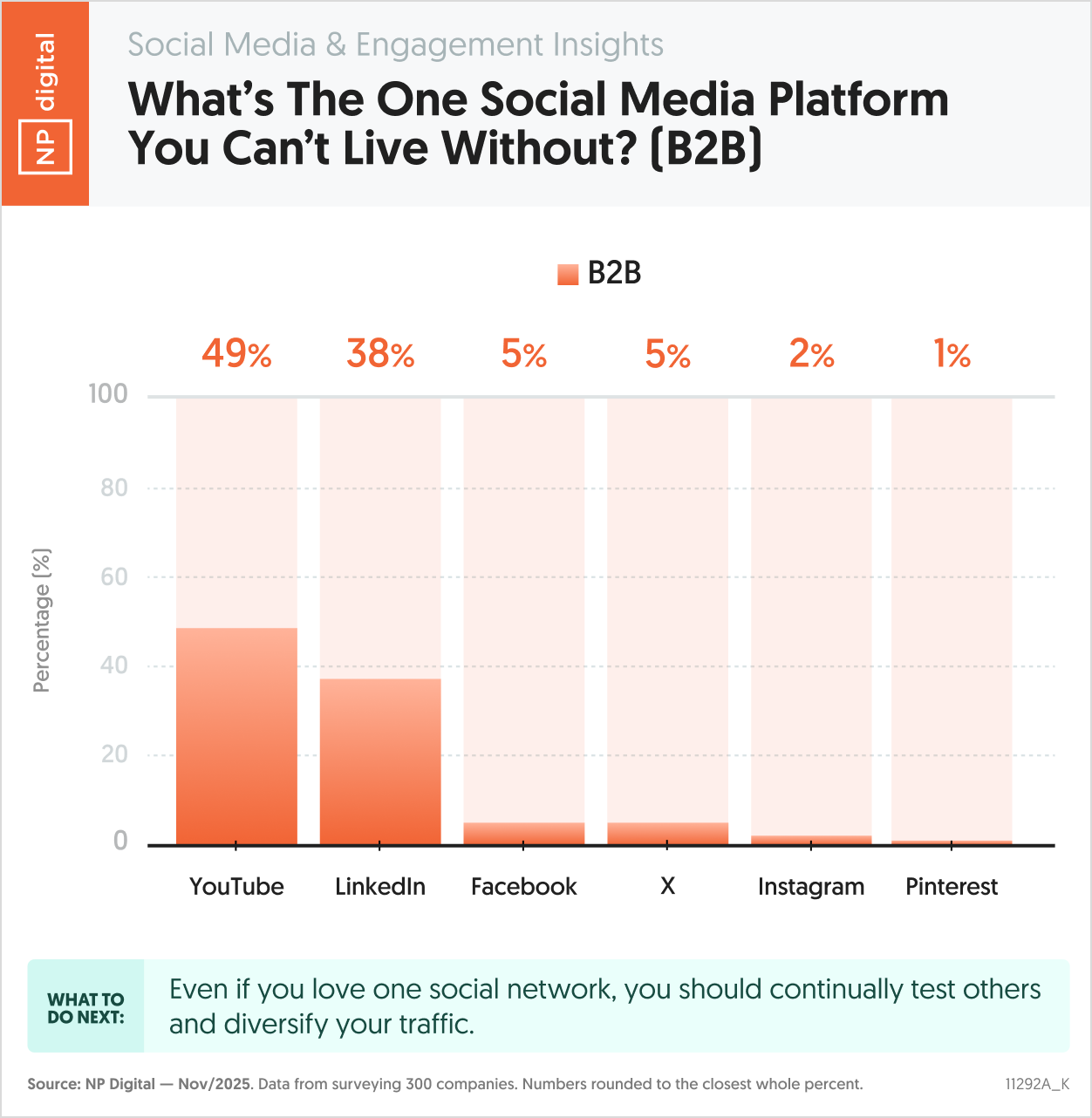
Study Methodology: Sample size: 300 companies; Method: Surveyed B2B companies on the single social platform they could not operate without; Numbers rounded to the nearest whole percent.
B2B teams often spread themselves thin across too many social platforms. This chart forces a hard prioritization by asking which single platform companies rely on most. The results show a clear hierarchy in perceived platform value. Use this insight to guide where your core social investment should live versus where experimentation makes sense.
Essential Statistics
- YouTube is considered indispensable by 49% of B2B companies, leading all platforms by a wide margin.
- LinkedIn ranks second at 38%, confirming its role as a core B2B networking and distribution channel.
- Facebook is essential to only 5% of B2B companies, showing limited strategic reliance.
- X is also cited by 5% of respondents, indicating declining criticality for B2B.
- Instagram is essential to just 2% of B2B companies.
- Pinterest ranks last at 1%, making it largely nonessential for B2B marketers.
Key Takeaways
- YouTube has become the most critical B2B social platform, not just a supplemental channel.
- LinkedIn remains foundational, but it no longer dominates alone in perceived importance.
- Most social platforms play a supporting role rather than being mission-critical for B2B.
- B2B social success depends on depth in a few platforms, not shallow presence everywhere.
- Video-driven platforms are gaining strategic importance in B2B marketing stacks.
- Testing new platforms should not come at the expense of core channel investment.
Actionable Insights
- Prioritize YouTube as a core B2B channel, because nearly half of companies say they cannot operate without it. Invest in consistent video publishing, educational content, and search-optimized video libraries that support both awareness and mid-funnel evaluation.
- Maintain LinkedIn as a primary distribution and credibility channel, because 38% of B2B companies still rely on it as essential. Focus on thought leadership, employee advocacy, and proof-based content that reinforces trust and expertise.
- Reduce resource allocation to low-impact platforms, because Facebook, X, Instagram, and Pinterest collectively account for less than 15% essential usage. Treat these as experimental or campaign-specific channels rather than ongoing priorities.
- Align social content formats with platform strengths, because YouTube dominance signals a preference for long-form, on-demand education. Shift more budget toward explainers, demos, and problem-solving videos that compound value over time.
- Audit platform dependency annually, because perceived platform importance shifts as buyer behavior changes. Revalidate which channels directly support pipeline, not just engagement metrics, before committing long-term resources.
- Use secondary platforms for amplification, not ownership, because the data shows only two platforms truly anchor B2B social strategies. Repurpose core content from YouTube and LinkedIn rather than creating net-new assets everywhere.
YouTube winning here tells you B2B buyers want depth, not just updates. If your best thinking is not searchable, bingeable, and on demand, you are leaving trust and pipeline on the table. – Neil Patel