 Sign In






AI Platform Trust Levels Compared
Info
-
Source: NP Digital
-
Date: August 2025
-
Category: AI In Marketing
-
Study Methodology: Sample size: 2,108 respondents; Collection method: Surveyed users on perceived trust across major AI platforms.
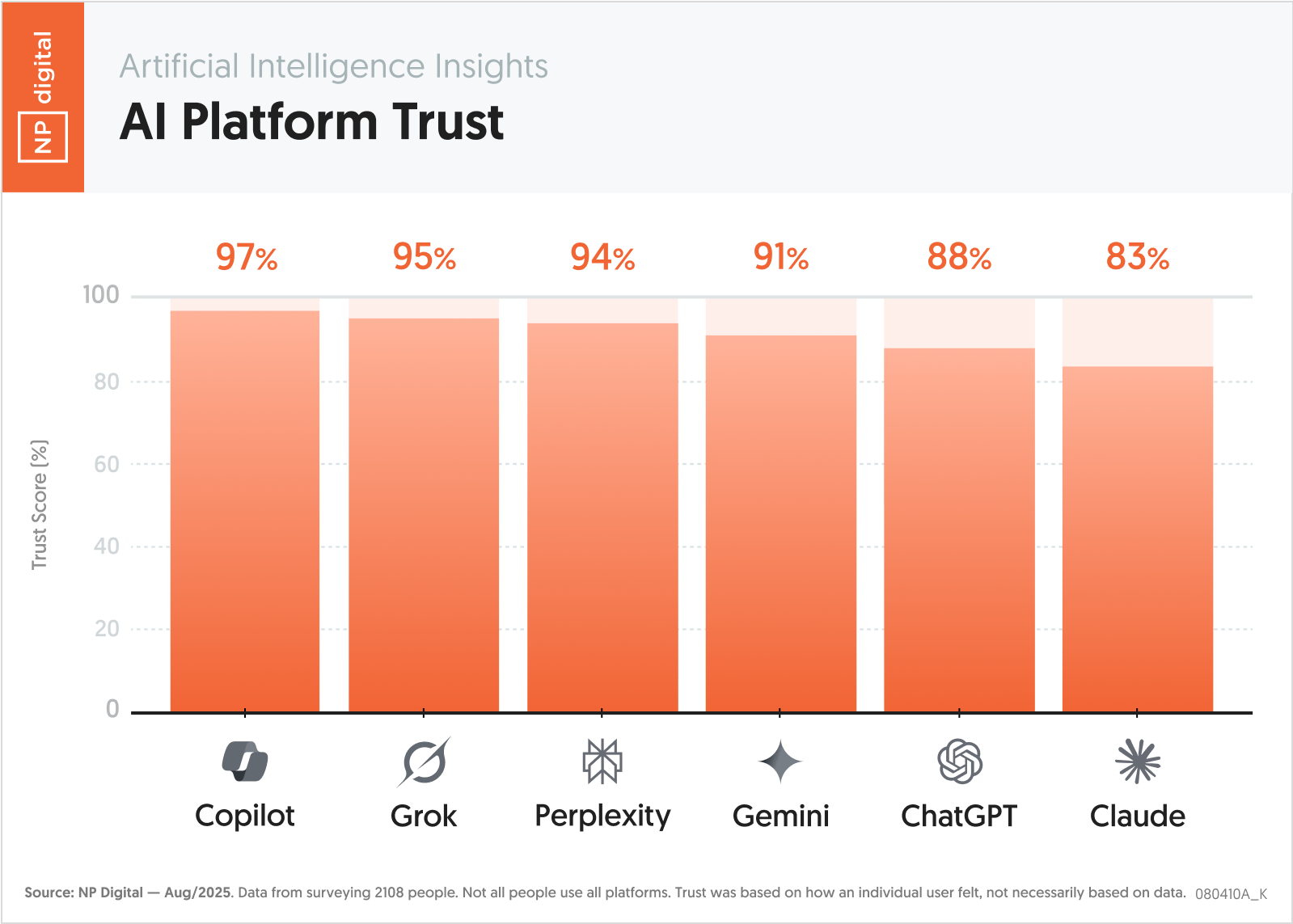
This chart shows how much users trust different AI platforms. While trust is high across the board, meaningful gaps exist between leaders and newer tools. The data highlights why trust plays a growing role in AI adoption.
Essential Statistics
- Copilot leads AI trust at 97%.
- Grok follows closely with 95% trust.
- Perplexity earns a 94% trust score.
- Gemini is trusted by 91% of users.
- ChatGPT holds an 88% trust score.
- Claude records the lowest trust at 83%.
Key Takeaways
- Trust varies meaningfully across AI platforms.
- Enterprise-backed tools lead in perceived trust.
- Lower trust may slow adoption in sensitive use cases.
- Brand reputation influences AI credibility.
- Trust is becoming a competitive differentiator.
- User perception does not always reflect capability.
Actionable Insights
- Choose AI platforms based on trust fit, because perception affects adoption and usage depth. Higher-trust tools reduce internal resistance.
- Use higher-trust platforms for sensitive workflows, because users are more comfortable relying on them. Align tool choice with risk tolerance.
- Invest in AI transparency internally, because trust gaps can limit ROI even with strong tools. Educate teams on safeguards and limits.
- Avoid assuming capability equals trust, because lower-trust platforms face higher skepticism. Plan adoption change management accordingly.
- Reassess platform trust over time, because perception shifts as AI brands evolve. Treat trust as a moving metric.
AI adoption is not just about features. If people do not trust the tool, they will not rely on it. – Neil Patel