 Sign In






Selling can be challenging because it involves s a complex process of human behavior and cognition.
More than likely, marketers who struggle to win customers either haven’t been prospecting the right way or aren’t putting in enough effort.
In this in-depth article, you’ll learn how to leverage the power of the human brain with neuroscience sales tips.
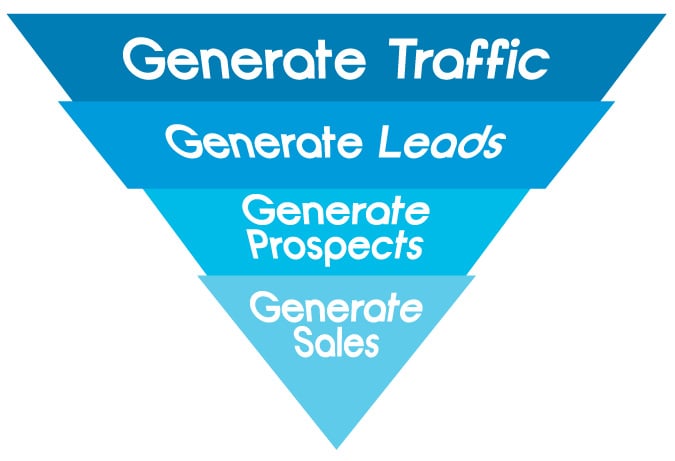
Whether you’re selling a digital product online or you run a brick-and-mortar business, these behavioral neuroscience principles will work for you. They’ll help you drive more visitors into your marketing funnel and convert casual visits into sales.
How to Use Neuroscience For Sales
tldr; 7 Neuroscience For Sales Steps
- Use Influence to drive value.
- Sell yourself before selling a product
- Build interest and desire with features and benefits
- Sell the results
- Use trust and expertise to build credibility
- Sales is a “give and give” relationship to customers
- Stop selling to close even more sales
1. Influence Drives the Value of Your Product
Influence marketing is here to stay, so you should embrace it.
Influence is your ability to persuade others to adopt your own perspective. You believe in your product (e.g., online course, ebook, software), so you naturally want others to believe in it, too.
Your ability to persuade others in this way by appealing to their emotions will increase your sales. Influence increases the perceived value of your products.
You see, influential people tend to sell more product. It’s not because they’ve created the best product — sometimes, that’s just not true — but because over the years, they’ve built credibility. People trust their opinions.
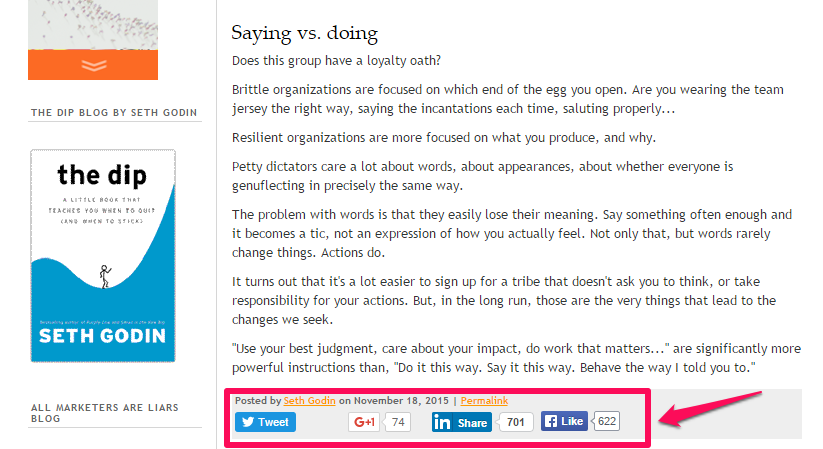
For example, in the digital marketing world, people trust Seth Godin. That’s because Seth Godin has written over 20 bestselling books. He’s a sought-after public speaker and social media influencer.
Seth doesn’t waste words. Most of his posts have fewer than 200 words, like the one below, but the social sharing and engagement for these posts is amazing.
Remember that influence isn’t the same as popularity. They’re not interchangeable, though a lot of people regard them as such.
Brian Solis reports that one person responding to a survey he conducted with Vocus put it like this:
Popularity is just that people like you, influence is when they listen to you.
When you’re selling online, becoming popular shouldn’t be your ultimate focus. Spend time building your influence. It takes time, but it’s worth the effort.
In the book Influence: The Psychology of Persuasion, author Robert B. Cialdini, Ph.D., identifies the 6 factors that get people’s brain function to do something that they wouldn’t have ordinarily done.

In my experience as a content marketer who’s built a loyal audience, influence can be achieved through consistently creating useful content for your target audience and forming relationships with influencers and readers.
If you’re a blogger, you’ve already cleared the first hurdle of building authority and influencing people. Macallan persuaded 32 people to do marketing for the company. This resulted in a huge increase in exposure and influence over an audience of 150,000 people.

Next, give adequate time to content creation and building friendships. Reply to comments, answer questions, and, every so often, visit a reader’s blog and give them some free feedback or tips on how to improve their site.
Public speaking is another way to establish your personal brand and build a loyal following.
2. You Have to Sell Yourself Before You Can Sell Your Product
Make no mistake: You’re a product; and like any product, you have to successfully communicate the value of that product. Until that happens, you’ll find it difficult to sell your actual products or services.
Before anybody is going to buy from you or your company, they’ve got to ‘buy’ the idea that you’re somebody worth working with. In other words, just like a job candidate, your first task is always selling yourself.
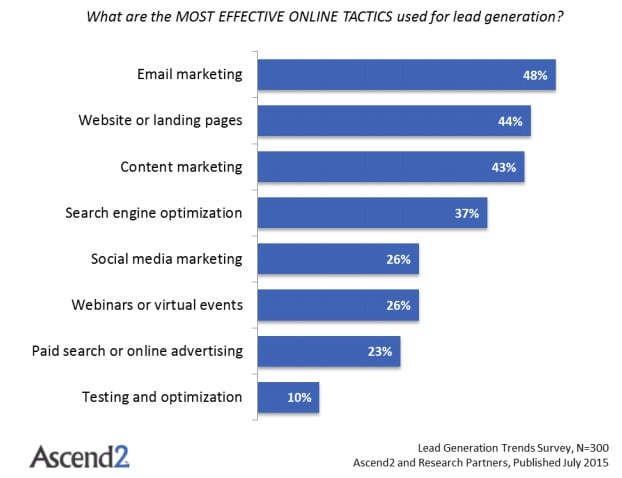
Email marketing is the most effective lead generation tactic, followed by websites/landing pages and then content marketing. But guess what? Each of these tactics will work better when you first sell yourself, then the product.
Selling yourself isn’t an insurmountable challenge. There are lots of opportunities in today’s world of marketing to appeal to the human brain. However, with many opportunities come an increase in competition.
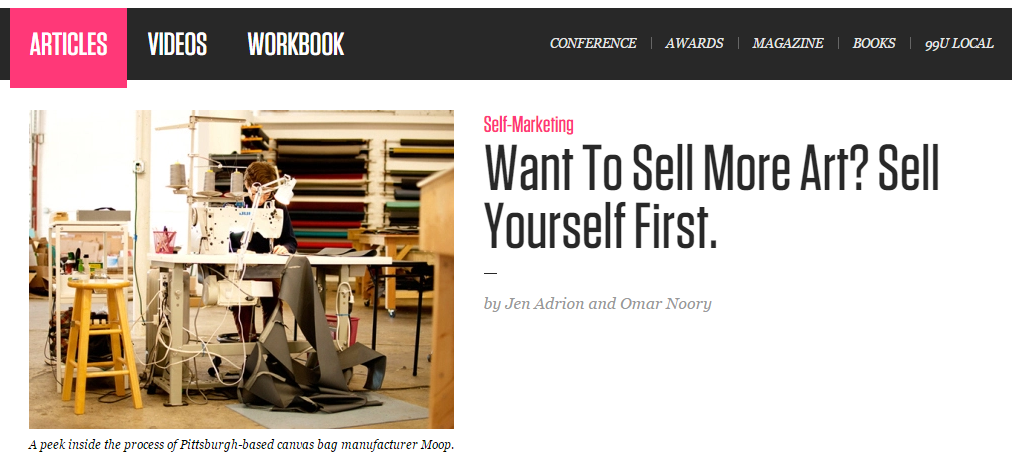
In a sea of writers, bloggers, freelancers, consultants, public speakers, etc., how do you stand out from the crowd?
It’s simple: Become passionate about your product.
When you’re selling yourself, you’re not concerned about the money. Your responsibility is to educate others’ human minds as you convey your brand’s core message.
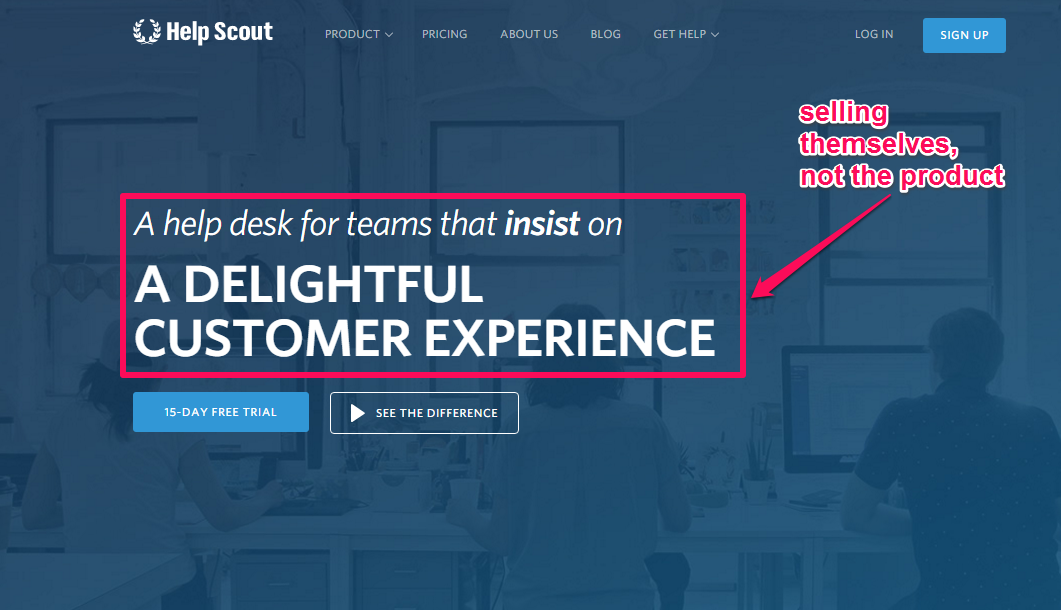
HelpScout doesn’t just try to sell help-desk software. Instead, it also sells itself as a brand.
Learning how to sell yourself first is critical to your success. No matter what product you’re offering for sale, do your best to connect with and communicate your core brand values to your prospects.
3. Build Interest with Features; Build Desire with Benefits
Sell the benefits, not the features.
Most people and companies think products and services sell because of their great features. That’s not the case.
Harvard Business School conducted a research study and found that products of all kinds sell because of their benefits. The benefits that drive sales aren’t always obvious from the customer’s perspective though.
Whether you’re selling via email, direct mail, or social selling, highlight the benefits as well as the features of your product.
Starting with the strongest benefits of your product will reassure customers that you care about them, not (just) their hard-earned money, providing social security.
Selling with benefits means that you’re transparent with your customers. That’s exactly what their cognitive function wants.
Copywriters know how to sell benefits.
For example, Dan Kennedy wrote sales copy that generated over $10 million in sales over the years. It’s the same with Eben Pagan, Frank Kern and several top digital entrepreneurs.
These people were successful because they focused on benefits, not features. Successful selling boils down to one thing: showing your customers how your offer/product meets their needs.
Kat Night agrees that quantifying the benefits of a product is more likely to result in a sale than describing its features.
However, in order to avoid misleading prospects and customers, you have to start by building interest with features. Then, you increase their desire for your product with benefits.
When people are searching for a solution to meet their needs, what their brain function is actually looking for is a future that appeals to them. According to BufferApp, “people don’t buy products, they buy better versions of themselves.”
Consumers are happy to spend money on products that’ll make their lives better. Before the iPod was invented, there were MP3 players on the market. So iPod sold the benefit: “1,000 songs in your pocket.”
What’s the difference between a benefit and a feature?
This is how the folks at User Onboard explain:
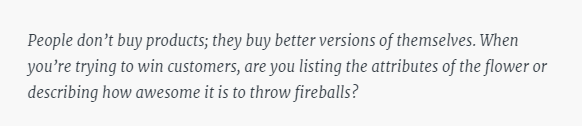
In a nutshell, benefits are what you (or your prospects) can do with a product. Features are what the product can do. They sound similar, right? Yet, they’re totally different things.
“You can get fit without straining your joints with an elliptical trainer” targets the benefit. “Easy-glide motion, timer, and adjustable intensity settings” are all features.
See the difference?
Customers’ cognitive functions are different depending on where they are in the buying journey. Their human brains all must first recognize a need, then seek potential solutions, evaluate the solutions, decide to take action, and finally make the purchase.
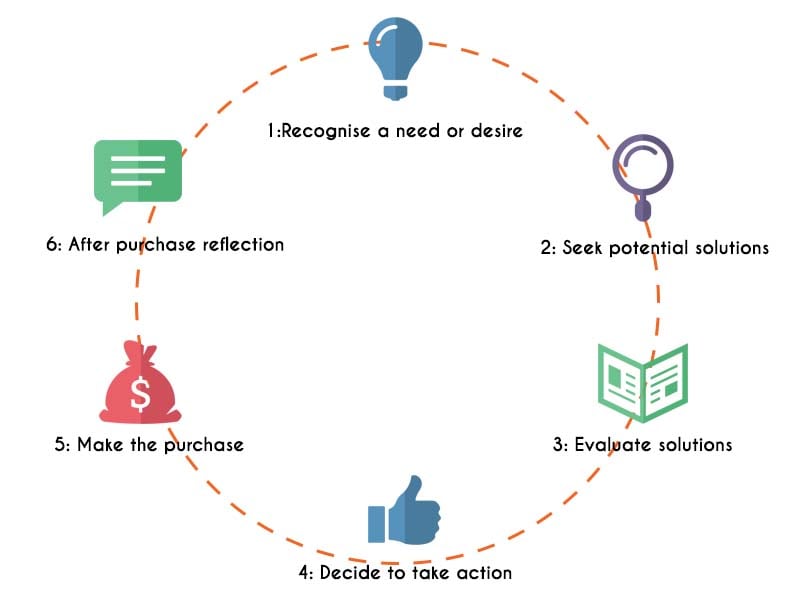
Use features at stages 1 and 2; benefits will work better on their brain activity when they’re actually making purchase decisions (stages 4 and 5).
Professor Albert Wenben from the University of Wisconsin-Madison conducted a study on the topic of “Consumer Values, Product Benefits and Customer Value: A Consumption Behavior Approach.”
He found that “from the customers’ perspectives, products are viewed as a bundle of benefits, not attributes” (features).
MBA Skool suggests that a product benefit is usually the answer to customer’s questions. You probably already know that questions are driven by the psychological phenomenon of an emotional desire to know more.
The level of satisfaction derived from a product will differ depending on human behavior and cognitive neuroscience. After all, two people may both need a product, but one can need it desperately, while the other could get along without it.
To get the best results, highlight 70% of your product’s benefits, and 30% of the features.

Let’s look at an example in the world of marketing consulting services and products.
For most retailers with optimized and high-functioning websites, SEO and email marketing are more beneficial than a Facebook page. That’s not always true for other retailers.
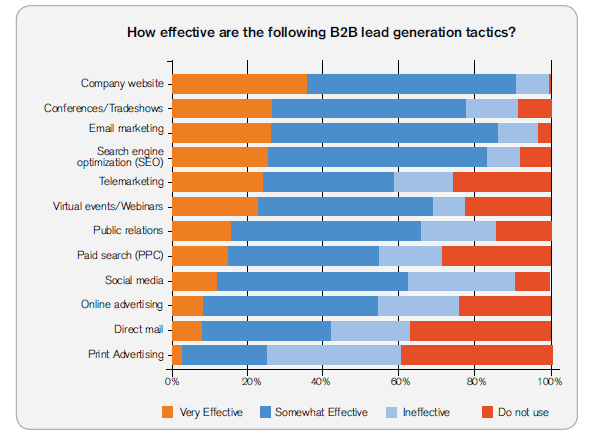
If you help businesses set up a Facebook marketing campaign (including a fan page), you need to sell with benefits while targeting your ideal customers (e.g., those without a functional website or with low-performing sites).
People buy products emotionally, and justify the purchases logically. When you use brain science to build interest with features and create strong desire with benefits, you’re meeting your prospects where they are and giving them the social security and social proof they need to feel confident in the purchase.
When you evoke the appropriate emotions, customers may not even know why they’re responding to your product. But they’ll buy it.
Remember that benefits are the things that you can do with a product, while features are what the product can do. Let’s look at a few real-world examples:
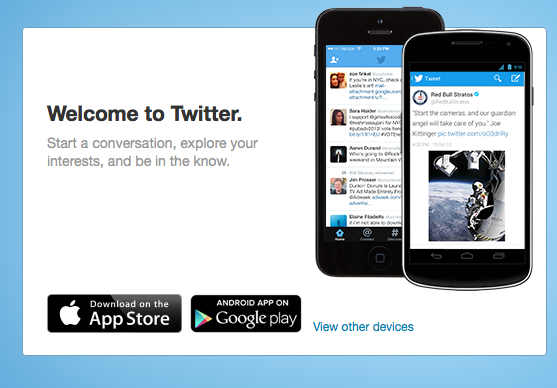
Twitter is a unique micro-blogging platform. It helps you update your timeline in real-time. It all began from their value proposition, based on the platform’s benefits: “start a conversation, explore your interests and be in the know.”
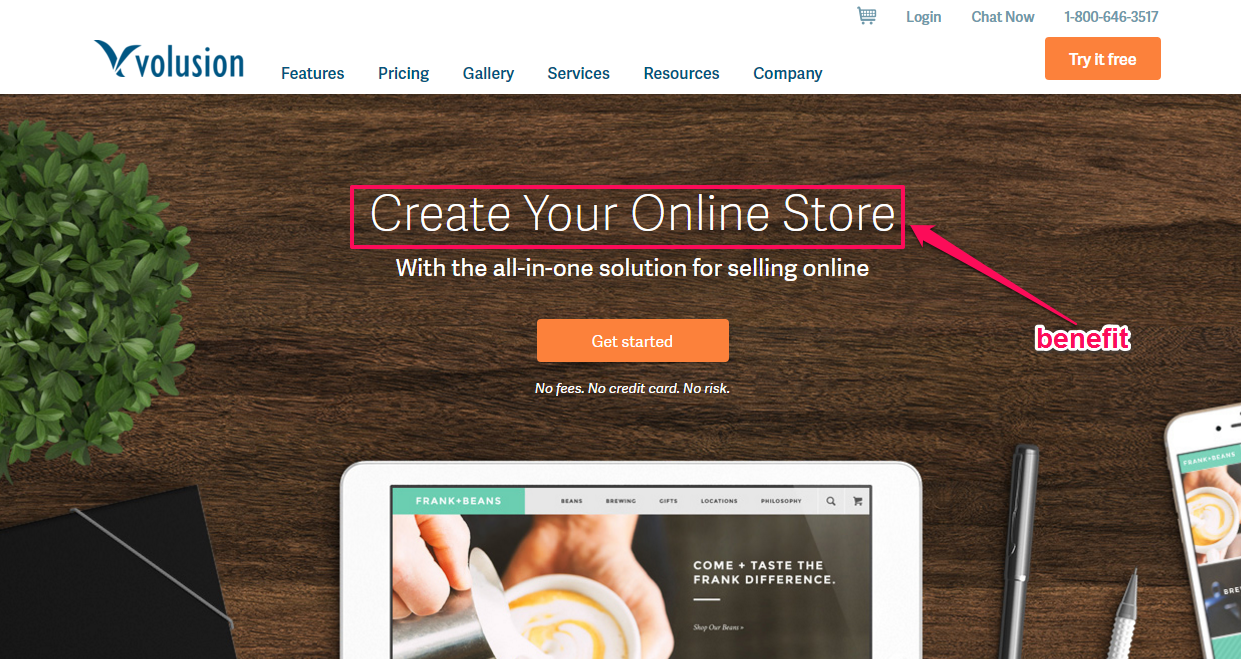
Volusion.com has a unique value proposition that simply and strongly projects the core benefit of its software.
It’s your responsibility to study your product and know its features, benefits and advantage over your competitor’s product.
4. Sell the Results by Painting a Clear Picture
Are you selling your product’s results?
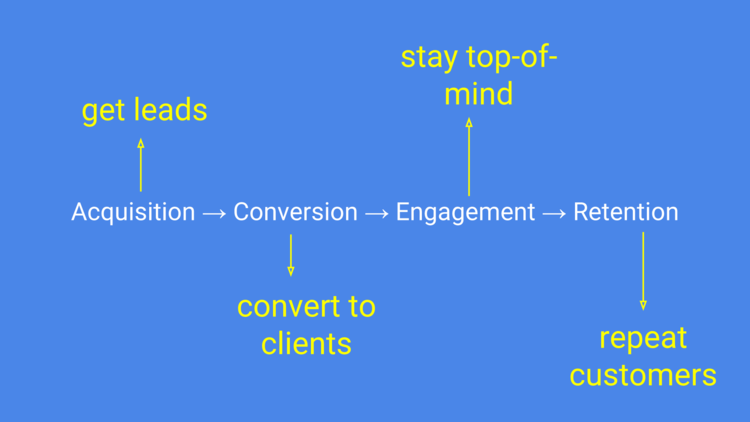
If you don’t do that consistently, you’ll likely struggle to acquire qualified leads and increase conversion and revenue.
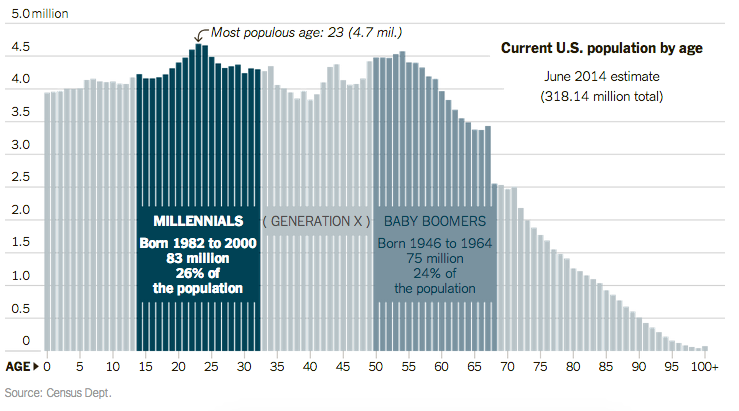
These days, most of us are selling to a new generation of customers: the millennials.
Millennials are a unique set of people born between 1982 and 2000 and making up 26% of the world’s population. Over 23% of millennials hold a bachelor’s degree or higher, making them the most educated generation in history.
Even if today’s consumers haven’t graduated college, they do know what they’re after in a product. They want results and they won’t let their human brain function be swayed by fancy copy that doesn’t give at least a sneak peek of the results that they can expect.
To market successfully to this group of consumers, you need solid research and data.
A study conducted by Harvey Research on “How to Sell with Ad Readership Studies” found that “one of the primary reasons for conducting an ad readership study is to obtain research which will help your organization sell advertising.”
When this research is documented and the data shared with advertisers, it becomes a marketing partner.
In advertising, the result is the data — that is, the actionable metrics. If your product helped a customer increase lead generation by 27%, that’s a metric that you can use to win more clients.
Have you ever wondered how introverts successfully sell products? An introvert is a person whose motives, actions, social preferences and human brain functions are directed inwards. Introverts generally don’t enjoy the human behavior associated with convincing or negotiating.
They’re reserved. Selling is not their preferred task, yet many of them end up becoming top salespeople and industry power players.
Brian Tracy was an introvert, but by studying consumer psychology and cognitive science and learning what social signals prompt people to buy, he’s become exceptionally successful through neuroscience principles of sales.
One of the sales secrets that the introvert masters know is that it’s much better to sell the results of a product, instead of the product itself.
Selling the result can be likened to painting a clear picture of your target in an ideal future setting — a point in time where they’ve conquered their challenge or solved their problem successfully — and displaying it on a shelf.
People who know that person will be captivated by the promise of the painting.
In the same vein, when you paint the picture of your product’s results and show people how easily they can use it, you’ll build interest and inspire action in them.
According to Tara Gentle,
People aren’t looking for your service (or your product, or your program). They’re looking for results.
In other words, your product isn’t the selling point, so why make it the focus? For example, instead of writing your copy headlines using your product name, focus on the product’s results.
A few ways to sell results instead of products are:
Lead with the value of the product, not the title: If your product helps people cut 5 hours off their workweek, lead with that. It’s your competitive advantage.
If your offer (e.g., service, program, online course, etc.) helps people lose 10 pounds in 60 days, let your copy focus on that core benefit.
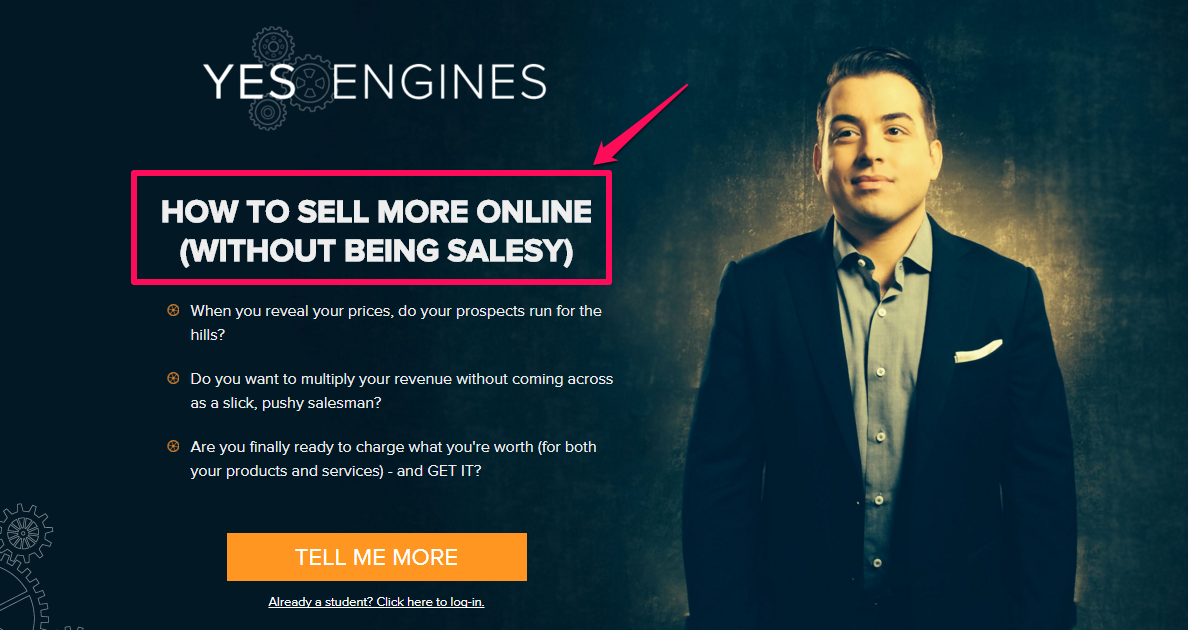
Derek Halpern sells the result of his online course, “Yes Engines.” See the captivating title?:
Showcase before and after results: Fitness trainers know how to use “before” and “after” pictures and videos to improve self-esteem, inspire action, and improve positive cognitive function.
If you’re looking to lose weight, would you be excited when you see amazing case study results from people like you and then find out you can do the same?
The same thing applies to makeup products or tutorials. If you’ve been searching for a makeup training program and you came across the before & after pictures below, would you want to know more?

In selling the results of a product, rather than the product itself, you’ve got to use visuals that allow your customers to see themselves getting the results they want. Don’t just describe what the end result will look like; represent it with visuals.
Even scientists are in sales. How do scientists sell brain science, cellular neuroscience or experimental psychology to the public? The public isn’t naturally interested in subjects such as developmental neurobiology, computational neuroscience, functional magnetic resonance imaging, or neural systems.
Also, difficult and upsetting subjects such as Alzheimer’s disease, brain damage, post-traumatic stress disorder, or other mental health issues can be difficult to sell to a reader.
Are there any typical results they have to show, the way a blogger who created an online course on how to “get 1000 email subscribers” would?
More than likely, the scientists don’t have visual results to show. Instead, they sell the validity of a case study and its importance to appeal to the reader’s cognitive psychology.
A study by Vanderbilt University concluded that scientists sell scientific data and ideas by convincing their peers and colleagues of the study’s validity and importance.
Since the population usually can’t fully understand all of the wide range of implications of scientific data, a scientist’s “pitch” is often translated by the news media into something that a lay audience can understand.
In many niches, before you can sell a product you need to first acquire leads, nurture them, and convince them to buy.
Selling isn’t a one-way street. Several factors play a vital role. The platforms where you generate your leads matter. Most people have generated more leads through Facebook ads than Google Ads.
On the other hand, the quality of leads of Google Ads tends to be higher.
When it comes to giving people value for their time and money, Google leads the pack. Google sells advertising, not search results.
That is why paid ads in Google are clearly marked and set apart from the actual search results. When it comes to displaying the right results, here’s what Google says:
Google search results take into account who links to a web page as well as how relevant the content on that page is to your search. Our results reflect what the online community believes is important, not what we or our partners think you ought to see.
As you can see, Google sells advertising on its search engine, but it delivers the most relevant, valuable, and helpful search results in its organic listings. Site owners can neither pay to stay at the top of the search results pages, nor manipulate their rankings (at least, not for long).
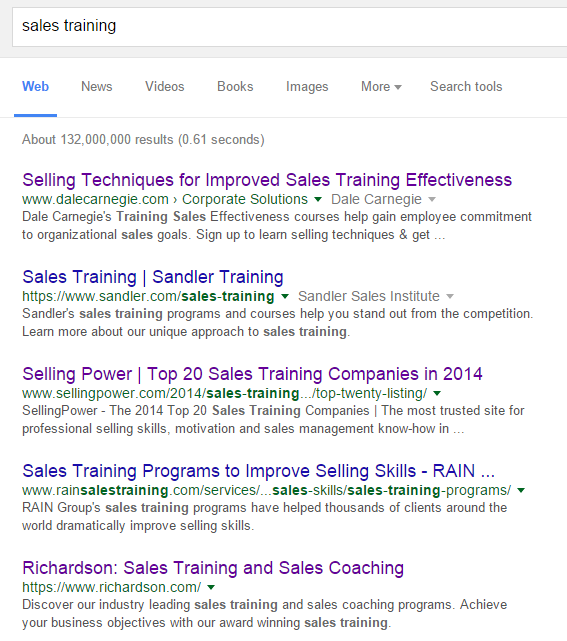
Google is the leading digital advertising company because first, it understands what people want, and second, it’s committed to providing the best search results.
5. Credibility Depends on Trust and Expertise
You are more likely to make sales when you have built credibility.
You can build credibility in a number of ways, including by providing top-notch customer service.
Customers want to reach an agent who can help them resolve problems quickly. They also want to interact with real people and gain access to information to resolve issue themselves.
Trust + expertise = credibility.
You can’t succeed in business if you lack credibility. Top brands can boast about their products, because over the years they’ve become known and are credible, offering social security.
That’s why it’s difficult for a new marketer, organization, or company to dominate the marketplace.
Customers’ cognitive functions are scared to trust you or your product. After all, you might take their money and vanish. Customer service is the hallmark of credibility. It builds credibility from the ground up.
The viral effect of bad customer service is alarming. More people share negative experiences than they share good ones. 66% of customers who experienced negative (bad) customer experience want to discourage others from buying from that company.
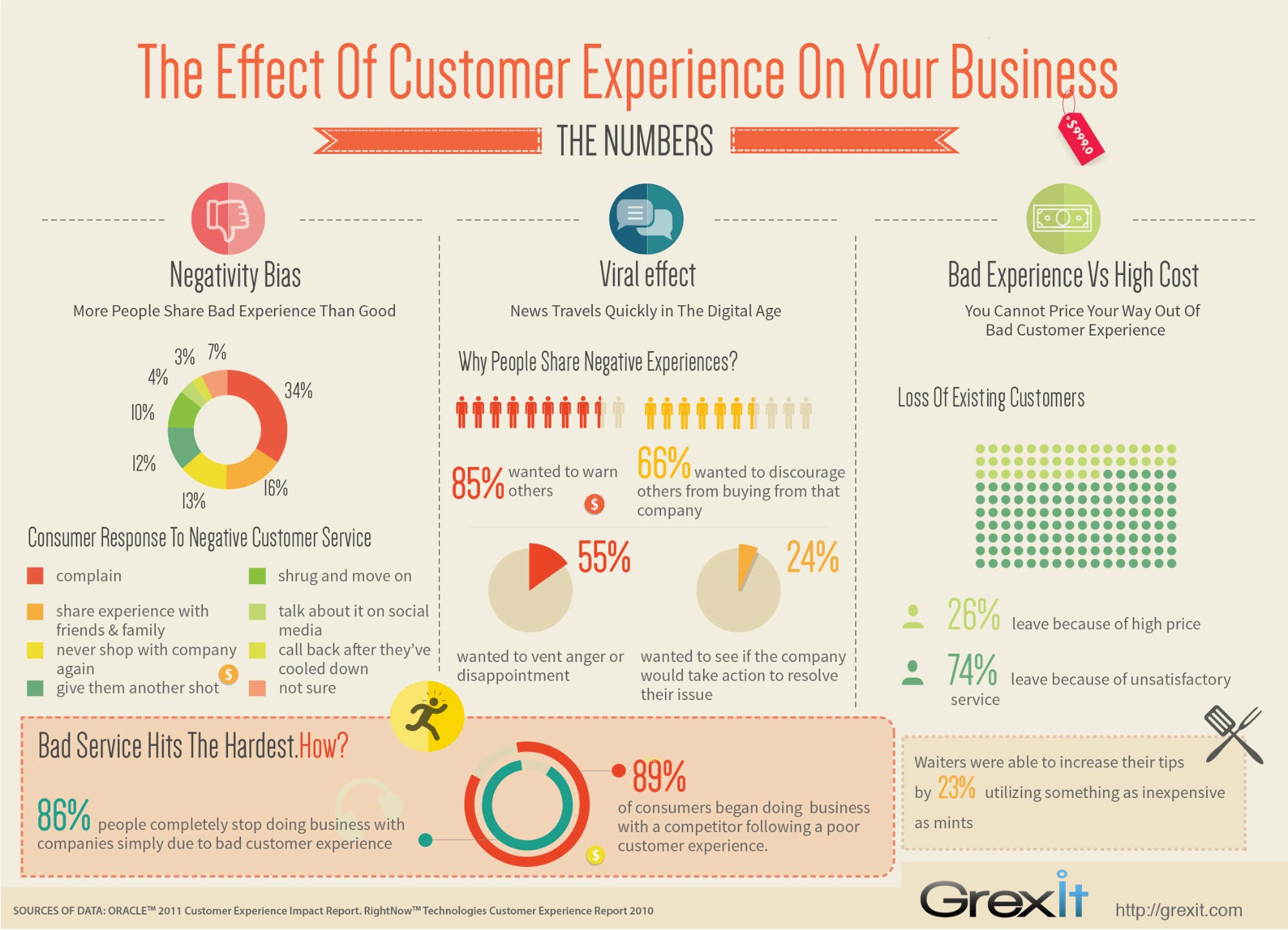
86% of people completely stopped doing business with companies over bad customer experiences. It negatively affects their human brain functions.
Every day, I wake up and ask myself a question: “What’s the best thing I can do for my customers today?”
It’s a simple, slightly dramatic exercise that reinforces for me the importance of building trust in prospect’s minds. People won’t trust you unless you’ve proven yourself and delivered immense value over a period of time.
How do you establish credibility when you’re an online business owner?
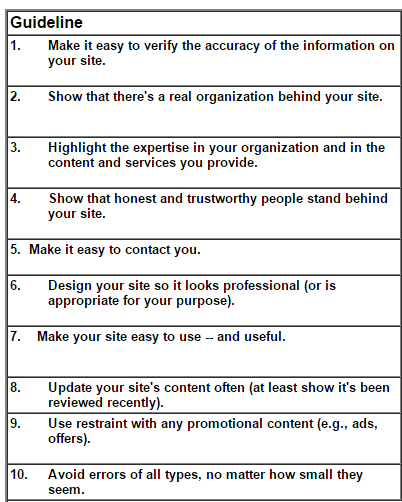
Stanford Web Credibility Research compiled 10 guidelines for building the credibility of a website. This can be applied to your product, personality, and brand.
Most local businesses know how to build credibility. They use sentiment to affect human behavior. While others are struggling to earn a customer’s trust, local businesses donate to schools, sponsor children’s sports teams and participate in community events bulletin boards.
Be willing to work hard. People respect people who work hard. But, don’t make it all about yourself. Credibility is best earned by looking out for the interests of other people.
Here are a few simple ways to improve your credibility:
Answer questions correctly: Trust and transparency are just as important to corporate reputation as the quality of products and services. If you give incorrect answers it will damage your reputation.
When people ask you questions, if you don’t know the right answer, then say so. Offer to do some research and get back to them.
Whatever you do, don’t spout off with something you’re not sure of just to sound intelligent. The more you answer questions correctly, the more people will trust you.

Produce valuable content regularly: There is no shortcut to content creation. You either do it yourself or outsource it to a knowledgeable freelance writer.
Always publish new content that helps people achieve their goals more easily. Your credibility level will increase.
Don’t just create generic content. Instead, focus on creating custom content that will be relevant to your audience and in sync with your goal.
Offer to solve relevant problems: If you have unique skills, you can offer to solve relevant problems for your target audience.
For example, if you’re a website developer, you could offer to help readers tweak their WordPress themes, or show them how to do it easily themselves.
Build relationships: We all need to treat others fairly, recognize their inherent worth, and respect them.
Don’t let your human behavior be solely consumed by the amount of money you can make. Instead, now and again, help people for free. Brenton Hayden recommends that you follow a few specific strategies if you want to up your credibility:
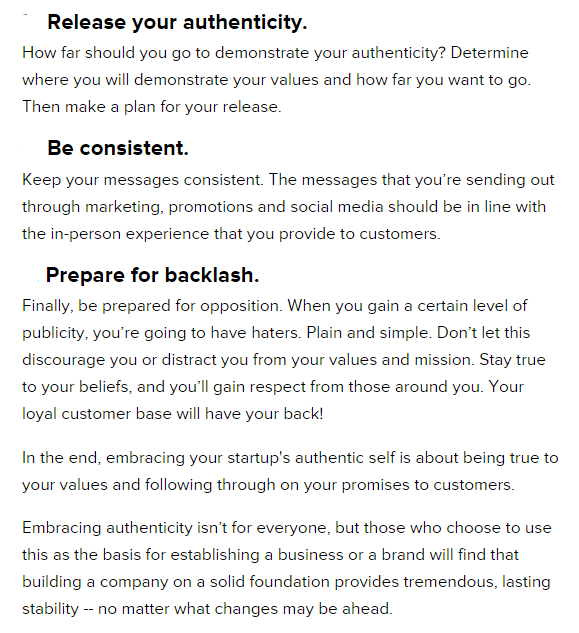
In today’s marketplace, brands and products disappear as quickly as they appear. Most of them won’t stand the test of time.
It’s obvious that the way to improve your credibility is to build relationships with prospects and customers and earn their trust.
You can also build credibility by showcasing customer success stories. If you don’t have any authority at all, it may be hard for people to trust you. The best approach to appeal to their cognitive functions is to show that your product really works.
Drew Manning, founder of Fit2Fat2Fit, knows how to showcase real-life results. He discovered that most people who sell fitness programs and products are athletic, fit people who have never been overweight.
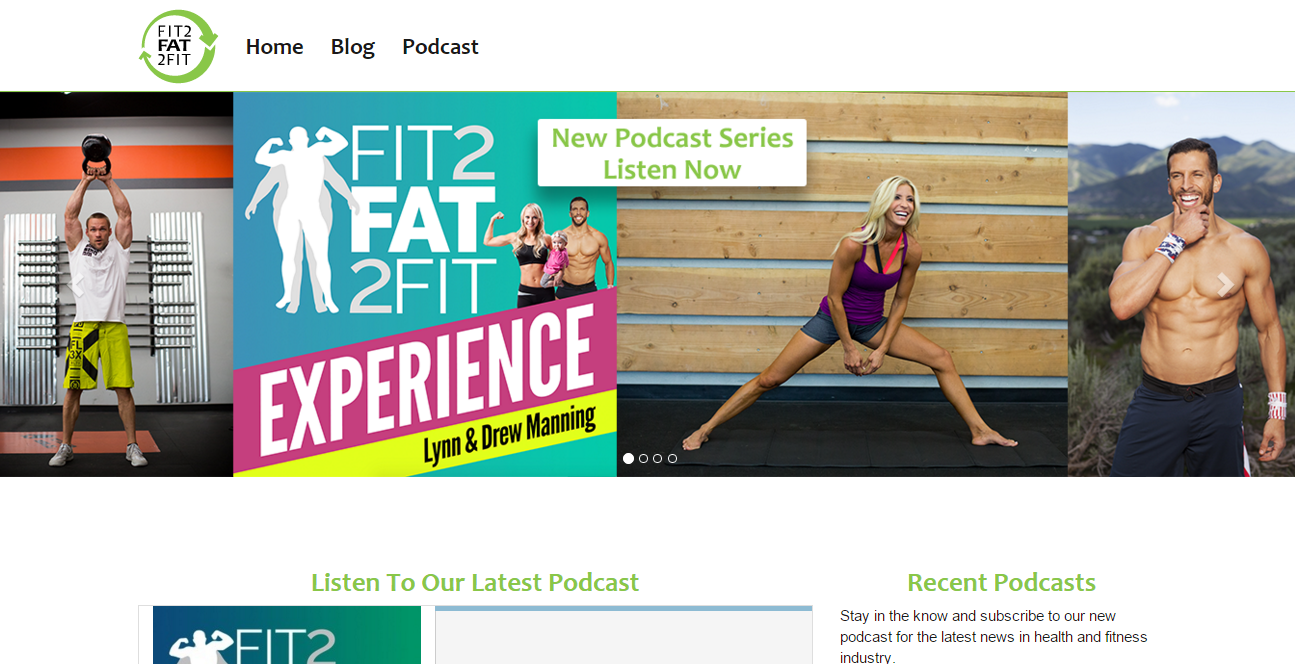
How can they possibly understand the human brain functions behind the struggles that overweight people endure and what that feels like?
Drew Manning did things differently. He spent 6 months gaining over 70 lbs. He then spent another 6 months taking the weight off.
This transformation was a source of confidence to potential customers. They thought, “If it worked for him, it’ll work for me, too.”

6. Sales Is a “Give and Give” Relationship
Giving usually comes into focus during the holiday season.

In The Science of Giving: Experimental Approaches To The Study of Charity, author Daniel M. Oppenheimer estimated that Americans donate over $300 billion each year to charity.
When you’re selling a product online or offline, giving should be in the form of value.
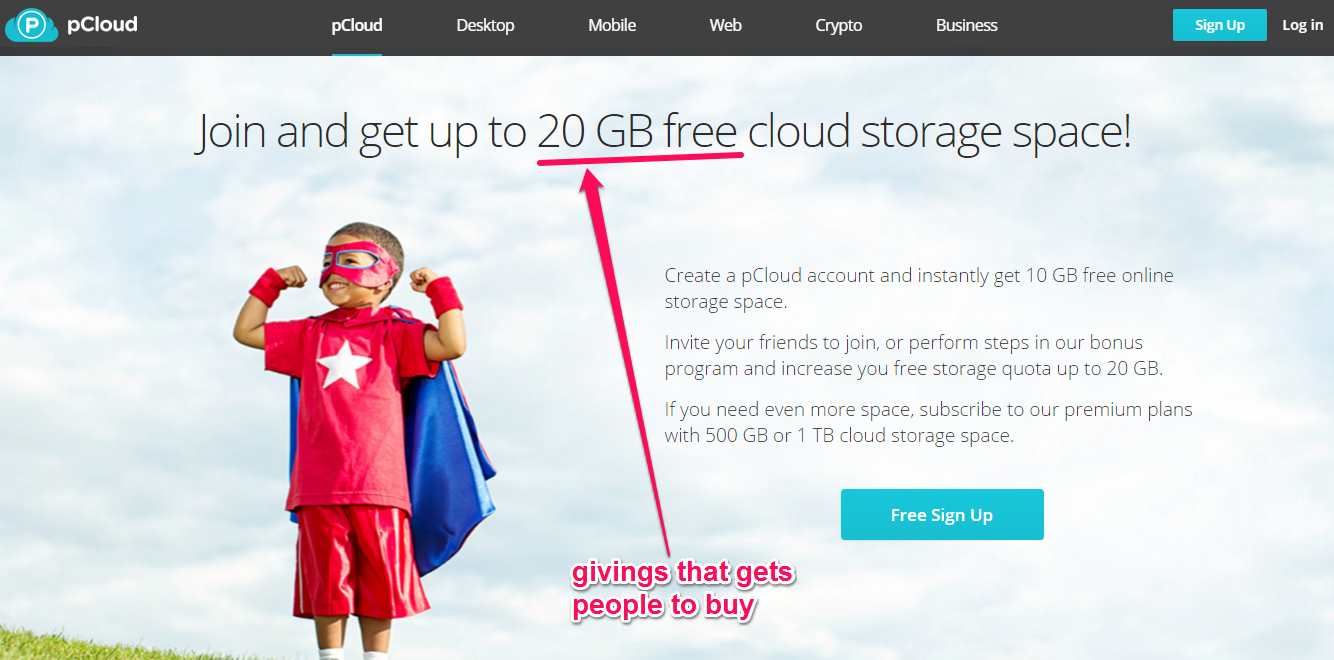
For example, you could give 1 – 10 GB free to customers who register your cloud storage solution, as pCloud does.
If you’re an author, you could give away the first two chapters of your book for free.
Giving is what I do on a daily basis because it’s the only way to build a sales relationship with potential customers.
I spent $30,000 on content creation; and instead of selling it, I gave the content away for free.
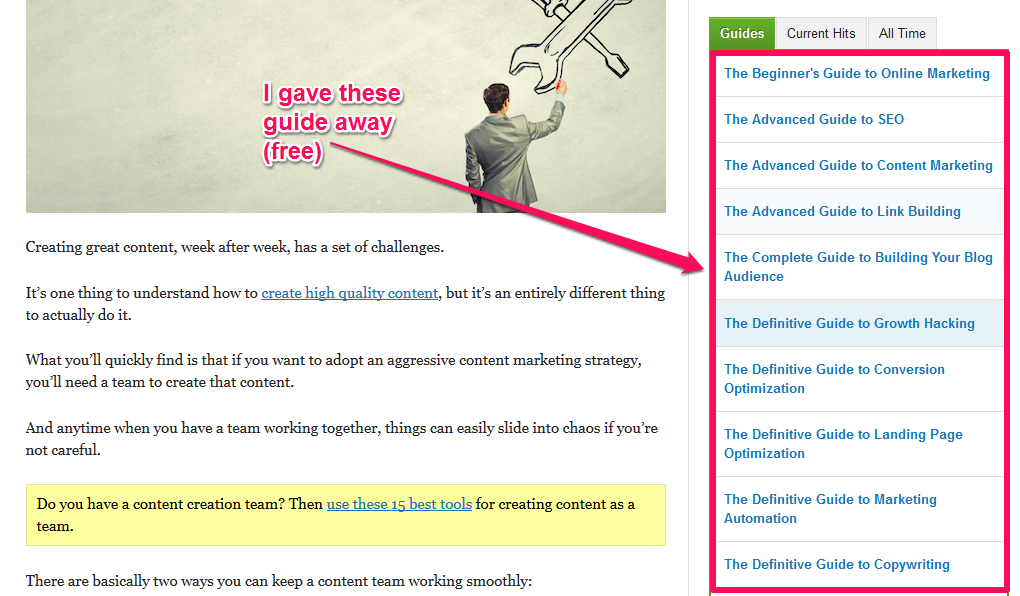
Your customers are your best salespeople. Before they can recommend your product to other prospects, you need to make up your mind to give and give. That’s the relationship between you and customers.
According to the Agricultural Marketing Resource Center, there is a way to sell that is rewarding, positive, and even enjoyable. It’s called relationship marketing and it’s a message Dale Carnegie started delivering over 80 years ago.
When you first establish a relationship with prospects, it affect their neural development and becomes easier to sell to them. The best salespeople are the best givers.
Contrary to what most people think, it’s not a “give and take” relationship, because you’re not taking anything from your audience.
If you love your customers (of course you should), then look for ways to give them as much value as possible and let it be more than what they’ll pay for.
Even though they may buy your product, that doesn’t mean you’re taking from them. The value of your product/service is expected to be higher than the price they paid for it.
Don’t get tired of giving. It’s your life as an entrepreneur, whether you run a brick-and-mortar business or are an online marketer.
Creating relationships that drive sales is critical to your business. That’s how top brands like Amazon, Zappos, Home Depot, and the like thrive in this competitive age.
The existing brain science research in psychology, economics, and neuroscience exploring the benefits of charitable giving has been largely correlational. Does it cause more happiness and fulfillment? Or is the connection between happiness and giving just a happy accident?
Happiness is a positive form of emotion, the province, and function of the limbic brain region.
To sell more products, give more value for free. According to Dunn and Norton, a study on happiness shows that the most satisfying way to use money is to invest in others. This might explain why so many people donate to charities that work in developing countries.
You can learn from two of America’s leading billionaires: Bill Gates and Warren Buffett. Buffett donated 99% of his wealth to help charitable causes, saying “I couldn’t be happier with that decision.”

Both billionaires give quite a bit to the world. Yet, here they willingly moved themselves down from being billionaires to millionaires. Heartfelt giving brings more into your life and your business.
Successful internet marketers who generated 6 or 7 figure incomes when they launched their products online followed this strategy.
They first started by giving tremendous value, well before selling. Eben Pagan, Frank Kern, Jeff Goins, Bill Baren and others launched their products in this manner.
For example, before Brian Dean opened his premium course “SEO That Works,” he first taught the best way to get top rankings for free in a blog post. I’m subscribed to his email list, so I can tell you that the value he provided made purchasing his online course a very simple decision. because he had already created tons of value for me.
If you don’t have a product to sell at the moment, it shouldn’t stop you from giving a richer experience to your prospects. Create high-quality content consistently.
I’ve been blogging for over a decade. Since that time, I’ve been creating 3 – 5 in-depth, relevant and valuable pieces of content for my audience each week.
That’s why you see huge traffic spikes in my blogs and a growing customer base for my software businesses.
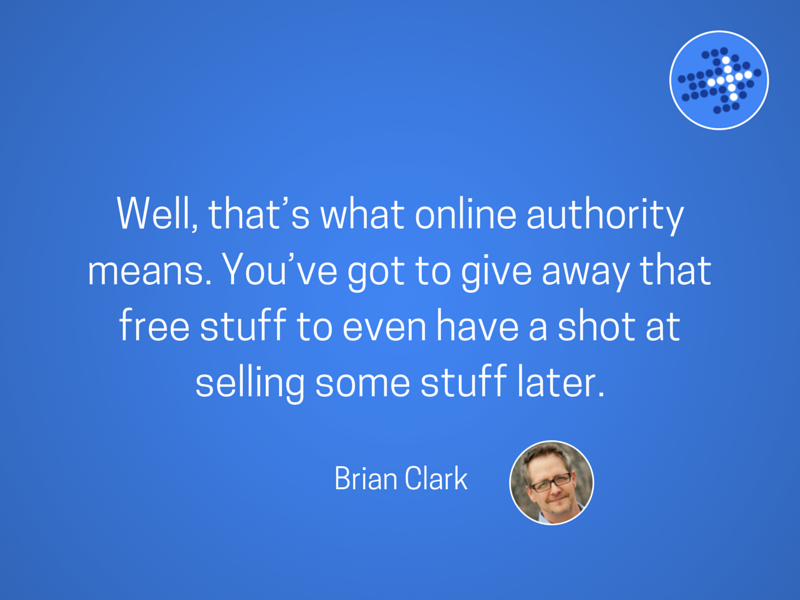
New studies prove that giving is beneficial not just for the recipients, but for the givers’ health and happiness. Giving promotes cooperation, positive human behavior, and social connection.
This is what you need to boost sales.
A study by sociologists Brent Simpson and Robb Willer showed that “when you give to others, your generosity is likely to be rewarded by others down the line—sometimes by the person you gave to, sometimes by someone else.”
7. To Close More Sales, Stop Selling
Brian Dean, the founder of Backlinko and SEO That Works, understands how to persuade people to sign up for his online course.
Even though his online course is closed, he still sells by requesting that you join the waiting list.
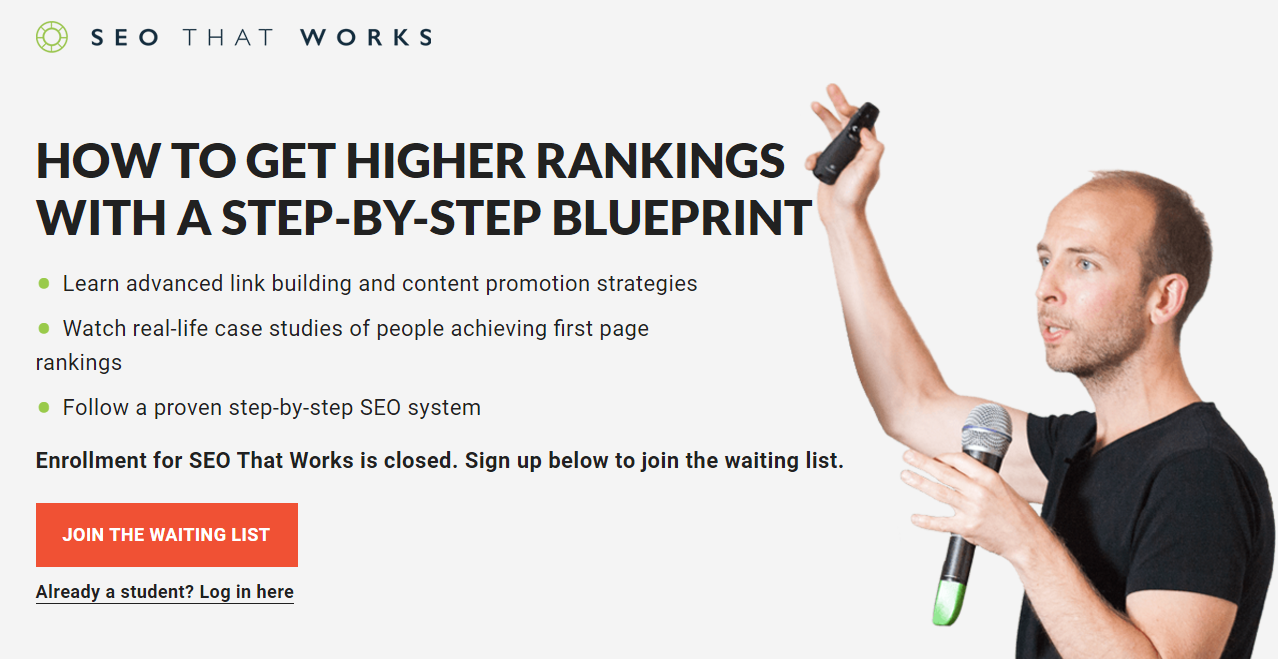
Why does he do this?
Well, when people join his waiting list, they get quality advice and case studies of people achieving first page rankings, etc. By the time the course re-opens again, subscribers who joined the waiting list will be desperate for the online course.
The majority of them will eagerly enroll. After all, they’ve already received tremendous value, free of charge.
In other words, stop pushing your products to the target audience. Instead, push high-value content. Answer questions and show the results of your services or products.
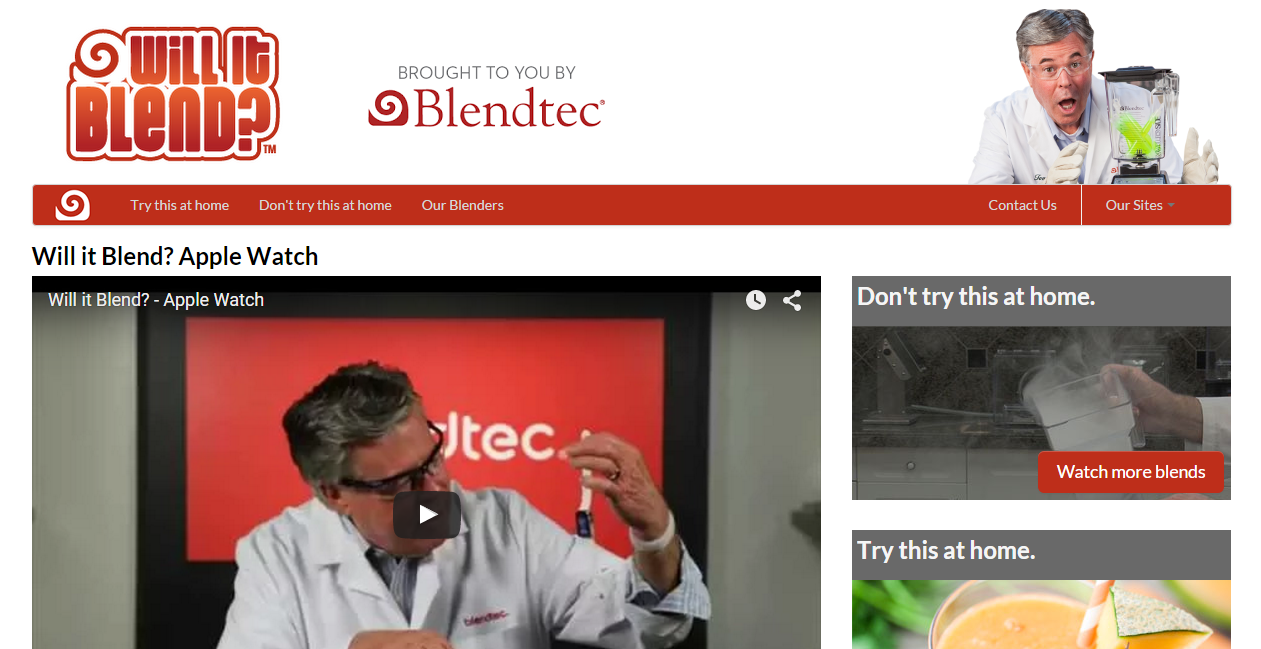
One company that sells its products quite successfully without sounding too salesy is BlendTec. BlendTec took a novel approach way back in 2007 with its “Will It Blend?” series.
The founder, Tom Dickson, understands that what people are looking for in a blender is the blade’s sharpness and the motor’s strength.
In each video in the “Will It Blend?” series, Tom tests his blender by blending anything from cell phones to wooden rakes.
Don’t try to push sales too much. Instead, educate more. Become a teacher. Become passionate about helping other people.
Brian Clark, the founder of Copyblogger, discovered early in his content marketing business that “Teaching Sells.”
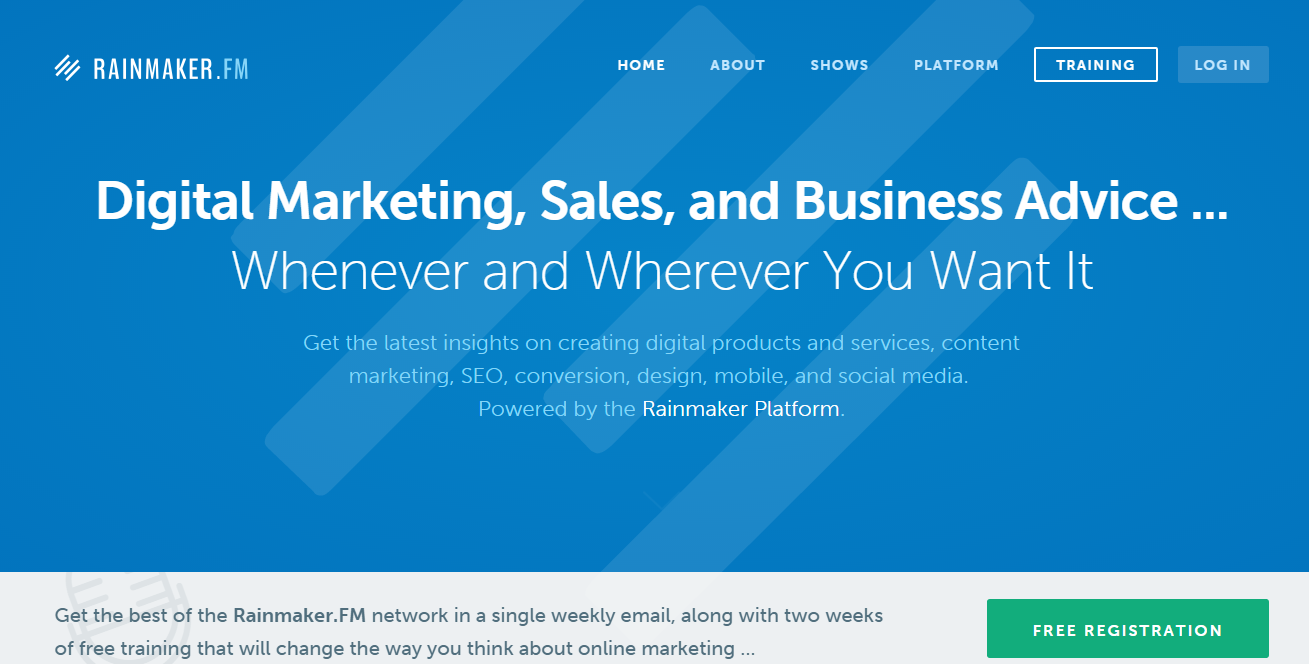
When he started teaching instead of selling, he turned his blog into a multi-million dollar software business. He also went on to start another new business called RainMaker.fm.
When you teach, you’re giving away value that people can’t find elsewhere. If you continually educate and inform your target audience, you’ll sell more products or services in the process.
Neuroscience for Sales FAQs
What is neuroscience?
Neuroscience studies how the brain works, both from the structure and the function perspective.
How does neuroscience affect sales?
Neuroscience can help salespeople understand how customers’ brains process information and communication. This helps salespeople change their messaging to have more of an impact.
How can you gain customers' trust?
You can help customers trust you by keeping your promises, have all your information clear and concise, and provide statistics and examples to prove your value.
How can salespeople use neuroscience?
One way to use neuroscience with sales is to choose a solution-oriented approach. Tell customers how you would solve their problems.
Neuroscience for Sales Conclusion
If you can tap into how your customer’s brains works at different stages in the purchasing process or lead funnel, you may be able to drive more sales with less effort.
The neuroscience sales tips we’ve provided should help you get started thinking about how you can leverage the power of the human brain in your own digital marketing strategy.
If all of this sounds intimidating and you want help enacting these principles, let us know. Our team of experts are ready and waiting to partner with you to create a stellar SEO or marketing plan that drives sales by considering how your customers think.
Which of these cognitive neuroscience principles have you applied to increase your product sales online?