 Sign In



You don’t sell in an email.
That sounds counterintuitive, right?
But it’s true!
How many times have you purchased something directly in an email?
Not often, most likely.
Instead, the goal of your email is to get someone to open it and hopefully click on what’s inside.
That’s it!
Emails get people interested enough to click on a link, and then the page where they end up does the selling.
The problem is that there are over 269 billion emails sent each day. That’s a lot of competition for attention.
Email service providers, like Gmail, have tried to help their users by filtering out the ‘junk’ before it even hits their inbox (even though it’s not technically labeled spam).
That means you face an uphill battle to ever get your emails opened (let alone clicked).
I’m going to show you a ton of examples today that have been able to overcome those challenges.
And at the end of this article, you’ll be able to tweak email campaigns to instantly increase results.
Does that sound good? Let’s get after it then.
1. WP Engine
Do you want to see one of my favorite sales emails of all time?
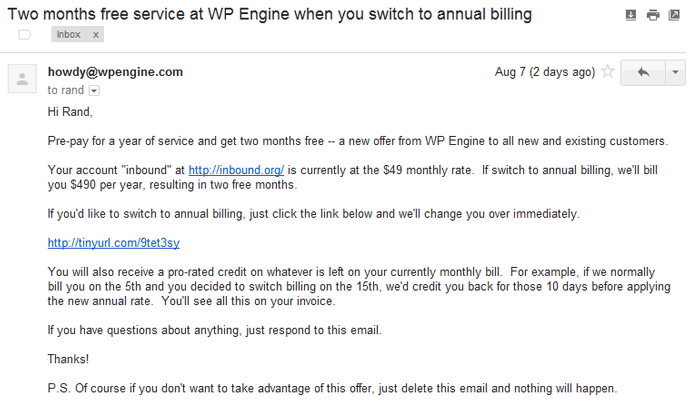
Here’s what it looks like:
What?!
How is a simple, text-based email like this with dry language a “good sales email”?
Don’t you believe me?
Check out what the CEO of the company had to say about it:
“It permanently moved the needle on sign-ups after just a week of work.”
See, I’m not lying!
But there is a trick at play here.
It’s not that this individual email is amazing. For example, there are obviously no images or exciting graphic details. And the copywriting is pretty simple, too.
There are no clever hacks or tricks inside.
Instead, what makes this email perform so well is what happened before people ever received it.
The people who received this email originally signed up for WP Engine’s Speed Tool. Basically, you plug your URL in, and they’ll tell you not only how fast your site is, but also what needs to change or improve to speed it up.
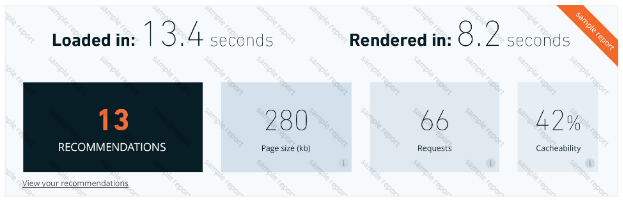
The catch is that users have to provide their names and email addresses to get the customized report.
Then, over the period of a few weeks, training emails were sent out to help those users implement all of the ‘action steps’ needed to speed up their sites.
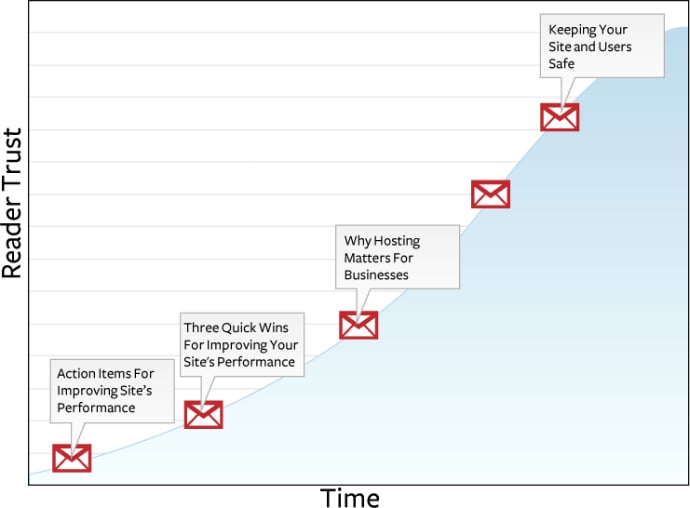
In each email, the writer first pointed out the mistakes, then told the reader exactly how to fix each one.
That built a massive amount of credibility over time.
So when someone does finally receive that original email above, they’re much more inclined to move forward with the purchase.
Robert Cialdini calls this “pre-suasion.”
It’s based on a psychological principle called “priming” that says that people are more likely to buy a product after they’ve been essentially pre-sold a concept or idea.
Pretty simple, right?
And yet it’s also incredibly powerful when done correctly.
Here’s another example of a company that uses a similar trigger to get you to take action.
2. Time Etc.
Most free trials never go anywhere.
People might sign up for one, try it out for a few minutes, and then leave forever.
The trick is to get those people back — somehow, some way.
Just telling people to “come back” wouldn’t be very compelling, though.
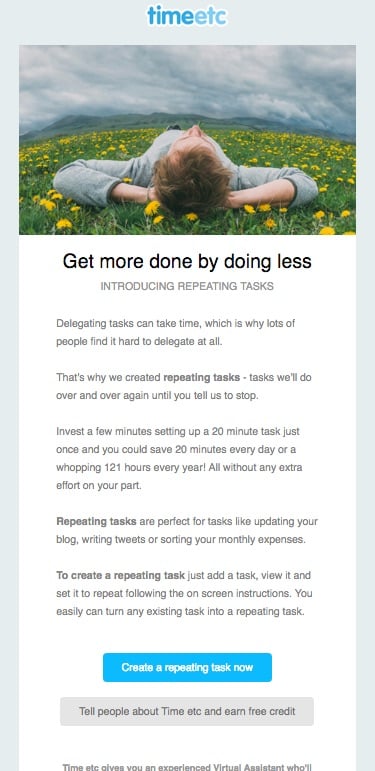
Instead, you should focus on the specific value that prospects are bound to get from the service.
That’s what Time Etc. does below. They’re introducing a feature (repeating tasks), but more importantly, they’re emphasizing what you can get out of the feature (as a benefit or outcome).
Here’s a similar example from Behave (formerly WhichTestWon).
The company compared two email variations for investors. One featured an in-depth investment analysis (like yield and rates of return) while the other simply focused on key house features.
Guess which one won?
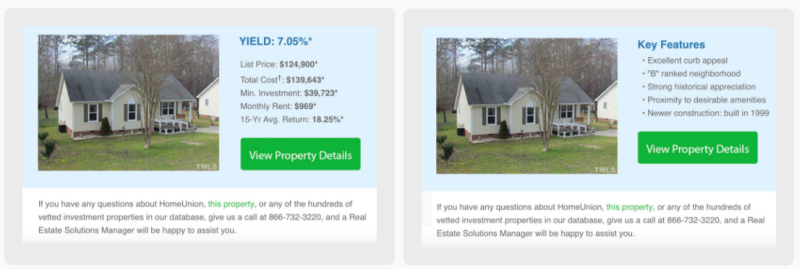
Surprisingly, the one with key features nailed an impressive 33.8% click-to-open rate increase.
In other words, the focus was on the short-term value as opposed to the long-term investment benefits.
3. Amazon
Amazon Prime customers are worth more than double what non-prime members are.
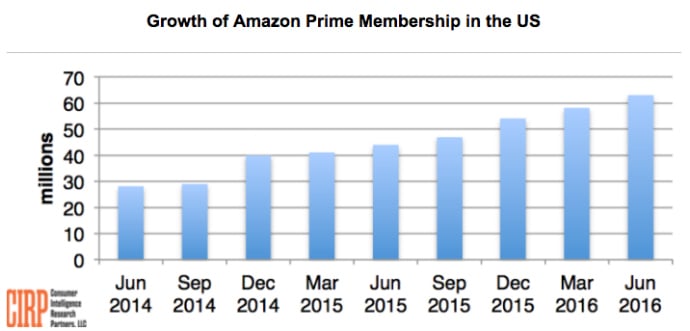
Prime members spend up to $1,200, compared with only $500 for non-Prime customers.
That shouldn’t be surprising when you consider the industry at large.
Repeat customers are likely to spend five times more than first-time shoppers, according to Adobe.
The implications of that statistic should be obvious. If you’re going to invest the time and money to create a new email campaign, whom should you target?
For example, here’s one from Amazon that pushes personalized site recommendations and uses email retargeting based on your past search history.
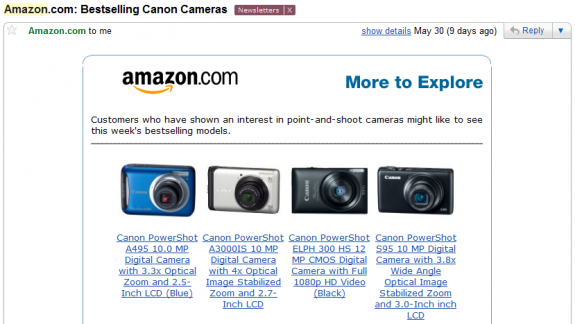
Automated emails like these can result in 20% more sales opportunities.
But notice that those awesome numbers don’t result from some overly sophisticated email strategy or creative marketing tactic.
People were just looking at these products on Amazon, but they left the page without purchasing. So Amazon is following up with related searches, possibly even throwing in a little incentive or pricing discount to sweeten the deal.
The subject line “Amazon.com: Bestselling Canon Cameras” isn’t especially clever or interesting.
But it’s incredibly timely and relevant for someone who was just looking at that exact thing on the Amazon site.
4. Expedia
81% of people searching for a trip will abandon the process before booking.
So it’s not that different from what happens when someone abandons their e-commerce shopping cart.
The trick is to catch these people in the act (or at least, immediately afterward) before they move on to someone else — like your competitors.
Here’s a perfect example from Expedia.
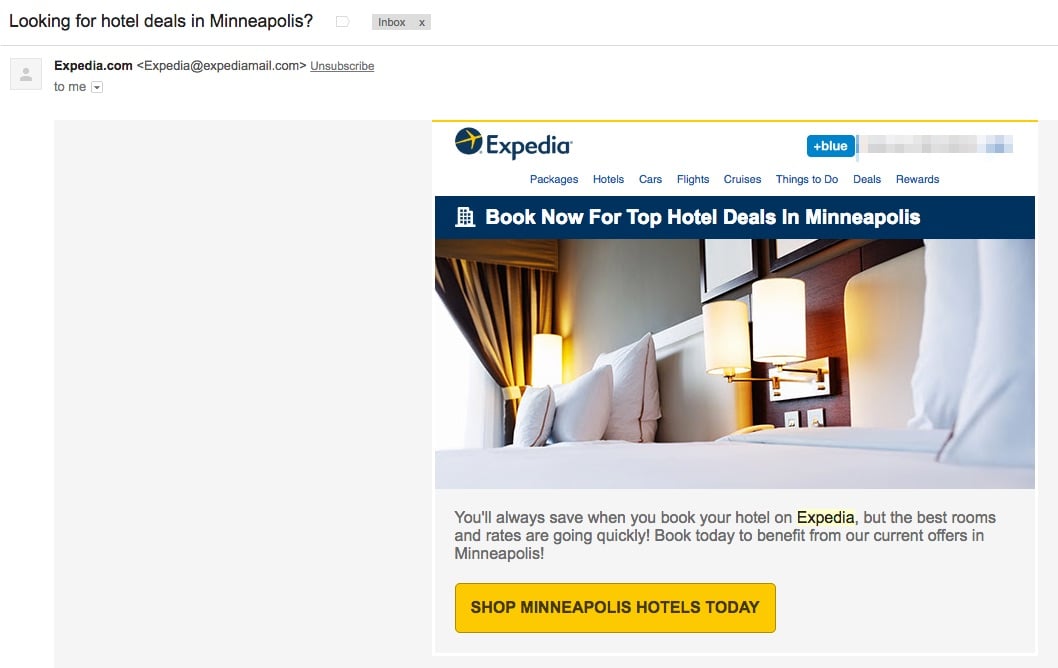
The question-based subject line piques your curiosity (because you were, in fact, just looking for hotel deals in Minneapolis).
And then the email headline, copy, and CTA repeat the same location destination.
Over 30% of marketers agree that personalization will have the biggest impact over the next few years when it comes to email marketing.
And that’s mostly because 86% of consumers say that it ultimately influences the purchasing decisions they make.
So don’t overthink it here.
The copy from Expedia’s email isn’t special. The stock-looking image it includes won’t make or break a sale.
Otherwise, though, this email does exactly what its authors intended.
It’s not selling anything particularly well. But it’s getting you to pay attention, open it, and consider giving Expedia another shot at your business.
Here’s another example of how Expedia will combine a couple of these approaches we’re analyzing.
You open your email inbox and begin scrolling the subject lines to see which ones you can ignore when the following jumps out at you:

No!
You were just looking at hotels in that location and now realize you may have missed out on getting a good deal.
So you click through and quickly get a pricing and availability update on every single recent search you made in that location.
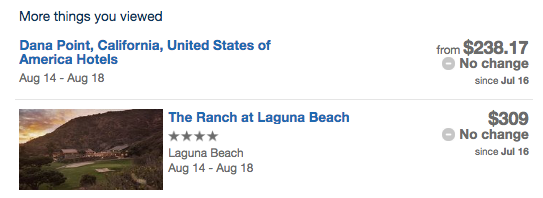
Phew, there’s been no change at The Ranch.
All is good… for now, anyway.
But the implication here is that you’d better go ahead and book now while prices are still relatively low, as other lodging options in the area seem to be getting more expensive.
5. Audible
Amazon-owned Audible has learned a few tricks from its parent company.
For example, the last thing Audible can afford (as a subscription-based company) is any customer churn greater than a few percent.
So almost all of its emails are personalized in some way based on a user’s actions.
Here’s what I mean.
A few weeks ago, I had at least three credits in my account just sitting there. Obviously, that looks like I’m not using the service.
So Audible sent out an email with a special promotion for using three credits (what a coincidence!).
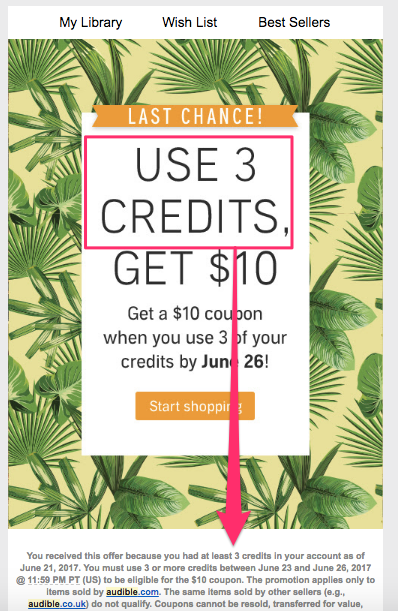
They were literally going to just hand me $10 for using the credits that I already paid for.
Let’s be honest with each other for a second.
Does Audible really care if I use those credits that I already paid for? No — I’m out the money either way, and I’m not likely to get a refund.
Instead, Audible doesn’t want me to churn because that’s potentially more harmful to the company.
Check out those restrictions on the bottom of the email: “You must use 3 or more credits between June 23 and June 26, 2017.”
That time window is pretty short. Audible’s not giving you much time to make a decision.
And that’s why it works so well. The company is creating an artificial deadline to get a response from you.
Think of it like a countdown timer that has the power to lift conversions instantly by as much as 8%.
Here’s another recent example based on my past behavior.
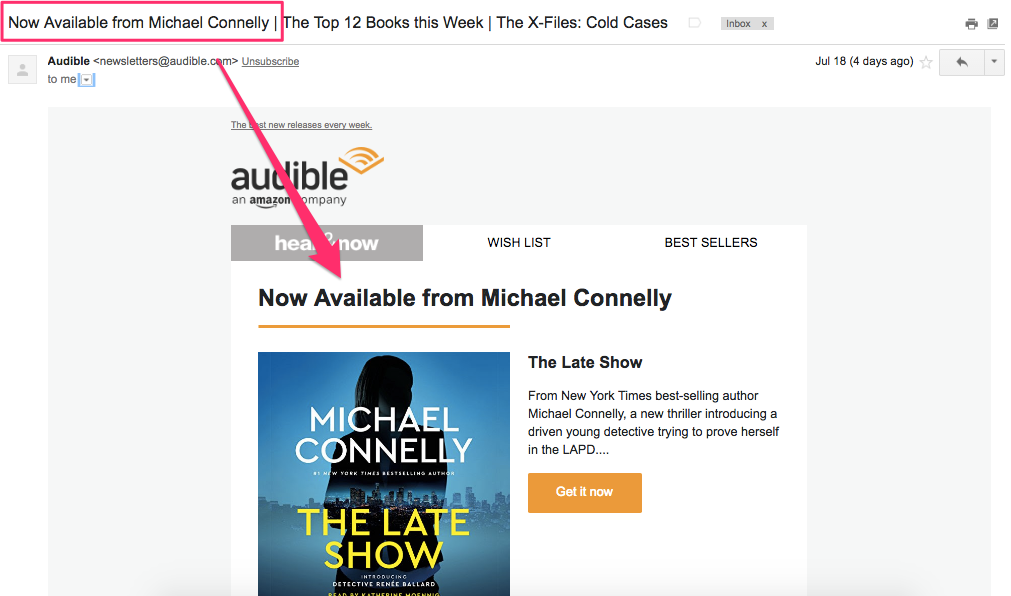
Recently, I took a long drive and listened to a book by Michael Connelly on my Audible app.
Now, I’m not sure what level of detail Audible considers for its email marketing campaign.
Maybe Audible knows that I’ve downloaded Connelly’s books in the past. Or maybe the algorithm could only see that I downloaded a book from that same category.
Either way, the topic relevance here virtually guarantees that I’m going to open this email.
Audible knew enough to get me to open, click on “Get it now,” and download the next book ASAP.
7. Ramit Sethi
Most of the emails we’ve looked at so far are extremely short.
You open them up and discover immediately that there are just a couple things to click on to get a specific benefit or deal.
That’s what makes this next from Ramit Sethi stand out:
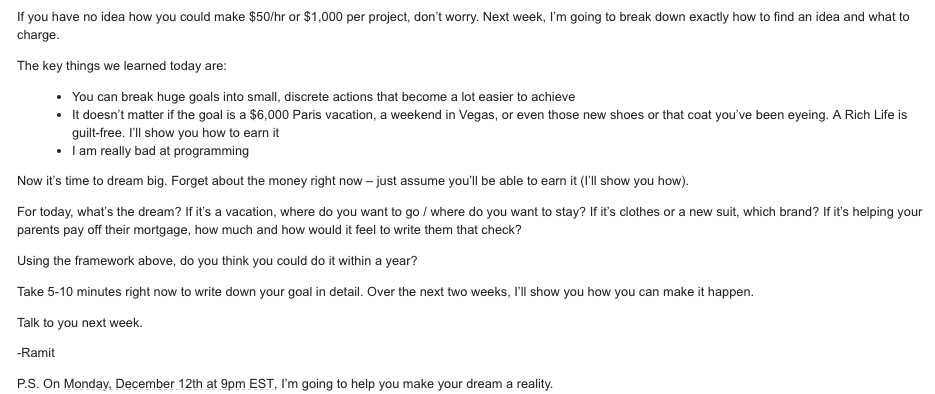
There are a few things to notice here.
First, the whole email is so long that I couldn’t even fit the entire thing in a screenshot! It just goes on and on and on.
Second, there’s no CTA. There’s no link or button to click on.
Instead, all he’s doing at the very end is prompting you to watch out for an upcoming email.
What’s going on here?
You’re looking at an email that’s in the middle of a long, slow build-up.
He’s priming the pump here, just like the first example we looked at, to get you on the edge of your seat for when the sales offer does materialize.
Ramit’s selling a big, complex product.
So he needs to develop enough attention and interest to make its perceived value worth a purchase.
That way, when it does become available for sale, he knows there will be a line out of the metaphorical door.
8. Dollar Shave Club
“Our Blades Are F***ing Great.”
That’s how Dollar Shave Club landed on the scene with a YouTube video that’s been seen over twenty-four million times!
E-commerce cart abandonments (like churn or booking abandonments) can be a killer. You worked so hard to get people to your site that the last thing you can afford is to just lose them forever.
Different tactics work for different companies to recover those abandonments.
Dollar Shave Club goes back to what worked so well for it in the past: Quirky humor.
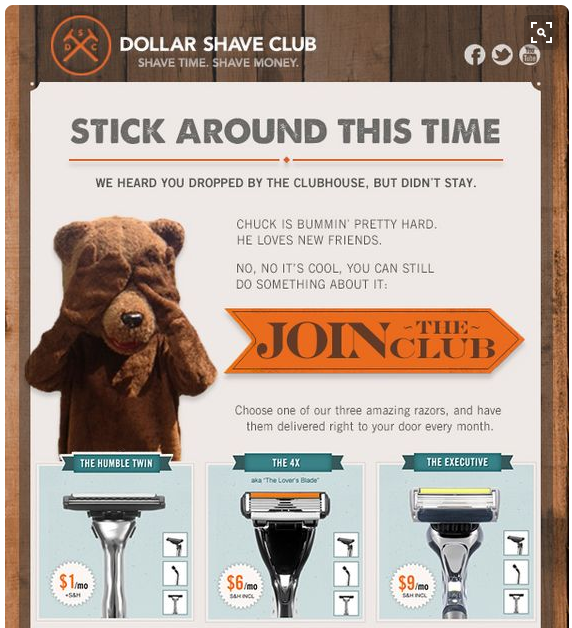
The email here is so bizarre that you can’t help but take a look (and react).
Chuck (the bear covering its eyes) “is bummin’ pretty hard” because you didn’t say hi (or join the club before bouncing).
An email like this would fall flat for most other companies.
Humor, especially of this variety, is tough to get right, though. Especially if the same tone isn’t already on-brand.
Reddit would probably have a field day with this email if it were from any other company.
But for Dollar Shave Club, it somehow works.
The other, less risky option for re-engagement emails is through an incentive (like a discount or free product offer).
It’s not exactly sexy. But it’s simple and effective.
9. Pinkberry
Pinkberry isn’t really known for its whimsical humor or personality (compared to the last example).
So instead, it sticks with what works when it’s time to bring an unengaged customer back: One free yogurt.
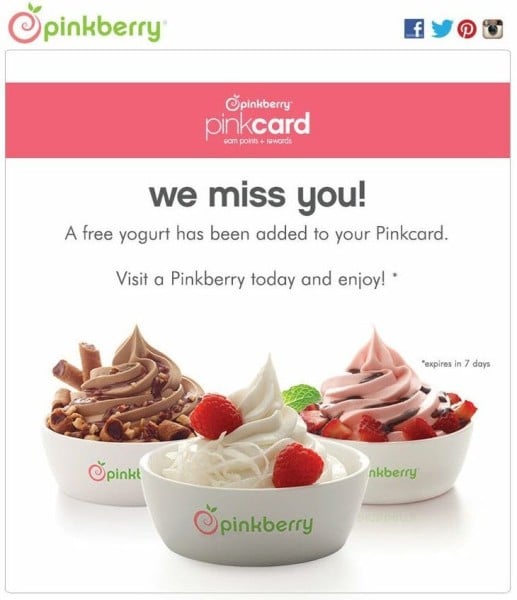
This one works for a couple of reasons.
- It costs them nothing if people don’t redeem the offer. Worst-case scenario: A customer does redeem the offer (in which case, it only sets the company back a few bucks in hard costs).
- There’s also a short, seven-day expiration date. So if customers are remotely interested, they need to act now (or risk letting this free offer expire).
That last motivator is especially powerful, seeing as even the tiniest bit of urgency can increase conversions by 27%.
Do you notice how this email (and a few previous ones) only have a single button or CTA?
There’s a good reason for that.
Several tests have shown that single-CTA emails increase results (over multiple-CTA emails) anywhere from 17% for HelpScout to 42% for Whirlpool.
It makes sense when you think about it. People are busy and multitasking while browsing email.
The last thing you want to do is inject more distraction into the equation by giving prospects more than one thing to do.
Instead, keep it simple and keep your customers focused on the one thing that matters most.
Now, this next example will combine both of these elements to get you to click.
10. Mint
Fear is one of the most powerful motivators we have in marketing.
But fear only works if you use it correctly.
For example, fear-based messaging can actually backfire when you’re trying to sell something to previously ‘warmed up’ people.
But there’s no better bet when you’re trying to reclaim attention from people who haven’t been active.
For example, I’ve tested this in the past with different subject lines. Which of these next two do you think resulted in better conversions?

That first one drove 65% more conversions.
It turns out that numbers can be intoxicating. They’re almost irresistible.
For example, one AdWords test compared a numbered headline (that highlighted a specific amount saved) versus a generic headline.
Unsurprisingly, the numbered headline increased CTR by 217% and conversions by 23%.
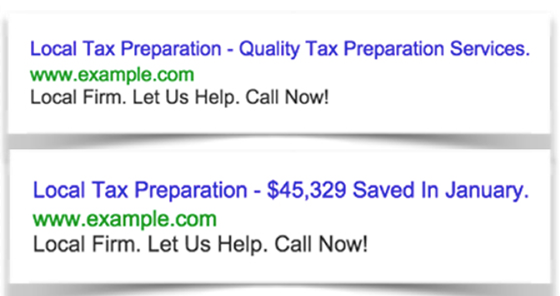
Which one of those would you most likely click on? It’s obvious, right?!
That specific number gives us some cold, hard data that we can’t ignore.
Now check out this Mint message to note the similarity between all of these examples so far.
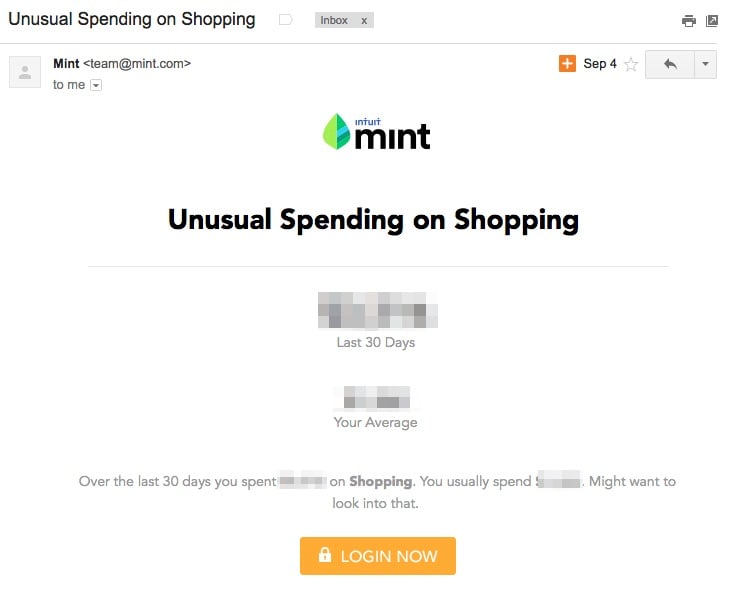
The subject line (“Unusual Spend on Shopping”) immediately grabs your attention because it almost sounds like something is wrong.
For a second, you might even think that your credit card has been compromised.
The body of the email is again personalized. But this time, it’s contrasting what you usually spend with this new ‘alert’ to show you the discrepancy.
Now you can’t help but click on that “Login Now” button to see what’s wrong.
Conclusion
Your goal with an email newsletter isn’t to sell per se.
Instead, your goal is to keep people around. You want to keep them engaged, opening your emails for when it’s time to ultimately trigger a new sale or promotion.
In that case, all you’re selling is the CTA click.
Today, the most effective way to get that to happen is through personalization.
You want to look at what someone just did on your site, has in their account, or is looking for, tailor both the timing and messaging to capitalize on your insider knowledge.
That’s how you get someone to open and click on your email ASAP.
Then your product or landing page can do the actual selling when it’s time (and when the customer’s ready).
What is the best way you’ve increased sales from emails?