 Sign In








It’s a story from the deepest pit of ad-spend desolation.
After a long and successful run with your AdWords campaign, you wake up one morning. You get your coffee, read the newspaper, and check your website’s analytics.
“Hm,” you think to yourself, “A little lower traffic than usual.”
To ensure that your website is still functioning correctly, you do a quick Google search for your business—
“Wait! What is that?” you think.
As Google finishes loading, you notice that some other website is at the top of the paid search results for your brand name.
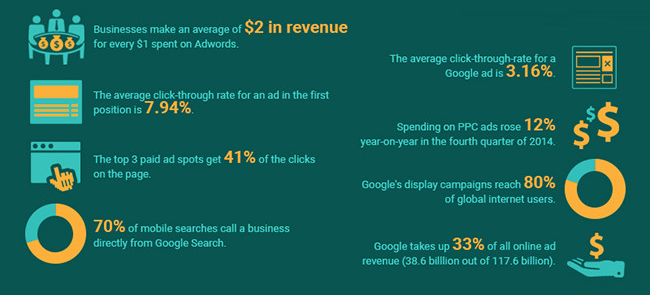
And the last thing you want to do is lose your 7.94% click-through rate for position number one.
Surely, such a thing is illegal. They can’t bid on your brand name…
Can they?
Well, I hate to be the bearer of bad news, but they can.
In fact, here are the words from the horse’s mouth (Google): “Google won’t investigate or restrict the selection of trademarks as keywords, even if we receive a trademark complaint.”
This basically means that you can’t claim keywords as your own. If a competitor wants to outbid you at your own game, they are more than welcome to.
And you can do the same to them if you like.
Still, that doesn’t make your morning any better.
So, grab your cup of coffee, put away the newspaper, and let’s talk about what you can do.
1. Determine the extent of the damage
The first thing you need to do is determine the extent of the damage.
While it’s possible that the damage is limited to your one Google search, it’s likely that the person attacking your PPC efforts isn’t just attacking you on Google.
They might also be coming after your brand on different websites and with Google partners.
Google search partners are websites and businesses that directly partner with Google AdWords to provide results for native searchers.
A few examples are AOL, Dogpile, and Amazon.
Damage done on Google AdWords probably also means damage done on all of their partnering websites.
Unfortunately, Google doesn’t explicitly disclose who these partners are. But here’s a fairly exhaustive list of their supposed partners.
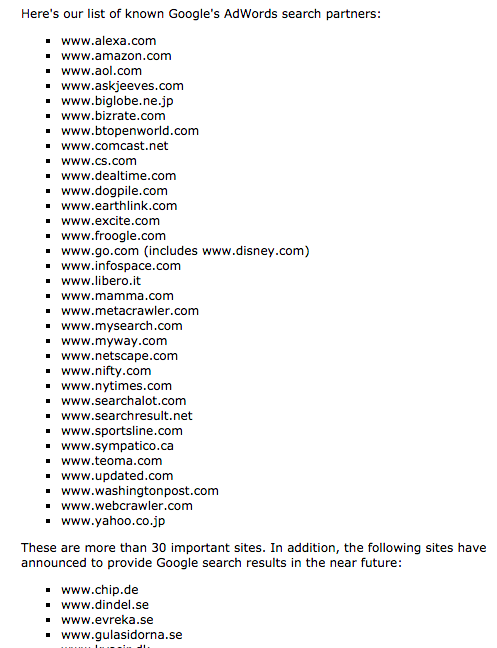
If you want to determine the extent of the damage done to your PPC campaigns, you need to search through as many of these partners as you deem appropriate.
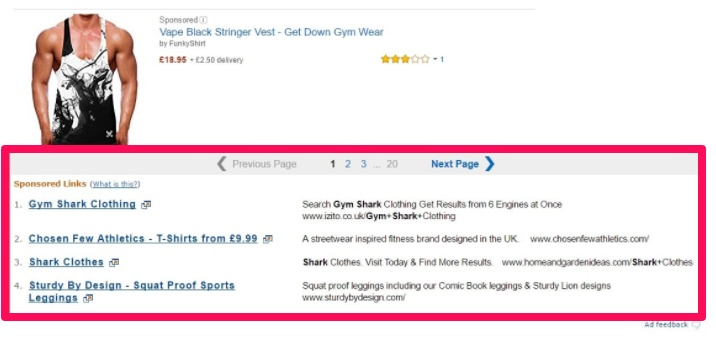
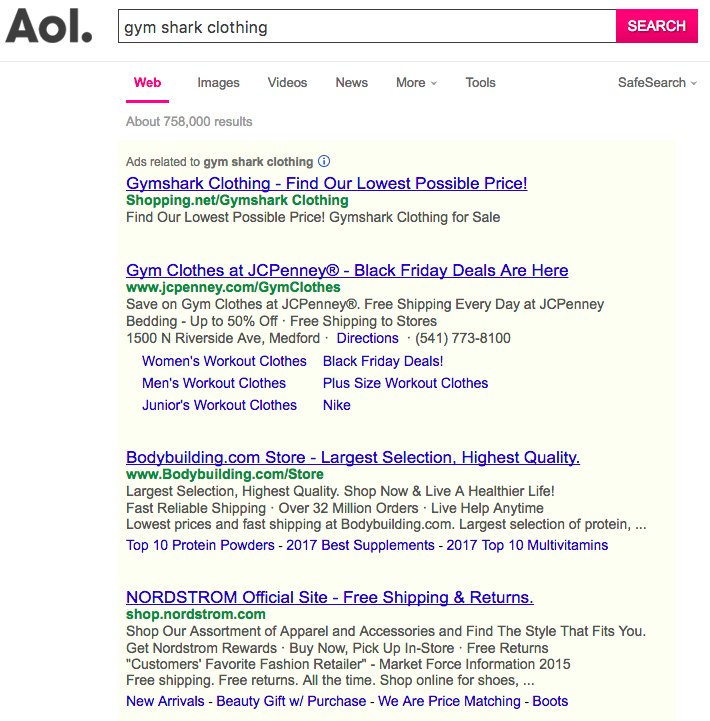
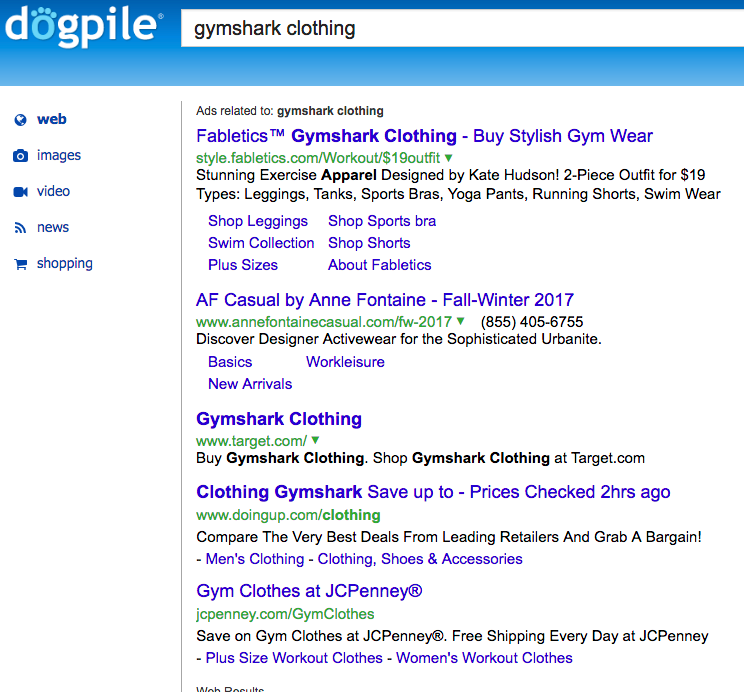
You don’t necessarily need to search through all of them, but you should at least look at the following:
Amazon…
AOL…
Dogpile…
And Ask…
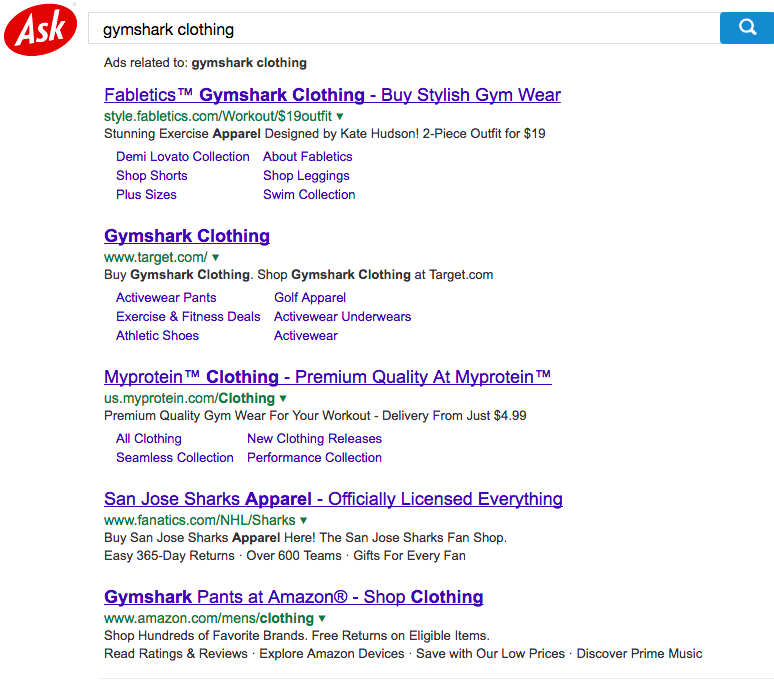
These are a good bare minimum of places for you to check.
Find every website where your competitors have started ranking above you and you’ll have a better idea of how much they’re spending and the audience they’re trying to target.
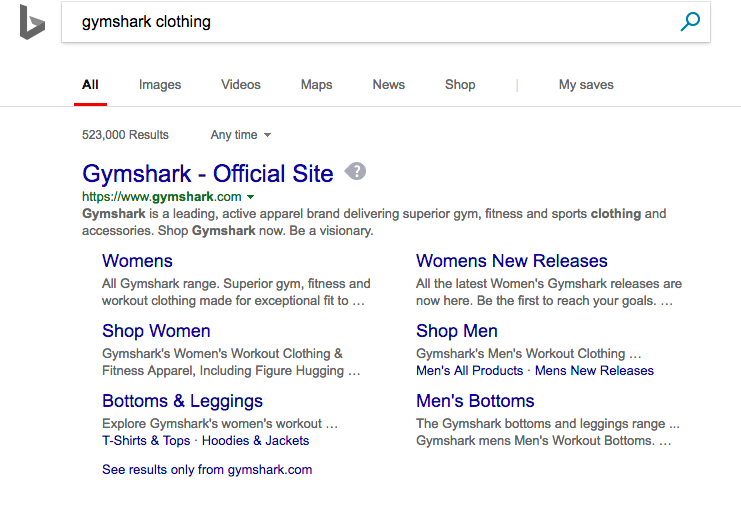
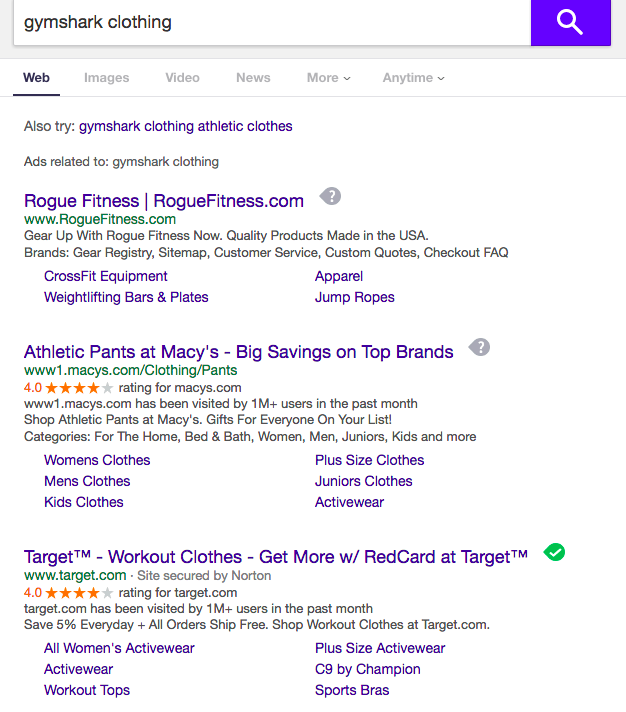
Don’t just limit your searching to AdWords and Google, though. If you run ads on Bing or Yahoo, you’ll want to see if there’s any damage done there as well.
Search for your brand on Bing.
And then on Yahoo.
The last thing you’ll need to check to determine the extent of the damage is your click-through rate.
After all, that’s the final determiner of damage to your advertising campaign.
If your click-through rate isn’t suffering, then you might not need to worry too much about taking further action.
To find out, here are the benchmarks for average click-through rate across every industry.
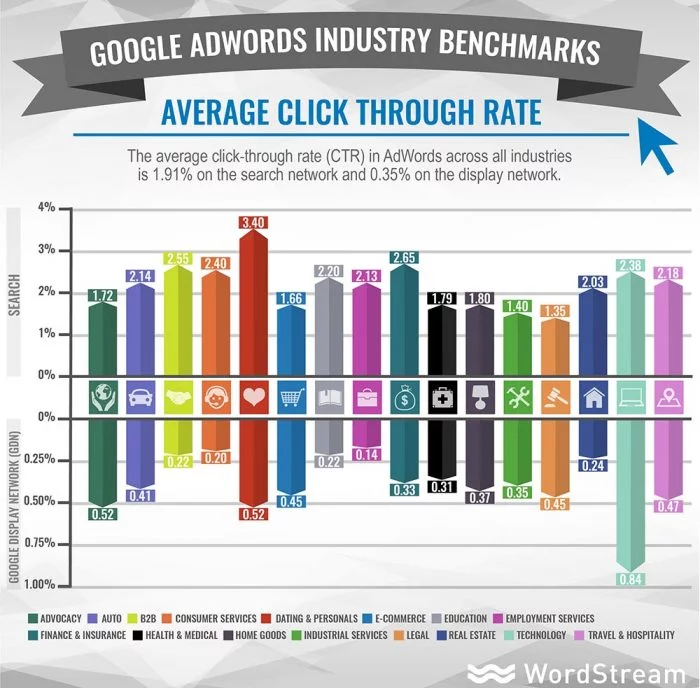
If your click-through rate is suffering, then it’s time to do something about it.
Now that you have an idea of how much damage your advertising campaign has taken, let’s talk about what you can do next.
2. Tell Google about it
Okay, I know that I said you won’t be able to get Google to help you get rid of the competition. But that might not be true.
It just depends on what the competition is doing.
If they are simply bidding on your brand keywords without any trademark infringements, then you can’t report them.
Having said that, you might be able to get them in trouble if they are using your trademarked brand name or slogan in their advertising copy.
For instance, say that your business is Swanky Sweetums and your slogan is “Your baby is already sweet. We make them swanky.” Then, someone comes along using either your slogan or your name to advertise their brand.
Voilà, you’ve got trademark infringement and you can report it to Google.
Here’s what it might look like.
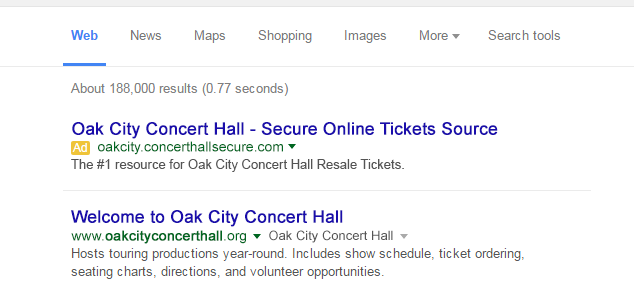
If you do some research and find that the competitor is stepping on your trademark toes, then you can report it to Google by going here.
Before you do, though, just make sure that the competition is using a phrase in their copy that you have officially trademarked. Otherwise, the whole process will be more difficult than it’s worth.
If they are using your branded phrasing, though, you’ll likely win the dispute.
I recommend doing it immediately. The sooner you get their ad taken down, the better it will be for your business.
3. Ask them to stop
If you determine that the presence of their heinous advertisement is doing significant damage to your traffic, lead-generation, or sales, and you also don’t think they’re officially breaking any trademark laws, then the first thing you should do is reach out to them and ask them to stop.
That might sound like an awkward conversation to you.
“Um. Will you stop stealing my business, pretty please?”
But it doesn’t need to be. You can easily turn that potentially awkward conversation into a friendly request that they stop targeting your keywords.
If they are doing damage to your click-through rate by bumping you from position number one, then every single awkward conversation you could possibly have will be worth it.
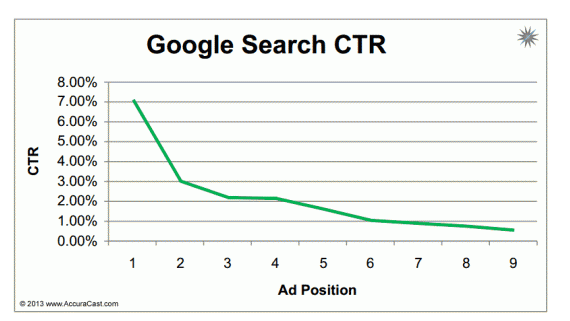
Sometimes, the best way to solve your problems is just to ask other people to stop creating them.
Here’s an example of a friendly email you could send.
Hey, [name]!
My name is [name] and I’m from [business]. I’m a big fan of what you’re doing over at [their website], but I recently noticed that you’re targeting our brand keywords with your AdWords campaign.
Heck, you’re even doing a good job of it!
[Show screenshot of their number one position]
Now, we don’t mind some friendly competition… but I was wondering if you’d be willing to target different keywords with your ads?
You’re not legally obligated to, but we’d appreciate it!
Otherwise, we’ll be putting some money on your own branded keywords 😉
Best of luck!
[Name]
Some people will take down their ad simply because you were nice about it. Others will keep it up. So now we’ll turn to what you can do if they don’t take down their advertisement.
4. Increase your branded ad spend
If you want to take the fast track to beat your competition, you can simply increase your ad spend for your brand’s keywords.
Of course, the amount that you have to increase your spending by to beat the competition is going to directly correlate to the amount that your competition is spending on the keywords.
I know it kind of stinks to spend more money on your own branded keywords, but it’s the nature of the beast. You just have to do it.
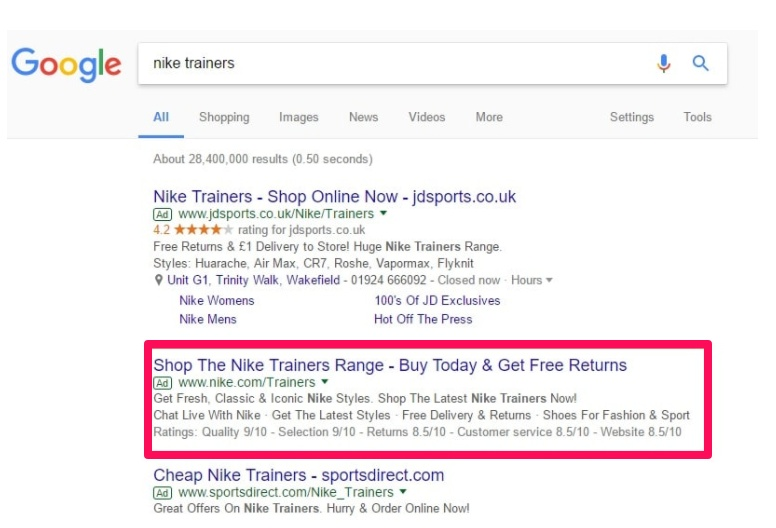
Heck, even Nike is doing it.
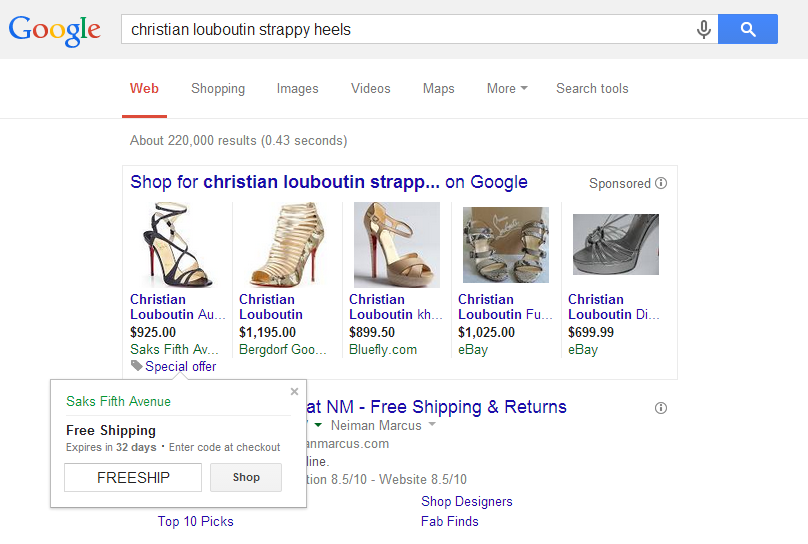
If you want to add some incentive to your own advertisement to get a leg up on the competition, you can also offer a discount.
Even if you’re ranking organically on Google, it might be worth your time to spend some money to rank on paid search as well. That way, when people start trying to rank with your brand’s keywords, it will be more difficult for them.
HostGator does this even though they are the first organic result.
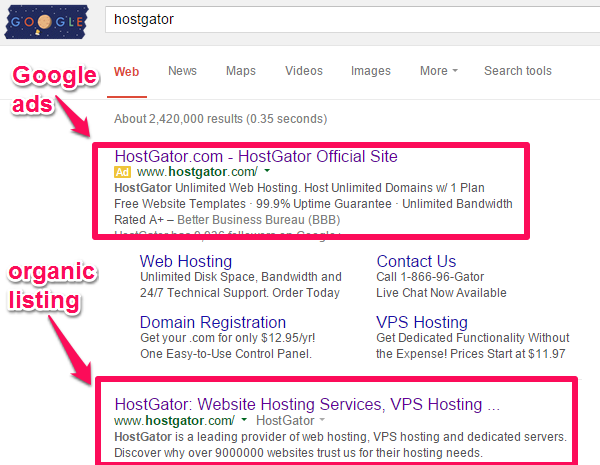
Paying to maintain the number one position on Google for your brand’s keywords is a great way to make sure that you always are there when people are searching for you.
What you don’t want to happen is for people to search for your keywords and then not be able to find you.
Securing your position with a bit of cash will ensure you’re always at least near the top. And beating the competition with a little more money will push you to number one once again.
5. Improve your quality score
Your quality score is basically the way that Google decides how high or low the quality of your advertisement is.
And this is a super important metric.
A good quality score means that you’ll pay less per click and the money you bid will be worth more than it would be otherwise.
Google measures your quality score on a scale from 1 to 10, and the higher your score, the better your ad will rank on search engines.
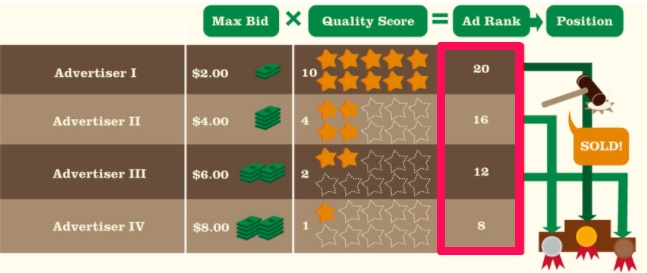
Additionally, you can see the quality score of your ads in your Google AdWords dashboard on the right side.
But how do you actually increase that number?
It’s all good and well to know that you need to increase that number, but it’s another thing to actually do so.
Well, there are a few factors that contribute to your score. Namely, landing page experience, expected CTR, and ad relevance are all important.
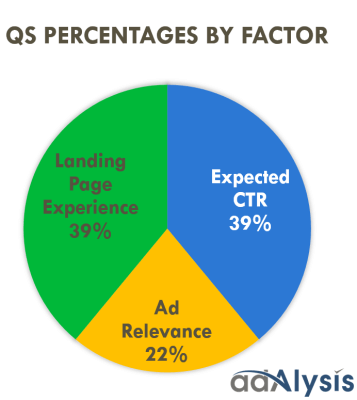
Later in this article, we’ll discuss the landing page. The ad’s relevance isn’t super important to this discussion since we’re just talking about targeting your brand’s keywords.
So instead, let’s take a moment to discuss your click-through rate.
To increase your quality score, you need to increase your click-through rate.
And one of the fastest ways to do that is to optimize your advertisement’s copy.
Here’s an example of good copy vs. bad copy.
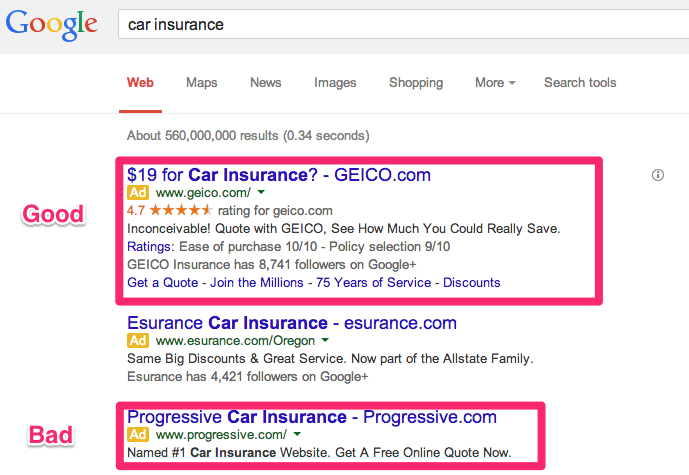
The second one is bad because it’s too vague. It doesn’t offer any real incentive for me to click.
The first one, on the other hand, gives me an actual price I can expect to pay, shows me the rating of four and a half stars, and even has a few CTA-style buttons at the bottom.
You can do the same things with your ad to increase the click-through rate.
The higher your quality score is, the better chance you’ll have of taking back position number one.
6. Retaliate by bidding on their brand
When a competitor starts bidding against your brand keywords, it might be time to draw your sword as well.
After all, that’s the nature of democracy. You can fight with other businesses for customers.
Just make sure you’re civil about it. Don’t hurt your brand image by throwing up heinous ads targeting the reputability of your competitor, even if that’s what they’re doing.
Here’s an example of what a competitive but civil PPC ad might look like.
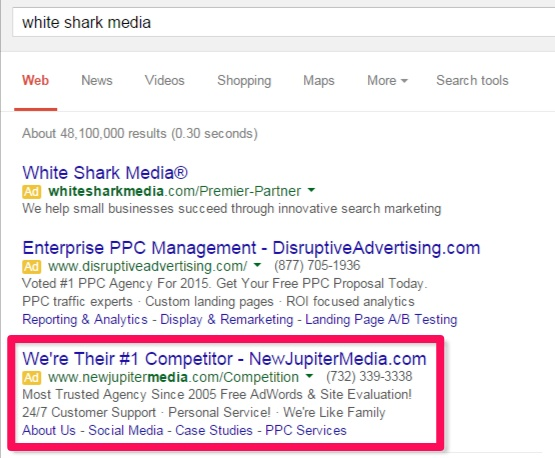
Additionally, as you can see in the following screenshot, BigCommerce is directly gunning for Shopify’s customers since they are direct e-commerce platform competitors.
They even have, “Switch to BigCommerce” in their advertisement.
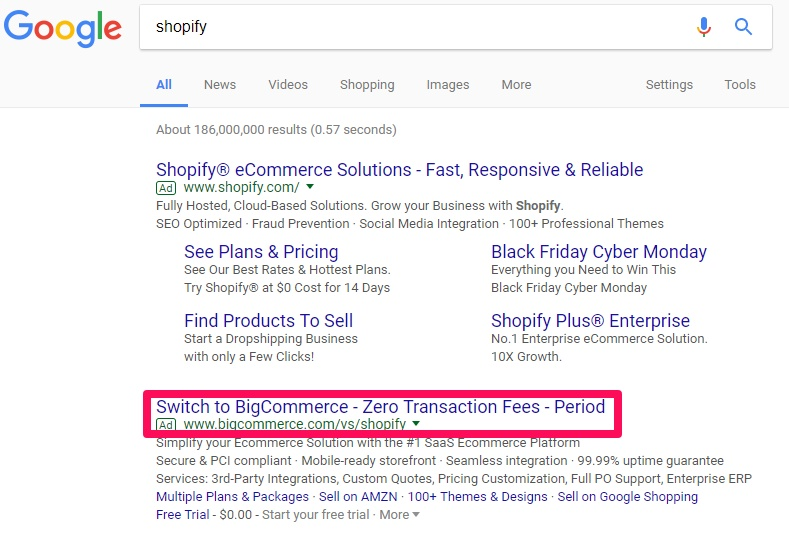
There’s nothing wrong with that friendly competition. In fact, I encourage using tactics like those to snag your competition’s customers, especially if they started the online battle.
Lastly, I’ll show you one of my favorite examples of this happening.
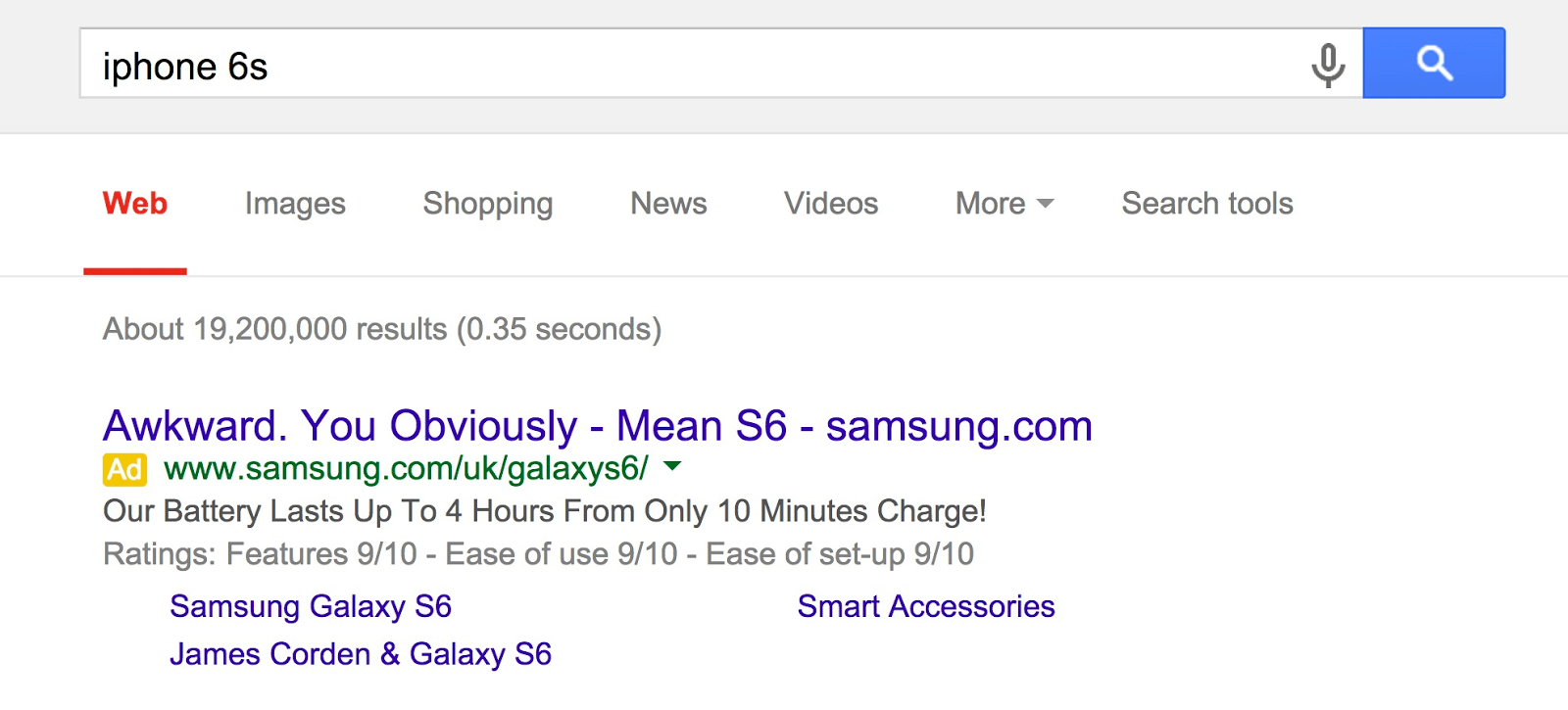
If humor fits with your brand image and the goal of your ad, then feel free to put some playful banter into your sales copy to lessen the blow.
However you do it, if the competition is targeting your brand keywords, then you should target theirs.
7. Optimize your landing page
As I mentioned earlier, the quality and relevance of your landing page make a big difference in terms of your quality score.
And the higher you get your quality score, the better your rankings will be.
How does your landing page make a difference with your quality score? Can Google actually look at your landing page and determine if it’s “good”?
Well, they sort of can.
Google can look at the keywords on your landing page to see if those phrases align with the objective and audience of your advertisement.
But the more important thing to note is that the quality of your landing page is what determines how long people stay and if they bounce.
Here’s a landing page I absolutely love.
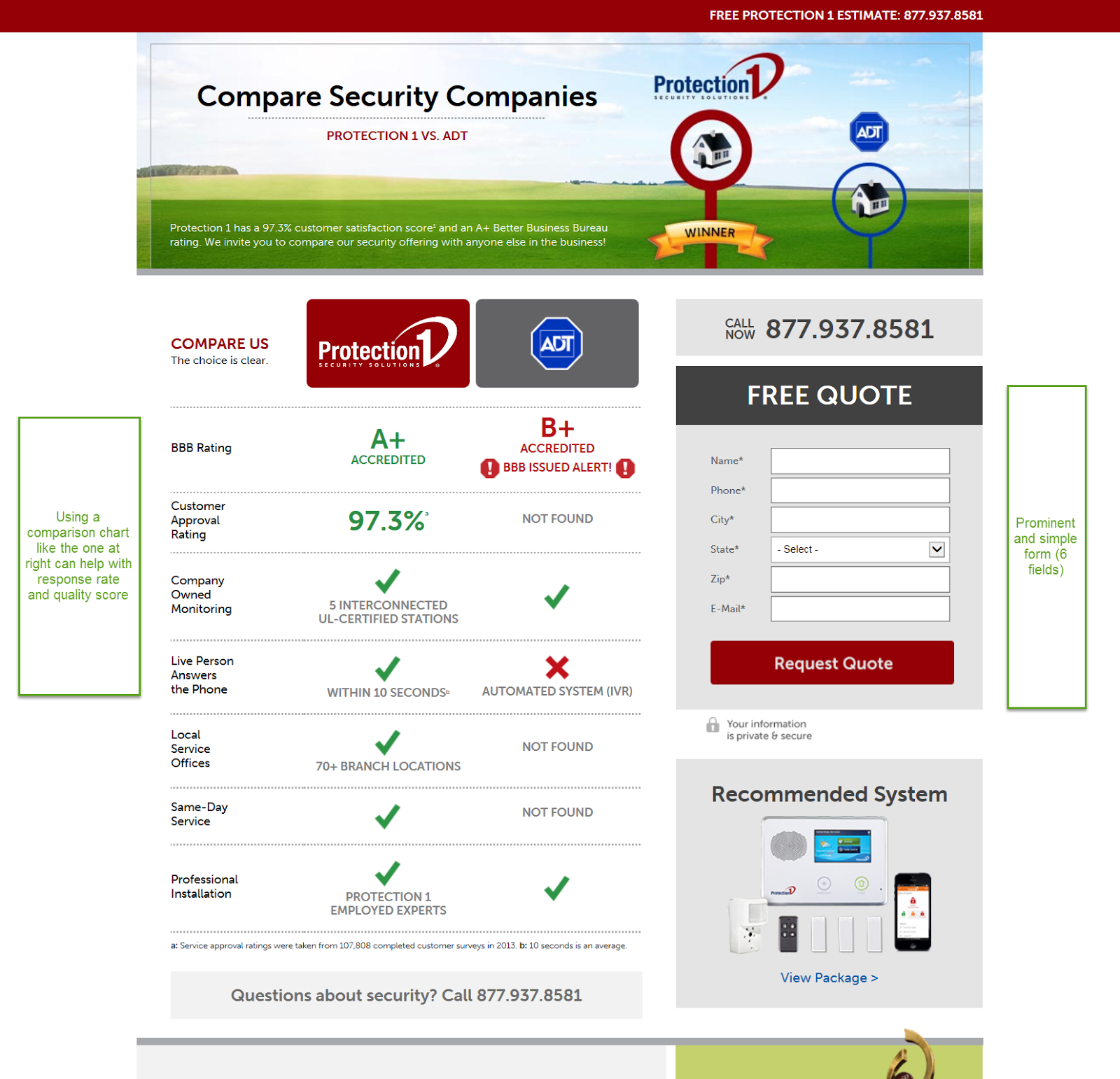
People are less likely to bounce on this page because all of the text is clear and the CTAs are obvious and the form is easy to fill out.
When people bounce from your website regularly after clicking on your AdWords ad, Google assumes that the landing page doesn’t provide what people are looking for.
And then they’ll lower your quality score. That will hurt your rankings.
To avoid that, spend some time optimizing the design, copy, objective, and keywords of your landing page.
Above all else, make sure it’s relevant to the ad that’s driving people there.
Here’s another great landing page for your reference.
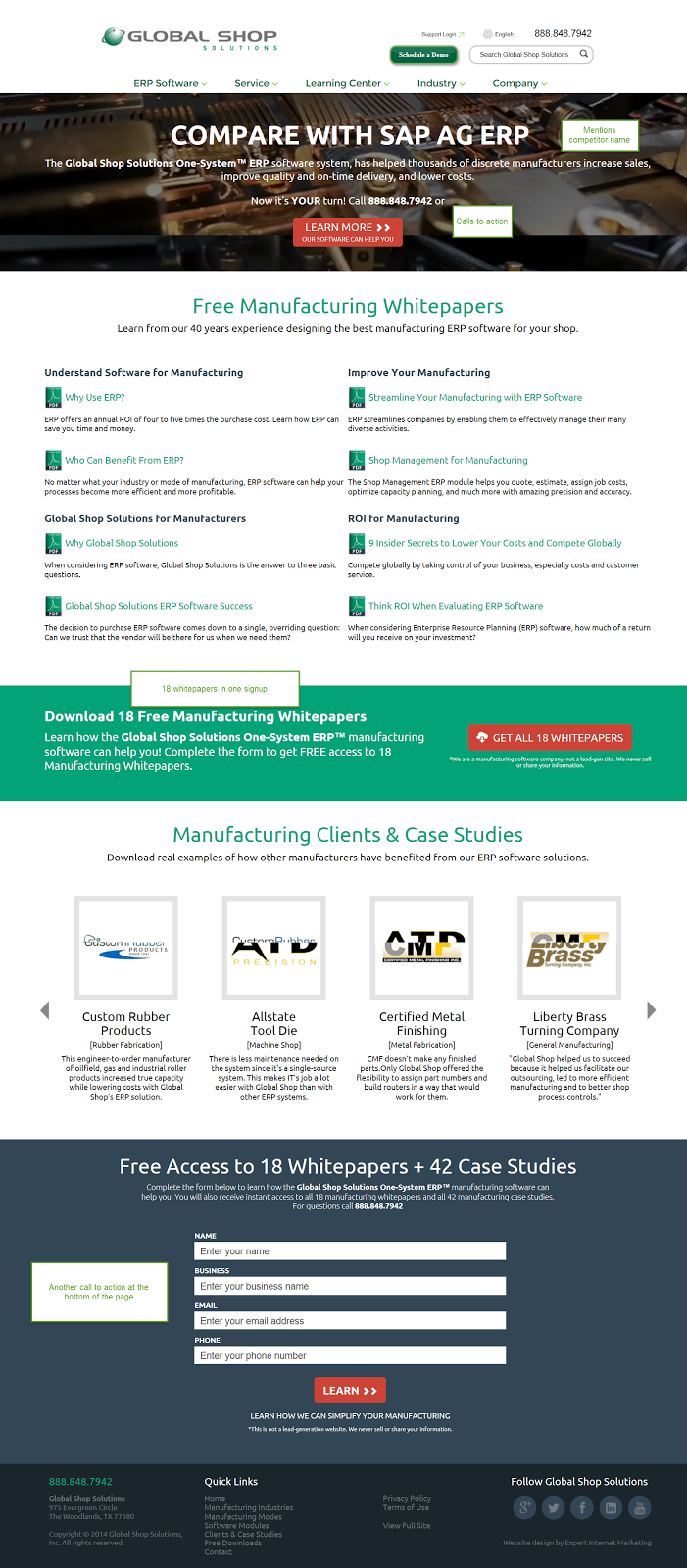
If you spend a little extra time making sure all the elements of your landing page are in order, you’ll be better equipped to outrank the pushy competition.
8. Leverage organic search
I know this probably isn’t what you came here for.
You came here to learn about how you can get rid of the heinous PPC ads targeting your brand keywords. You came here to find out how to outrank the competition.
You didn’t come here to find out how you can rank organically on Google.
But the reality is that ranking organically is far more powerful over the long run than ranking on paid search is.
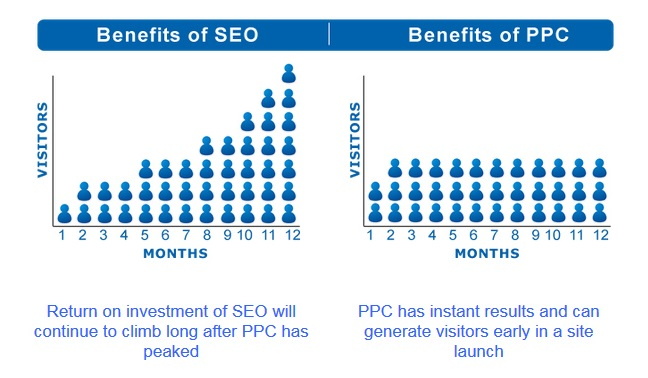
Generally speaking, paid search is better for businesses that are just starting out and need to generate leads from scratch.
And SEO is better for larger businesses that are trying to generate passive traffic over a long period of time.
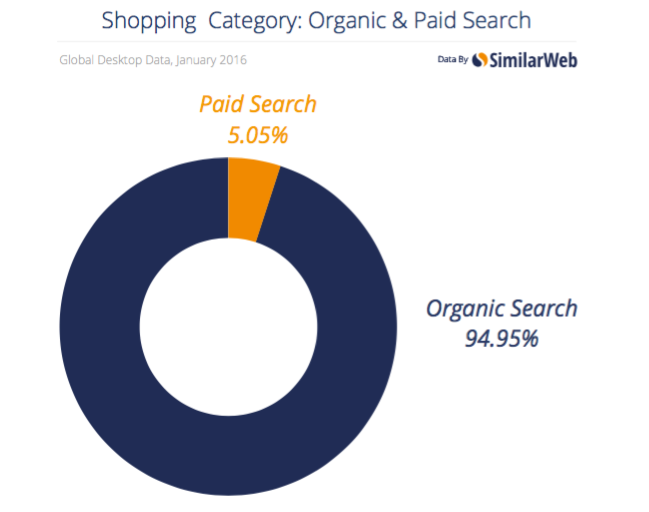
In the end, though, organic search snags 94.95% of search traffic and paid search only get 5.05%.
What I don’t want you to think is that paid search is worthless. It’s not — especially for the business that is starting out.
But if you want to avoid people taking your paid position in the future, ranking organically is one of the best things you can do.
A lot of people are going to skip over the advertisements and go straight to the organic results anyway.
It’s up to you.
But you eventually have to optimize your website for search engines if you’re in this business for the long haul.
Conclusion
When you woke up and saw that someone had stolen your paid search position for your branded term, you wondered if it was illegal.
You thought to yourself, “How could they do that?”
But now you realize that it is totally legal so long as they aren’t infringing on trademark laws.
You also understand that asking them to stop targeting your brand keywords is the next best strategy for resolving the issue.
And that increasing your ad spend, improving your quality score, bidding on the competitions brand keywords, optimizing your landing page, and leveraging organic search are great ways to retaliate and climb back through the rankings.
After all, there’s nothing worse than losing your rankings to an aggressive advertisement. But there’s also no better feeling than taking that number-one position back.
Alright. You can put your coffee down and get back to work.
What do you do when someone targets your brand keywords?