 Sign In









 Ubersuggest
  AnswerThePublic
 Traffic vs Revenue Metrics Marketers Track
Info
-
Source: NP Digital
-
Date: February 2026
-
Category: Measurement & Strategy
-
Study Methodology: Sample size: 500 marketers; Source: NP Digital; Method: Survey data collection
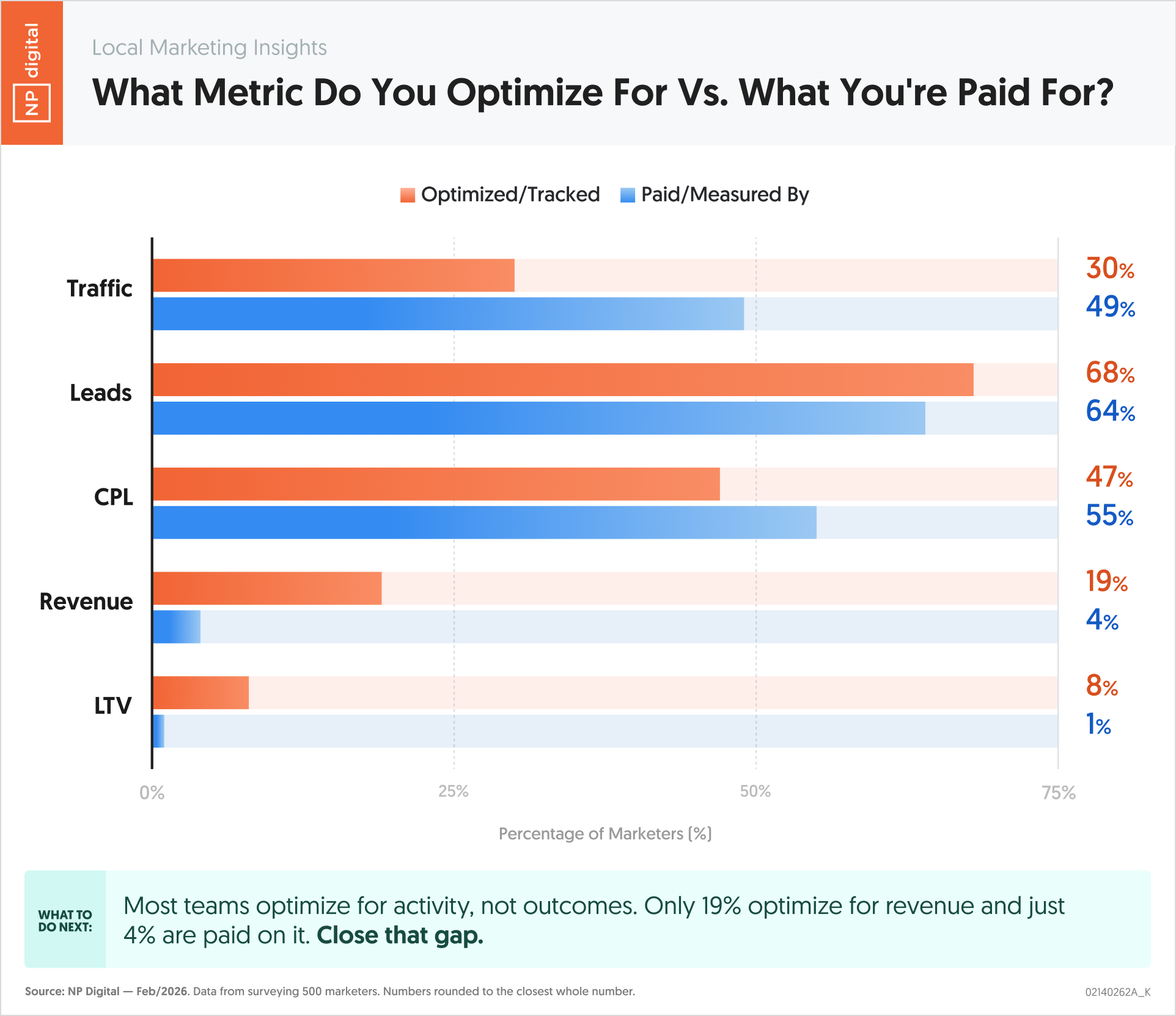
Marketing teams often focus on what is easiest to measure, not what drives business results. This chart highlights a disconnect between optimization metrics and compensation structures. It reveals how teams prioritize traffic and leads over revenue-focused outcomes. That gap creates inefficiencies in how marketing performance is evaluated. Closing it can directly improve ROI and alignment with business goals.
Essential Statistics
- 49 percent of marketers are paid based on traffic, but only 30 percent optimize for it.
- 68 percent optimize for leads, closely aligned with 64 percent measured on it.
- 55 percent are paid based on CPL, but only 47 percent optimize for it.
- Only 19 percent optimize for revenue, despite it being the ultimate business outcome.
- Just 4 percent are compensated directly on revenue performance.
- LTV is largely ignored, with only 8 percent optimizing for it and 1 percent measured on it.
Key Takeaways
- Most teams focus on top-of-funnel metrics because they are easier to influence.
- Revenue accountability is missing from most marketing compensation structures.
- Lead generation is the only area with strong alignment between effort and incentives.
- Ignoring LTV limits long-term growth and customer profitability.
- Marketing teams risk optimizing for activity instead of outcomes.
- Organizations that tie compensation to revenue will see stronger performance alignment.
Actionable Insights
- Shift KPIs toward revenue-driven metrics. Teams rarely optimize for revenue because they are not held accountable for it, so tie bonuses and goals directly to revenue impact to change behavior.
- Rebalance reporting dashboards around outcomes. Traffic and leads dominate reports, but adding revenue and LTV metrics forces better decision-making across campaigns.
- Audit your compensation structure. If marketers are rewarded for traffic instead of revenue, they will keep prioritizing low-impact activities that do not drive growth.
- Introduce LTV tracking into campaign evaluation. The data shows almost no focus on lifetime value, so start segmenting customers by long-term profitability, not just acquisition cost.
- Align CPL targets with revenue quality. Lower cost per lead is not useful if those leads do not convert, so connect CPL benchmarks to downstream revenue performance.
- Reduce overinvestment in traffic-only campaigns. High traffic does not guarantee results, so shift budget toward channels that show measurable revenue contribution.
Most teams are busy hitting activity metrics, not business outcomes. If you want real growth, tie marketing success directly to revenue and lifetime value. – Neil Patel