 Sign In








Forecasting SEO and Paid Together Lifts Revenue Accuracy to 83%
Info
-
Source: NP Digital
-
Date: June 2026
-
Category: Measurement & Strategy
-
Study Methodology: Forecast accuracy defined as percentage within plus or minus 10% of actual revenue. Base: 210 marketing teams.
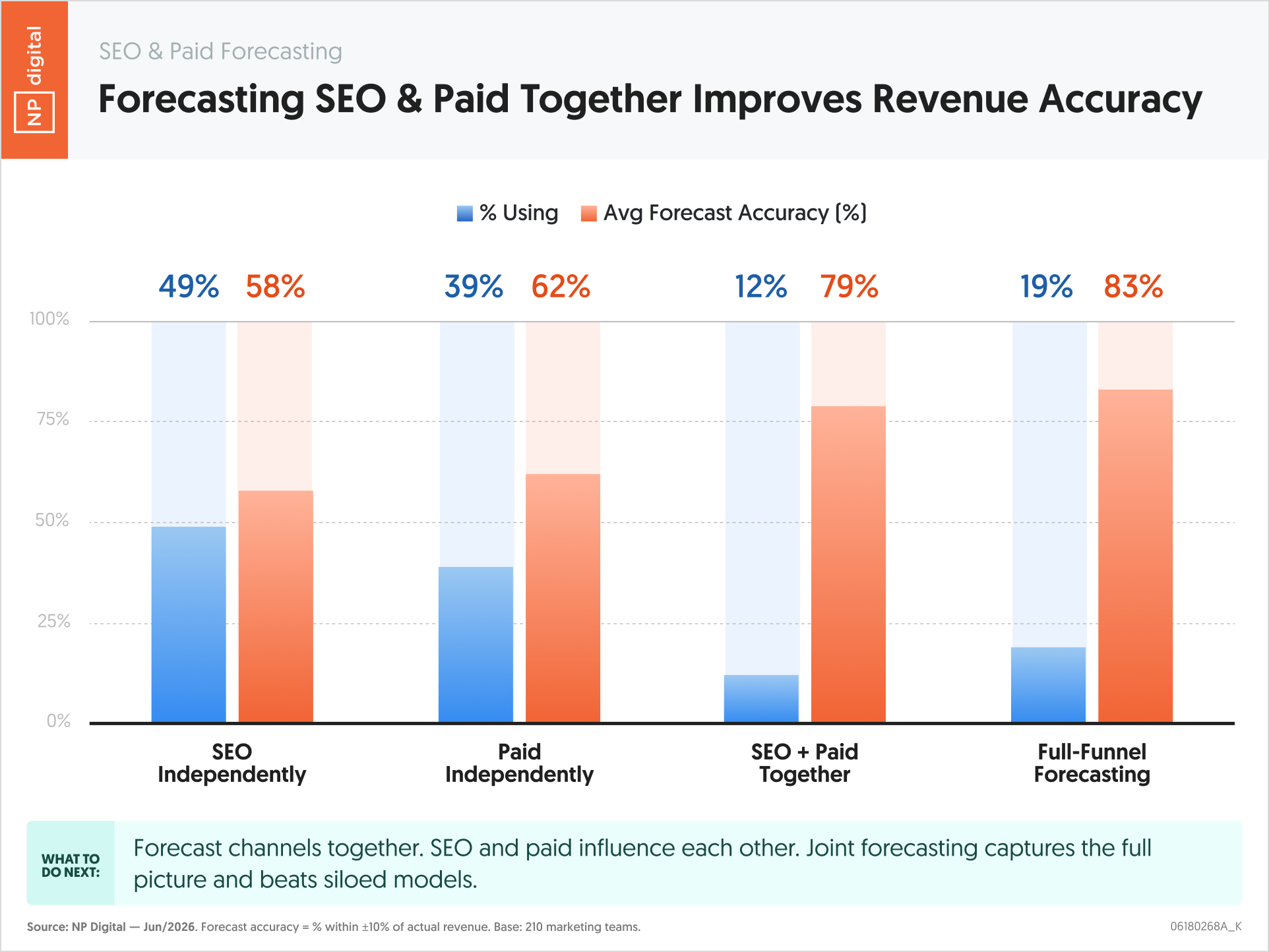
Most marketing teams forecast SEO and paid media in separate silos. This data from 210 marketing teams shows exactly what that costs in forecast accuracy. SEO forecasted independently produces 58 percent accuracy. Paid forecasted independently produces 62 percent accuracy. Forecasting SEO and paid together reaches 79 percent accuracy. Adding full-funnel forecasting reaches 83 percent. Each step toward integration produces a measurable accuracy improvement, and the gap between siloed and integrated forecasting is large enough to represent a different quality of planning input entirely.
Essential Statistics
- SEO forecasted independently achieves 58 percent average forecast accuracy, used by 49 percent of the 210 teams surveyed.
- Paid media forecasted independently achieves 62 percent average forecast accuracy, used by 39 percent of teams.
- SEO and paid forecasted together achieves 79 percent average forecast accuracy, used by only 12 percent of teams.
- Full-funnel forecasting achieves 83 percent average forecast accuracy, used by 19 percent of teams.
- Forecast accuracy is defined as the percentage of forecasts landing within plus or minus 10 percent of actual revenue.
- The accuracy improvement from independent to integrated forecasting represents a 21 to 25 percentage point gain, a substantial difference in how reliably these teams can predict business outcomes.
Key Takeaways
- The 21-point accuracy gap between SEO-only forecasting at 58 percent and SEO-plus-paid forecasting at 79 percent reflects the interdependence of organic and paid channel performance. SEO and paid influence each other’s conversion rates, keyword coverage, and audience overlap in ways that siloed models cannot capture.
- Only 12 percent of teams use integrated SEO-plus-paid forecasting despite its significantly higher accuracy. The adoption gap indicates that most marketing organizations have not yet restructured their forecasting process to reflect how their channels actually interact, even when the performance benefit of doing so is measurable.
- Full-funnel forecasting at 83 percent accuracy is the best-performing approach in the dataset and also the second-least adopted at 19 percent. The teams using it have a planning quality advantage over the 88 percent that do not, with a 25-point accuracy edge over the most common standalone approach.
- The paid-only forecast at 62 percent slightly outperforms SEO-only at 58 percent, likely reflecting the more direct revenue attribution available in paid media compared to organic channels where attribution is more complex.
- The fact that 49 percent of teams still forecast SEO independently, despite its being the lowest-accuracy approach in the dataset, suggests that organizational structure rather than methodology preference drives most siloed forecasting. Teams built around channel ownership rather than revenue ownership naturally produce channel-level rather than integrated forecasts.
Actionable Insights
- Restructure your next annual forecast to combine SEO and paid inputs into a single revenue model rather than delivering two separate channel forecasts. The 21-point accuracy improvement from this change alone makes it the highest-ROI forecasting process change available in this dataset. The starting point is a shared spreadsheet model where organic traffic, paid traffic, and conversion rate assumptions feed a single revenue output rather than two separate traffic outputs.
- Identify the specific interaction effects between your SEO and paid channels before building your integrated model. Common interaction points include branded keyword cannibalization, where paid ads reduce organic CTR on the same terms; quality score effects, where organic content improvements lower paid CPCs; and audience overlap, where retargeting campaigns capture users who first discovered the brand through organic search. Quantifying these interactions is what makes the integrated model more accurate than the sum of two independent models.
- Use the 83 percent full-funnel accuracy benchmark as your forecasting quality target for the next planning cycle. If your current forecast accuracy is below 79 percent, the gap is likely methodological rather than data-quality driven. The data shows that 19 percent of teams are already achieving 83 percent accuracy with available data. Adopting their approach is a replicable improvement, not a resource-dependent one.
- Present integrated forecasting as a risk reduction tool to leadership when requesting the organizational change needed to break down channel silos. The business case is concrete: integrated forecasting produces forecasts that land within 10 percent of actual revenue 83 percent of the time, while siloed forecasting produces that accuracy only 58 to 62 percent of the time. That accuracy difference translates directly into better resource allocation, fewer forecast misses, and more credible planning.
- Track the adoption gap: only 12 percent of teams currently use integrated SEO-plus-paid forecasting. For teams that adopt it now, the competitive advantage in forecasting credibility and planning accuracy is real and sustained until the broader market catches up.
“The teams forecasting SEO and paid together hit 79 percent revenue accuracy. The teams forecasting them separately hit 58 to 62 percent. That is a 20-point accuracy gap driven entirely by whether you model the channels as connected or independent. They are connected. Your forecast should reflect that.” – Neil Patel