 Sign In





 Ubersuggest
  AnswerThePublic
 How Attribution Maturity Drives Forecasting Confidence
Info
-
Source: NP Digital
-
Date: June 2026
-
Category: Measurement & Strategy
-
Study Methodology: Data from 400 companies surveyed. Percentage of respondents at each confidence level by attribution maturity stage.
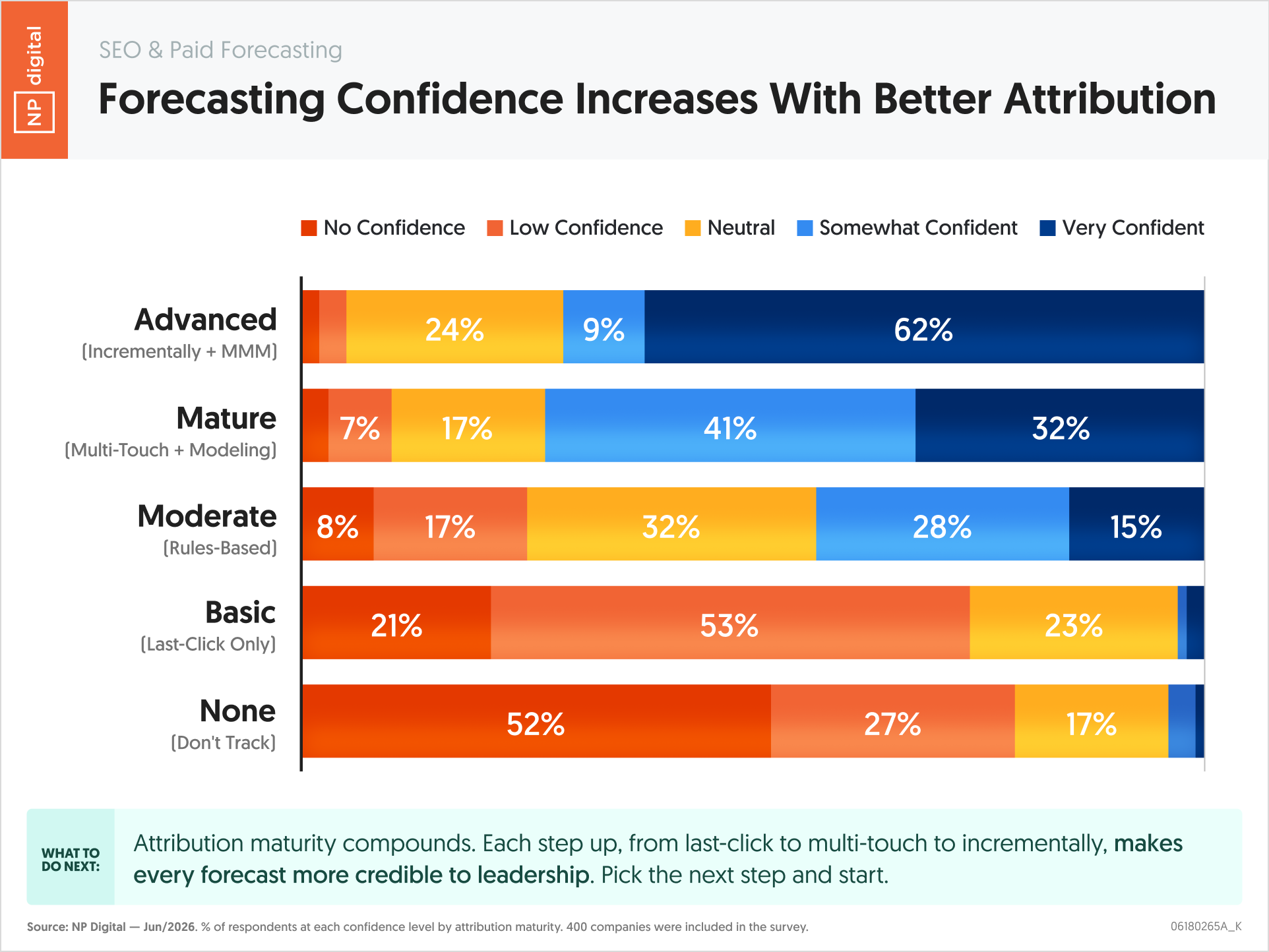
Forecasting confidence is not a personality trait. It is an output of your measurement infrastructure. This survey of 400 companies maps forecasting confidence levels against five attribution maturity stages, from no tracking through advanced incrementality plus media mix modeling. The pattern is consistent: each step up in attribution maturity produces a measurable shift in the confidence distribution. Companies with no tracking report 52 percent no-confidence. Companies with advanced attribution report 62 percent very confident. The gap is not subtle.
Essential Statistics
- Companies using advanced attribution combining incrementality and media mix modeling report 62 percent very confident in their forecasts, the highest very confident rate in the dataset.
- Companies at the mature attribution stage using multi-touch plus modeling report 32 percent very confident and 41 percent somewhat confident.
- Companies using moderate rules-based attribution report 15 percent very confident, 28 percent somewhat confident, and 32 percent neutral.
- Companies using basic last-click only attribution report 21 percent no confidence and 53 percent low confidence, with only a trace level of very confident responses.
- Companies with no tracking report 52 percent no confidence and 27 percent low confidence, with virtually zero respondents reporting confident or very confident forecasting.
- The shift from basic last-click to mature multi-touch attribution moves the very confident share from near zero to 32 percent, a substantial change driven by a single step up in attribution maturity.
Key Takeaways
- Attribution maturity and forecasting confidence have a direct, measurable relationship. The data shows a consistent progression: each step up in attribution sophistication shifts the confidence distribution toward higher confidence levels with no exceptions across the five stages shown.
- The 52 percent no-confidence rate among companies with no tracking is not a forecast quality problem. It is a measurement problem. Companies that do not track attribution cannot build credible forecasts because they lack the causal data needed to project forward.
- The jump from last-click to rules-based attribution produces a meaningful reduction in no-confidence responses, from 21 percent to 8 percent. Even a moderate improvement in attribution quality produces a visible confidence improvement, which makes the first attribution upgrade the highest-ROI step for most organizations starting from basic tracking.
- The 62 percent very confident rate at the advanced stage confirms that a comprehensive measurement infrastructure is the source cause of forecasting credibility. Advanced teams are more confident because their attribution data gives them reliable causal evidence to build projections from.
- The neutral category is largest at the moderate rules-based stage at 32 percent, suggesting that rules-based attribution produces data but not yet enough signal clarity to generate strong directional confidence. The move from neutral to confident requires multi-touch or modeling-level attribution, not just rules.
Actionable Insights
- Identify your current attribution maturity stage using the five categories in this chart, then define the specific next step rather than trying to jump to advanced in one move. The data shows each stage produces a confidence improvement, which means the highest-ROI path is the next stage up, not a distant target. A last-click team moving to rules-based attribution cuts its no-confidence rate from 21 percent to 8 percent before any further investment.
- Use the confidence distribution data to make the business case for attribution investment to finance or leadership. The shift from 21 percent no-confidence at last-click to 62 percent very confident at advanced attribution is a concrete, data-backed argument for measurement infrastructure budget. Framing attribution investment as a forecasting credibility improvement rather than a marketing analytics expense positions it as a risk management tool, which resonates with finance stakeholders.
- If you are at the moderate rules-based stage with a high neutral rate, prioritize moving to multi-touch attribution before adding any additional marketing channels. This means your current measurement may be producing data without a clear directional signal. Adding more channels to a measurement infrastructure that cannot confidently attribute existing activity compounds the problem rather than improving it.
- Build attribution maturity into your annual planning cycle as a standalone investment line. Most organizations budget for campaigns and tools but not for the measurement infrastructure those campaigns depend on. A dedicated quarterly budget for attribution improvement, whether that is implementing a media mix model, adding incrementality testing, or moving from last-click to data-driven attribution, produces compounding forecasting confidence returns.
- Track your team’s forecasting confidence distribution as a KPI alongside campaign performance metrics. If your team cannot produce forecasts with high confidence, that is an early signal of attribution gaps before those gaps show up in misallocated budget or missed revenue projections. A quarterly self-assessment of where your team falls in the five confidence levels tells you whether your attribution investment is translating into practical forecasting improvement.
“Attribution maturity is the single most controllable variable in forecasting confidence. The data from 400 companies shows a clear staircase: each step up from no tracking through last-click through rules-based through multi-touch through advanced produces a measurable shift in how confidently teams can forecast. Pick the next step and take it.” – Neil Patel