 Sign In







In 2025, marketers don’t suffer from a shortage of data. Every campaign, online and off, can be tracked and measured using an ever-growing number of analytic tools.
That’s not hyperbole. The size of the big data analytics market was $231.43 billion in 2021. By 2028, it will be worth $549.73 billion.
You’d be hard-pressed to find a marketer who doesn’t use data to prove their methods are working. What about marketers who inform their marketing strategies with data analytics, though? They’re a much rarer breed.
It’s time to change that. By marketing with data analytics, you can do away with the guesswork, transform your campaigns, and send conversion rates and revenues soaring.
Here’s how.
What Is Data Analytics in Marketing?
Marketing with data analytics means measuring, analyzing, and applying data to your marketing campaigns—not just tracking the results of your campaigns to prove ROI.
It starts with data collection. Adding a tool like Google Analytics to your site lets you collect information on the behavior of users. The real key is to spend time analyzing and interpreting the data you collect and then applying those findings to your marketing campaigns.
You can incorporate data analytics into new and existing marketing campaigns. For example, you could use data from PPC campaigns to inform copy for a new email marketing campaign. Or you could use Google Analytics data to change the layout of your site to increase conversion rates.
There’s no shortage of tools to help you gather data.
You’ll already be familiar with tools like Google Analytics and my tool, Ubersuggest—but that’s just the tip of the iceberg. There’s also:
- Hotjar for website heat mapping
- Optimizely for A/B testing
- Mention for social media monitoring
These tools let you track just about every KPI you can imagine and many more you won’t have heard of yet. Common KPIs include traffic levels, click-through rates, open rates, conversion rates, and social media engagement.
If you’re tracking data using Google Analytics, Databox identified the ten most popular metrics. They are:
- users
- bounce rate
- sessions
- average session duration
- percentage of new sessions
- sessions by channel
- pages per session
- goal completions
- pageviews
- pageviews by page
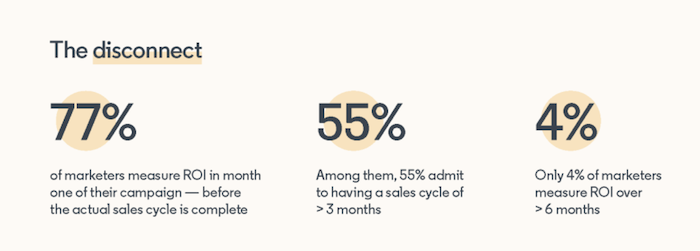
The exact KPIs you track will depend on the campaign you’re trying to improve. Regardless, slowing down your data tracking is essential, says Alexandra Rynne. The typical sales cycle of B2B companies is longer than three months, yet only four percent of marketers measure ROI over six months or more.
At the same time, you need to be tracking data daily, says Heidi Cohen, the Chief Marketing Officer at Actionable Marketing Guide:
As with any business metrics, you should measure your results regularly. For digital businesses, this can be as often as daily.
Why It Makes Sense to Use Data Analytics in Marketing
Marketing with data analytics gets you results. Pure and simple.
Research by Forrester shows marketers who use five or more tools in their marketing analytics stack are 39 percent more likely to see improvements.
More specifically, however, it removes the guesswork from your campaigns and allows you to make choices about marketing spend and campaigns that are much more likely to be correct.
The evidence backs up this assertion. Research by Google and Econsultancy shows two-thirds of marketers believe decisions made with data are better than those made using gut instinct.
Marketing with data analytics helps you set better goals, too. For instance, you can use past performance to determine whether a 10 percent increase in web traffic from SEO really is viable.
Third, it lets you create better, more personalized campaigns. Personalization matters in marketing—80 percent of shoppers are more likely to make a purchase when a brand has used personalization strategies.
You can’t personalize marketing messages to customers if you can’t understand their wants, needs, or behaviors. When consumers are incredibly selective about which brands they interact with, using data to create amazing customer experiences is vital to your success.
Finally, using data makes it easier to grow your marketing budget. 13.4 percent of marketers say securing their budget is their biggest challenge, and it’s much easier to build a case for more funding when you incorporate data analytics into your marketing campaigns and see success because of the other benefits I’ve described above. Data analytics lets you prove to executives that increasing your budget will have a measurable increase in sales.
Marketing With Data Analytics: 5 Strategies You Can Use
There are many ways you can use data analytics to inform and optimize marketing efforts. Here are five specific and actionable strategies I recommend testing.
1. Personalize the Customer Experience
Don’t worry about upsetting consumers with personalization. Most consumers (65 percent) are happy to share data to enable a more personalized experience.
Leveraging data analytics is the easiest way to personalize the customer experience—and the sheer amount of data your customers generate means you can personalize virtually every touchpoint.
Emails are a common entry point for brands when it comes to personalization. Platforms like Klayvio, ActiveCampaign, and Campaign Monitor make it easy to use information like previously purchased items, browsing behavior, and abandoned carts to send personalized emails automatically.
Website experience is another opportunity for personalization. Use Google Optimize to turn the KPIs you track in Google Analytics into personalization opportunities. For instance, you can:
- show a personalized page to users from a specific country or city
- show different pages depending on the website that referred them
- personalize pages depending on a previously purchased product
In situations where the expensive tools and platforms required for big data personalization are prohibitive, Michael Ringman, CIO at TELUS International, recommends brands turn to small data:
Small data collection requires highly engaged agents who care about the company and are invested in helping improve its offerings by highlighting any trends they may uncover over the course of several conversations, or even potentially mitigate or eliminate problems before they are widespread. This requires companies to foster a workplace culture that is employee-centric, recognizing and rewarding these positive behaviors.
Data-backed personalization doesn’t only need to happen online. Analyzing offline data sets can be just as effective in improving your marketing efforts.
Take the example of DirecTV, which created a personalized marketing campaign targeting people who’d recently moved.
The company knew consumers were more likely to try new services after a move, so they analyzed the USPS’ change-of-address applications to create a personalized version of their homepage that only these people would see. Unsurprisingly, the personalized homepage saw a significantly higher conversion rate.
2. Run A/B Tests to Optimize Your Site
If you’ve ever done an A/B test, then congratulations, you’ve already incorporated data analytics into your marketing. A/B testing (also known as split testing) is a popular method of optimizing emails, landing pages, and other marketing messages.
Around three-quarters of companies (77 percent) use A/B tests to vary campaigns to find the best performer.
A/B testing helps you focus on what really works for your brand and audience. It takes the guesswork and luck out of your campaigns, relying instead on cold, hard data. As a result, you unequivocally find what works and what doesn’t.
The results can be powerful and, sometimes, surprising.
Wrike, a project management software company, split tested multiple variables on their site after a brand refresh. The team found that landing pages without a floating CTA converted 42 percent better than those with a floating CTA. They also found a dark theme converted better than a light theme and multiple CTAs increased conversion rates by as much as ten times.
You can A/B test just about any part of your marketing campaign, but the most common channels, according to Invesp, are websites (77 percent), landing pages (60 percent), email (59 percent), and paid search (58 percent).

Getting started with A/B testing is easy—especially if you run it using Google Optimize. Google provides a detailed walkthrough, but the process is largely broken down into these steps:
- Choose the marketing channel you want to optimize.
- Come up with a strong hypothesis.
- Select the KPIs you want to track (open rates, conversions, etc.).
- Develop different variations of the variable you want to improve.
Coming up with a good hypothesis is vital. Make it specific, measurable, and able to be used in future campaigns. For example, you could hypothesize that changing the heading of a landing page to focus on a particular benefit will result in a 10 percent increase in conversion rates.
Make sure to look for statistical significance when running each test. A tool like Optimize will help you understand the level of traffic you need, but you’ll want at least a minimum of 5000 unique visitors.
3. Create Content Customers Care About
Measuring content performance is par for the course in the content marketing world. According to the Content Marketing Institute, roughly three-quarters (78 percent) of marketers measure content performance, 63 percent establish KPIs, and 51 percent measure content ROI.
It’s far less common for marketers to use data to inform future content marketing campaigns—except for keyword research, of course. That’s a shame because data analytics can help content marketers identify the best type of content and write about topics that interest customers.
Some of the highest-converting content comes when you listen to the needs of your users. That’s the premise behind Grow and Convert’s Pain Point SEO process. Rather than focusing on keywords, they hold in-depth interviews with customers to find specific issues that become the basis of their articles. In doing so, they create content targeting topics their competitors don’t cover.
One-on-one interviews are a fantastic way to gather qualitative data—but what if you want to hear from hundreds or even thousands of people at once?
Enter social listening.
Social listening is one of the best ways to leverage data analytics at scale to create content your customers want to read. Using dedicated social listening tools, you can scale this strategy and unearth topics no one else is covering.
I recommend starting with Mention, a leading social listening tool that makes it easy to create alerts for any topic across every major social media channel. It will set up alerts for your brand terms when creating an account by default.
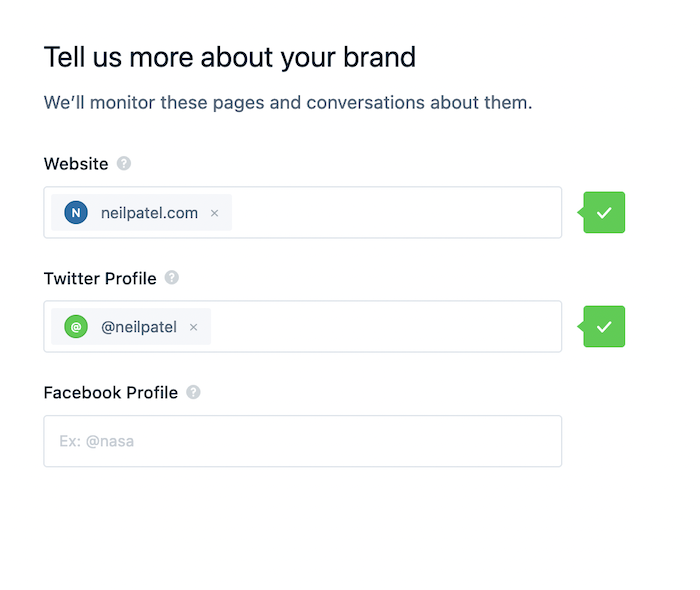
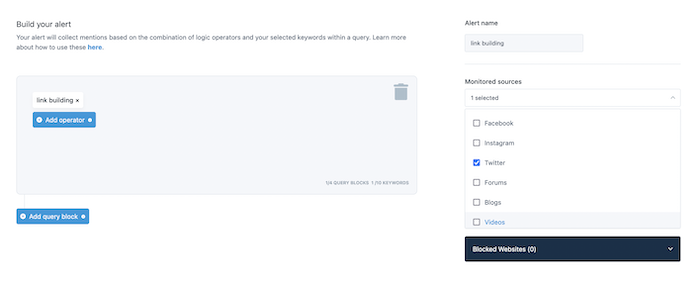
Setting up a new alert is easy. Click on the blue “Add a new alert” button in the top right-hand corner to get started. Choose Standard Alert.
Next, add your topic and the social media channels you want to track. I’ve chosen to monitor mentions of link building on Twitter.
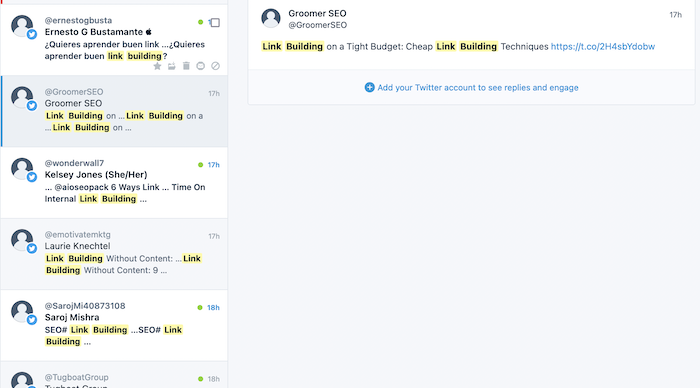
Mention will automatically collect every tweet that includes “link building” and list them in a feed. I can then scroll through at my leisure, identifying interesting angles I can use for my next blog post.
Don’t worry about getting super-specific with your alerts. It’s better to track broader terms to find niche topics that are only mentioned a handful of times. By monitoring terms like “email marketing” and “lifecycle email,” Janet Choi, head of content at Clearbit, discovered people want guidance and tips.
She also found people talking specifically about deliverability and spam filtering. That allowed them to create content that specifically spoke to those issues—content that was much more specific and actionable than anyone else’s.
4. Improve Buyer Personas
Buyer personas are detailed descriptions of your target audience. They’re typically based on a fictional person but backed with real customer information.
They’re incredibly valuable. Research collated by HubSpot shows buyer personas make websites two to five times more effective and easier to use by target users. They can also increase email open rates by 14 percent and conversion rates by 10 percent.
Most businesses have buyer personas, but how accurate are yours? Are they based on your marketing team’s thoughts and impressions—or are they backed by data?
If your buyer personas aren’t based on data, then they aren’t as accurate or credible as they could be. Customer data is essential to creating fully-fleshed out and genuinely useful buyer personas.
Best of all, almost every business has access to the kind of data they need to create these kinds of buyer personas: Google Analytics.
The part of Google Analytics you’ll want to focus on is the Audience Reports section. Here, you’ll find a bunch of data reports you can use to form the basis of buyer personas.
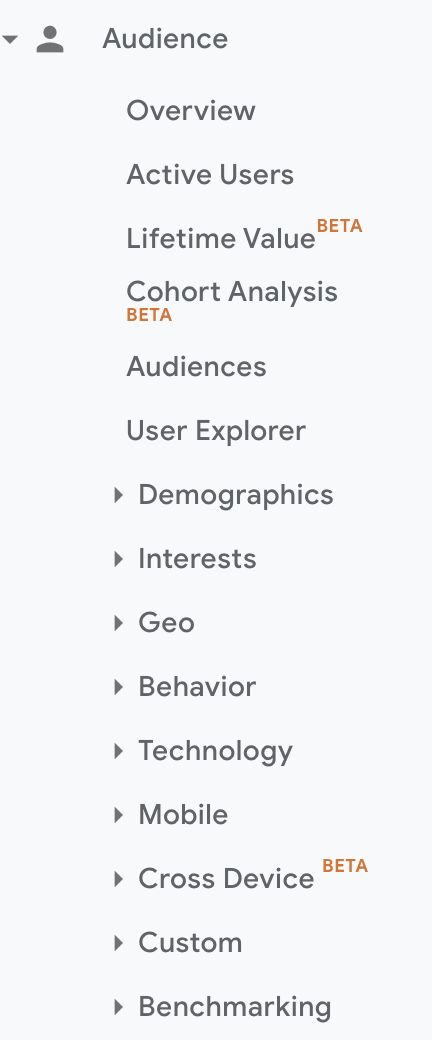
Pay close attention to:
- age and gender reports
- interest reports
- in-market segment reports
- geo reports
- device reports
Using just those five reports, you’ll be able to get a clear idea of the age and gender of your customers, where they live, their interests, purchase interests, and how they access your site.
You can also use Acquisition Reports to see where users have come from and Behavior Reports to see how they navigate your website.
With all of that data to hand, you can follow my guide on creating user personas to start creating your own.
5. Improve One Marketing Channel With Data From Another
When you’re looking to launch a new marketing channel or improve an existing one, you don’t need to start from scratch—at least, not if you’re able to leverage data analytics.
This is good because while most brands can afford to invest in a marketing channel that doesn’t perform for a short while, very few can afford to subsidize any marketing channel that’s a complete failure. (And why would you?)
You can do this for almost any marketing channel. For instance, email open rates can highlight potential new blog topics. Live chat inquiries can identify potential new landing pages. Your Instagram data can inform your TikTok strategy.
One way virtually every brand can leverage data across channels is to use PPC data to improve website copy. Of course, you should use tools like Ubersuggest to see accurate keyword volumes to discover the most common search phrases. Keep in mind, these keywords help you attract users—not convert them.
PPC copy is the opposite. Because ads are entirely copy-focused, there are very few other variables to consider. If one ad converts more than another when targeting the same keyword, it’s almost certainly because of the copy.
This is a strategy used by gig marketplace Hiresquare, says its founder Rick Vugts.
There are multiple ways in which we use data for marketing on our site. We use PPC data to optimize our web copy for SEO. Sure there are keyword tools and whatnot, but they are all estimation tools. By running a PPC campaign for just a short amount of time we learn about the actual search volume and we get all kinds of combinations by looking at the keyword query report.
Bonus: Marketing With Proprietary Data Analytics
All of the strategies above show you how to use data analytics to improve current and future marketing campaigns. However, you can also use data to create a killer marketing campaign from scratch—especially if you have access to a lot of proprietary data.
Since no one else has access to proprietary data, you can create campaigns that literally no other brand can compete with. You can use proprietary data in virtually any way you want, but there’s only one company to look to for inspiration: Spotify.
Alongside the company’s efforts to use proprietary data to improve the customer experience—through suggested artists, Discover Weekly, and Spotify Wrapped—they also use proprietary data to create attention-grabbing adverts.
In 2016, Spotify launched national advertising campaigns in the U.S., the U.K., France, and Germany, highlighting users’ listening habits. Ads included this Valentine’s Day gem:

Then there’s this Brexit-themed one.

The campaign was so well received it returned the next year, where it contributed to a tripling of Q1 revenue.
Frequently Asked Questions About Marketing With Data Analytics
How is data analytics used in marketing?
Use data analytics to track, measure, and improve your marketing campaigns. All channels, from SEO and email to PPC and your website, can be improved using data analytics.
What are examples of marketing analytics?
Common examples of marketing analytics are using data from A/B tests to improve your website, creating SEO content based on keyword research and social listening, and personalizing website content based on user behavior.
What is the importance of data analytics in marketing?
Data analytics in marketing is vital. It helps you make better decisions, improves the quality of your campaigns, and leads to more conversions and revenue.
What are the types of marketing data analytics?
There are many different types of marketing data analytics. They include website analytics, social media analytics, SEO analytics, and PPC analytics.
Conclusion: Marketing With Data Analytics
Don’t just use analytics to track your campaigns. Start marketing with data analytics, too.
Begin by using tools that provide helpful audience data insights for your digital marketing campaigns, like Google Analytics and Ubersuggest.
See what people are saying about your brand with social listening tools like Mention, so you can respond accordingly in your marketing campaigns.
Run A/B tests to ensure you’ve made all the best decisions for your campaigns.
Finally, measure and track the success of your campaigns over time so you can use that data for future marketing decisions and budget planning.
The benefits of marketing with data analytics are clear: no more guesswork, better decision making, improved customer experiences, and better results.
Which data-backed marketing strategy are you going to try first?